

- Contributed by
- Julie Howarth
- People in story:
- Philip Howarth
- Location of story:
- Middle East, Tobruk, 1940-41
- Background to story:
- Army
- Article ID:
- A8943681
- Contributed on:
- 29 January 2006
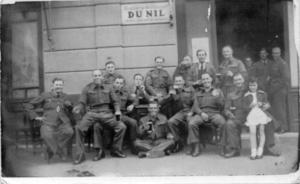
2nd Bn King’s Own Royal Regiment, Cairo, 10th January 1942. Philip Howarth is third from left at back. The reverse of his print was signed by those present.
The following account was written by my father Philip Hamer Howarth several years before he passed away in March 2005. He seldom spoke about his war experiences during his working life, but spoke more during latter years and strived to put his memories to paper for ex-army association archives, British Legion talks and family. I am sure he would have approved of his story joining those of so many other veterans on this site. Dad was born in Millom (in what was then Cumberland) in 1919. Shortly after he was born, my grandparents moved to Canada to tried their luck at prairie farming but life was too tough and after two-three years they retuned to England and finally settled in Cartmel, Lancashire. Dad was educated at Cartmel School and Ulverston Grammar and worked before the war in Local Government as a surveyor’s assistant in Ulverston. The following is his account of his Infantry days in the 2nd Battalion, King’s Own Royal Regiment - an Introduction to War in the Middle East — Tobruk.
I received my call-up papers and enlisted at the King’s Own Royal Regiment Headquarters at Bowerham Barracks, Lancaster on 15th February 1940. After training I spent three months on local security duties in Barrow in Furness before sailing on 5th August from Liverpool on HMT P12 Empress of Britain. We docked at Suez on 15th September and I was one of draft reinforcements entrained to Mersa Matruh to join 2nd Battalion King’s Own Royal Regiment who had arrived in Egypt from Palestine earlier in September. We lived in dug-outs and Italian bombers visited us daily. (Dad drew sketches of life in the dug-outs). We were involved in the December offensive, the role of the 2nd Bn being to hold up defences of Matruh Fortress and escort and guard thousands of Italian prisoners of war. I was fortunate to get seven days leave in Cairo over Christmas and this was followed by several months of Regimental guard duties in Cairo, while some of unit escorted prisoners of war to India. In June-July 1941 I was involved in the bitterly fought Syrian Campaign against the Vichy French and then spent a period in Palmyra to look after security on the Iran-Iraq pipeline over the Syrian desert. This was a respite from the fighting but it was a long hot Summer in the Syrian desert and we were glad when it was time to leave. Little did we know what lay ahead.
We left Syria through Lebanon to Beirut. We sailed on HMS Ajax on an overnight voyage to Alexandria. Thereafter we had a few days in security camp waiting for a moonless period when HMS Kandahar took us to Tobruk. A fairly uneventful 18 hours except for high level and inaccurate bombing attack by Italian aircraft. We crept silently into Harbour, it was pitch black and we had 20 minutes to unload and disembark so they could take off waiting Australians who we were replacing and have the ship away before there was sufficient light for her to be seen. There had been Australian political pressure on Churchill firstly to fulfil a promise to keep the Australian Division together and secondly to get them home to counter the threat from the Japanese. And so I arrived in Tobruk with the 2nd Battalion Kings Own in October 1941. We arrived, tired, cold and stiff. We were raced off in light trucks to our appointed areas- A hot drink, cigarette (log cabin roll) and sleep.
We were based on the perimeter defences and took over the Eastern Bardia Road sector. After climbing out of the Tobruk town and the Tobruk escarpment, the desert was flat with scattered camel scrubland. Everywhere debris of battle - ammo, ordnance and hardware abandoned, everywhere gun positions, weapon pits, wire and mine fields. There were a great variety of captured machine guns and other weapons. I was attached to Battalion Headquarters which was about quarter of a mile down a wadi from the Bardia Road. A Villa — four rooms ex Italian bordello. We took over from the Australians and adopted their troglodytic Tobruk life style. There was daily ‘stand to’ from 1 hour before dawn to half an hour after. There was debriefing of night patrols as they came in and charting and reporting the intelligence gained. There was daily patrol briefings or patrol duty. Normal dress was relaxed depending what you had and the climate. The essentials were steel helmet, rifle and ammo. We were regularly dive bombed by JU87 Stukers. Night time sleep was limited. The food and water were limited. We survived on corned beef and dehydrated potatoes and onions. We had fig jam from Palestine; the Tobruk bakery bread with weevils and condensed milk and sugar for tea. We were allowed one bottle of desalinated water per day which was like ‘Enos’, plus sea water. We had canned butter left by the Aussies to start with. That was good — like clotted cream. But we had no fresh fruit or vegetables. The smokes — ‘log cabin’ roll your own, disappeared with the Aussies and issue cigarettes arrived, only to run out when the Navy ran into trouble and supplies were lost. Toilet paper and fig jam substitutes were not a success. There was a rum ration — but it was very rough and few of us drank it. We saved it — what for? The latrines were exposed individual thunder boxes. The flies and fleas were not too bad compared with the Egyptian desert but we developed desert sores as a result of the poor diet. They were weeping sores that would not heal and I still have scars from some of them. Painting with silver nitrate or gentian violet was not effective. We were issued with ascorbic acid tablets. The sores later disappeared quickly in the Delta given medication and fresh diet.
The hospital outside Tobruk town maintained a blood bank and prior to battle we were required to donate our blood. One of my jobs in HQ was to draw maps and I drew the detailed map for the 2nd Kings Own prior to the Tobruk Sortie to show all the new information that had been accumulated.
The attack took place on 21st November. It was a classic attack, half an hour before dawn on the front out of the night behind a creeping barrage, infantry following Valentine tanks. The sappers cleared perimeter mines, bridged ditches and set out direction tapes like at School sports! I was attached to B Company for the Battle for position Butch. Our primary role was to attack, capture and hold. It became apparent that Butch was occupied by Germans, and it was during the Battle for Butch that a 9 mm Luger pistol was acquired, which remained in my possession for some time. It now forms part of the museum collection of the King’s Own Museum in Lancaster. Later as the battle progressed and we moved forward we picked up quite a lot of Italians and Italian weaponry, which was of a different kind. There was a subsidiary attack by D company who were given the role of assisting an attack on position Jill. As we attacked and Butch was taken, the objective changed and broadened to Jill territory and as the day wore on I found myself attached to D company supporting the attack that D company were putting in to take Jill.
It was all very mixed up and we also became involved with the Black Watch. I remember doing a wound dressing on one of the Black Watch soldiers. As the morning wore on and we held our positions, we picked up quite a lot of Germans prisoners who were giving themselves up and coming forward. The Jill position had quite a lot of German dead lying at it and wounded Black Watch. We were at that time breaking open some rations and making ourselves a quick meal — I think some bully beef.
A little while later I moved back and towards the South and found myself with the battalion doctor and he was attending to some of our wounded who had taken wounds during the attack. One of them I remember was in a state of shock and we got him on the way back to another dressing station as quick as we could.
At some time during the battle I was given the job of escorting on foot a German prisoner or war — a pilot, probably from a Stuker- back to one of our prisoner of war pens. He had been shot down by the King’s Own and he was a bit fed up about it too. He spoke mostly in French or English and expressed confidence that the Germans would win the war. I disagreed with him.
After the attack we were involved in occupying the position and a number of us were dug in defence positions that night when the evening rations came up. We were unlucky that night. The rations came up in one of our trucks and maybe it was one of the drivers that showed a light but the enemy picked up on some light and fired off two German 88 mm shells into the position we were occupying just as we were having supper. Of course the Germans were well aware of our Butch position because they had occupied it too. They caught two of our chaps from 2nd Bn HQ who were friends of mine.
Captain Waring who was leading B Company was wounded in the skirmish for Butch and transferred to a dressing station for attention to wounds and transferred to a troop ship that would take him to Cairo or Alexandra, but a German submarine intervened and the hospital ship was sunk and Captain Waring lost.
After the sortie a column was sent out on clearing up operations on the road to Gambut, half way to Bardia and then westwards towards Acroma. On 11th December the battalion was ordered to carry out an attack on El Acroma but news came that 4th Indian Division had taken Acroma and the battalion was required to occupy it. On the 21st December we set off by truck to the railhead at Sidi Mohamed and were entrained to move slowly East, arriving at our destination in the Delta late Christmas day. Christmas festivities were postponed to New Year’s Eve.
When in 1942 Tobruk fell to the German Rommel, we could not believe it and were very upset though we were then far away deep in the jungle of Ceylon and concerned with new enemies and intense jungle warfare training to become Chindits.
57 years later, in 1998, I made an emotional journey back to Mersa Matruh and Tobruk on a tour with other veterans. I wondered if I might come across my steel helmet that I had lost on the road to Tobruk. I had been in the back of a truck, leaning up against the canvas when, going round a bend, a truck coming the other direction had scraped along the side and knocked the helmet off my head. I was lucky to survive the war and that helmet no doubt helped.
My father left the 2nd King’s Own in Ceylon in September 1942 for India and officers training, OCTU, Bangalore. He was commissioned in May 1943 and posted to HQRE 4th Indian Division, Egypt and then to Italy and reposted to 8th Indian Division and 7 Field Company. I am submitting three further sections (A8944086, A8944356, A8944653) that include Monte Cassino and his role in preserving the architectural history of Italy — the Ponte Vecchio.
© Copyright of content contributed to this Archive rests with the author. Find out how you can use this.


 Recommended story
 Story with photo