

- Contributed by
- John Inman
- People in story:
- Anthony Inman Lt RNVR
- Location of story:
- The Pacific
- Article ID:
- A8109281
- Contributed on:
- 29 December 2005
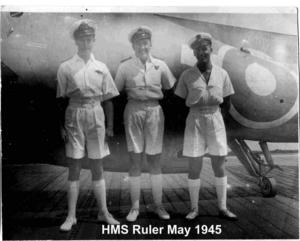
From left Norman Grant (pilot),Jim xx (gunner, Tony Inman (observer) shortly before accident
A View from the Back: The Recollections of a Fleet Air Arm Observer 1941-1946 by Tony Inman
Part 12 of 14 (May - Jul 45)
On another occasion we had been detached to find the hospital ship, a Dutch ship named Tjitjalengka, and signal them to rendezvous with the fleet to embark some casualties. On the way back I had found a wind which was almost directly in our face. This always created problems for it is necessary to steer into the wind to a certain amount so that the wind flow keeps you going in the direction you really want. So if you are using a wind that is blowing from the right of your required track you steer slightly to the right to allow for the push of the wind. But if your calculations are slightly wrong so that the wind is actually blowing from the left the error is doubled. Wind finding was not an exact science and it was easy to be 10 degrees out so that you could allow for a wind 5 degrees on port bow when it was actually 5 degrees on starboard. This is what happened that day so that a couple of hours later when we should have been coming close to the ship she was nowhere to be seen and was 25 or 30 miles away. We had radar but it was rather rudimentary and did not have the all round sweep of today. Ours was directional but could only sweep 10 or 15 degrees on either bow and, into the bargain, was not very reliable. Suffice to say: nothing on the screen. Luckily for us, on that day our beacon radio was actually working and I was able to use this. It was a receiver which picked up a signal from the ship whose transmitter made an all round sweep transmitting a Morse letter which changed every few degrees. So that on receipt of the letter I knew which segment we were in and could then steer for the centre. Our troubles were not quite over for, as we approached the position of the ship, we came across fog, not very deep, but enough to cover all the ships. We knew we were overhead from the beacon and from conversation with the ship and so had to stooge round hoping the fog would disappear before our fuel did. The fog went first.
It was about this time we had the squadron's first casualty when a Hellcat coming in to land was waved off by the batsman but did not react quickly enough so that his wheels caught the top of the crash barrier. It was like being tripped up, the plane went nose first into the deck, skidded across the aircraft park and over the side, and straight to the bottom, pilot and all. In addition the propeller had chewed up some of the planks on the deck and one of the flight deck crew was fatally hit by splinters.
The next day when we emerged from the ops room and climbed on to the deck there was no sign of an Avenger aft on the deck, only the 4 Hellcats. On enquiry the Flightdeck Officer pointed up the deck. "On the Squirter" he said, “Wings thinks there is not enough wind". There she was on the catapult looking unhealthily close to the edge of the deck. The catapult was a slot at the side of the flight deck, probably about 50 feet long, with a hooked traveller in it. The aircraft was placed astride the slot and the tail wheel was attached at the back end. My recollection is that a rod of mild steel passed through the centre of the tail wheel and was secured to the deck. On the strut of each wheel was a downward facing hook and a steel hawser, looped at each end, was looped over these hooks and round the traveller on the catapult slot. One of the engineering officers was in control of this contraption and he moved the traveller far enough to take up any slack on the hawser. The crew boarded, strapped themselves in, anchored anything loose and signified ready to the pilot. He gave thumbs up to the flightdeck officer, who after receiving permission from the bridge waved his flag round and round his head. This was the signal for the pilot to open the throttle to its full extent, tighten the wing nut so that it would not slip with acceleration and for the crew to brace themselves, head back against the partition. Down came his flag, the engineer officer pressed his button and we were off. The catapult went off with an enormous thump that could be heard and felt all over the ship. Great pressure was applied to the traveller until it passed the breaking strain of the mild steel rod. When this broke the plane was free, the traveller shot to the end of the slot, pulling the plane via the hawser and flicked us off the end. As we passed the end the loops on the end of the hawser slid off the hooks, and could be recovered for future use as it was tied to the ship with a piece of rope. As the plane went from rest to 65 knots in about 60 feet the acceleration was fierce and on one heart stopping trip the acceleration was enough to stop petrol getting through - only for an instant but enough to make the engine miss a beat. After the first nerve wracking time, future trips on the catapult were not so bad.
Soon after joining 885 squadron, the Fleet Train put to sea again. After a few day we were up to the operational area and ready to start work. We were at sea on VE day when the signal was received "Splice the Mainbrace", which means that everyone has a tot of rum. VE day came when the battle fleet was away so, as there would be no flying the next day, there was rather a wild party.
Two days later we were flying again and next day introduced to the catapult! 14th May was a sad day. I did not see much carnage during my years in the Navy, mainly because I was rarely anywhere it might happen but also, I suppose, because aircrew casualties were different in that they mostly happened away from base so that somebody would be there in the morning but by evening just gone. Only when it happened at base did it hit home. We were catapulted off just before 8 o'clock and were diverted from our patrol to look for the hospital ship. We arrived back at the same time as a flight of Hellcats and as we had been in the air for about 3 hours (a long flight for an Avenger) we were landed on first. We taxied forward of the barrier which had been lowered for our benefit and then raised again for the next plane. As soon as we stopped, I hopped out as I had to report to the ops room about the hospital ship and as I reached the catapult someone shouted. The Hellcat following us down had bounced hard and was floating down the deck. He was just high enough to clear the barrier and ploughed into our aircraft right on top of my cockpit (luckily empty of me). The Avenger was pushed over the edge of the flight deck on to the fo'c'sle below. The Hellcat went straight over the side and sank immediately. Somebody on the bridge was very quick thinking for already the ship was under helm to take the propellers away from anyone in the water but the pilot had gone with his Hellcat. There was one of those long moments of silence when all I seemed to hear was the sound of the wind over the deck and the swishing slap of the bow wave. There was a click as the Tannoy came on "D'you hear there? Fire on the fo'c'sle". There wasn’t but it was out of sight of the bridge so a precautionary pipe had to be made. Normality returned and I climbed back on to the flight deck from the catwalk where I had hurled myself and ran to the edge and looked down on to the fo'c'sle. The Avenger was lying mostly on its back with one wing broken. Jim, our air gunner, was just climbing out of the rear door but Norman was not moving. He was half in and half out of the cockpit, head down and a bit bloody. The MO arrived with his helpers and Norman was soon in sickbay. He died the next day. Unhurt by the crash, as he was protected by the armour plate behind his seat, he fell out, having released his harness when the plane tipped over and fractured his skull. He was buried at sea the next day. I don't recall much of the service, just the padre speaking and the ensign on the stretcher. I can't remember if the ship stopped (I doubt it) nor if there was a bugler. It was a very difficult letter to write to his parents.
*************
Jim and I thought that this was the end of our flying until we would be put ashore on return to harbour, for there were no spare pilots to fly Avengers. But 3 days later one of the observers went down with bronchial pneumonia (in the tropics?). As there was a spare observer (me) I had to fill his place and flew for the rest of the month with this other crew. I flew 7 trips with them before the Fleet Train returned to Manus to replenish. All aircrews were given leave. We were included though it was known that we would not be with the squadron when it went to sea again. We were flown down to Sydney by Dakota which was about 16 hours flying time but took 3 days. The first leg was to Milne Bay in New Guinea where there was an overnight stop in very primitive conditions. There were rumoured to be Japanese soldiers still hiding in the jungle bordering the strip who made occasional attacks. But it was quiet for us. The next leg was to Townsville in North Queensland. The main street was like the film version of a western town. Unmade up road with wooden sidewalks and swing doors to pubs. There was even a band which marched along playing "Come and join us, come and join us." The next day we flew to Rockhampton, still in Queensland, where the pilot scared us by descending in fog over high hills, but luckily when the fog cleared it was over the sea. A refuelling stop, then it was on to Sydney.
This time I was holidaying with two of the hellcat pilots, Ted Hardwick and Frank Greenaway. We stayed with some people on the south side of the city, which meant crossing the bridge every time we went to the city centre. We were there for a week acting like tourists, shopping, going to Taronga Park Zoo by boat across the harbour, bathing at Manly, and being taken to see an Australian Rules football match which was played at Sydney Cricket Ground. Then back to Manus where Jim and I left the squadron and were off loaded to Ponam, one of the small islands of the Admiralties, just an airstrip and a few buildings on a coral island. What we were supposed to be there for I never found out. Memories of Ponam are buglers being sent to the far end of the island to practise, all members of the football team having bandaged knees from coral scrapes which always turned septic, and the appearance in the wardroom one day of a small bear, about 3 feet high on his hind legs. Where did he come from? Somebody's pet, I suppose. To pass the time I started to take driving lessons and when this was done in the Royal Navy you learnt on a 3 ton truck. So I ploughed up and down the primitive roads with a very bored Royal Marine instructing in the delicate arts of double-declutching. After a very short while we were transferred to No. 1,R.N. Forward Aircraft Pool on the neighbouring rather larger island of Pityliu.
© Copyright of content contributed to this Archive rests with the author. Find out how you can use this.


 Recommended story
 Story with photo