

- Contributed by
- B_A_Stewart
- People in story:
- Winifred Joyce BEDFORD nee PAGE
- Location of story:
- Hounslow, Reading, train journey to Scotland and life aboard SS Georgic
- Background to story:
- Army
- Article ID:
- A8239980
- Contributed on:
- 04 January 2006
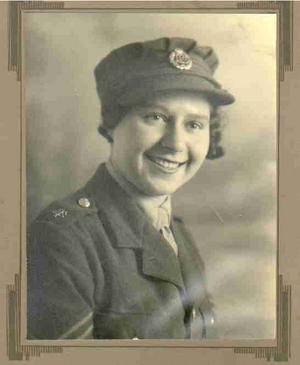
Winifred Joyce PAGE - ATS
My mother (Winifred Joyce PAGE)was in the ATS - this is my mother’s story and was dictated onto a tape for me. She was born in 1920 and lived in Vicarage Farm Road, Heston.
Territorial Army
I joined the Territorial Army at the local Drill Hall which was near Hounslow Barracks nearly a year before the outbreak of World War 2. I remember going down there and speaking to a Sergeant about joining the TA and being asked ‘what would you like to be?’ I said ‘I would like to drive’ and he asked if I could drive and when I replied ‘No’ he said ‘Well, we haven’t got time to teach you to drive’. So, I became a Steward helping in the Dining Room.
On occasions the TA girls would go into Hounslow Barracks and help set out the food for the regular soldiers (Fusiliers). I remember there was an old man who did the washing up, a very old man who used to be in the Army. Oh, he was a funny old man, but likeable though. He used to wear a wig and it was not a very good wig. Every now and again, whilst he was at the sink washing up, you would see him take off his wig and fan himself and then put it back on again.
Call-up : 28 August 1938
I worked at Gillettes on the Great West Road, Isleworth, Middlesex and a week before the war was declared, I was sent a telegram to my home and my Mum brought it down to Gillettes, where I was working in the canteen. The telegram said I had to go into Barracks straight away and so, she brought it down to the Works and off I trotted. We girls were given rooms in empty Married Quarters and issued with three blankets (one under and two on top) and three squares (known as biscuits) which we put together to make into a thin mattress and a pillow.
I was not very good at lighting a fire or keeping them in, so my room was not very warm in the winter. If you were handy with wood and coal you could keep a fire going. Some of the Cooks (female) were very handy at keeping their fires in and they always had a kettle of water on the go and in their off-duty times their rooms were always very warm, mine wasn’t very warm at all. I remember having the duty of lighting the fire early morning in The Keep (Houslow Barracks) — I could never keep it alight and was always glad when a soldier came along who would help me get the fire to stay in.
Phoney War (from September 1939 to April 1940)
During that first year of the Phoney war I was already in Barracks. The very first time the Air Raid Siren sounded I was sitting in Church in Hounslow (near Hounslow West) and we had to leave the Church and got halfway back to the Barracks and the Air Raid Wardens were sending us off the street and we went into someone’s house. For a whole year nothing had happened, not bombing anyway. In the early Spring of 1940, I and three other girls were sent to Kneller Hall to serve food to returning soldiers who had just arrived home from India. The lads walked in to the Dining Room and their comments ‘Women’, etc.! Thank goodness for a Sgt ‘Jack’, who (like a lion tamer) got the men in line! I never knew what happened to those soldiers from India, did they make up part of the BEF? The British Expeditionary Force had gone off to France (I believe in the Spring of 1940) which included three of our male Cooks from the Hounslow Barracks. They survived and came back to us via Dunkirk. One of them, Sid married one of our girls, Betty W-P, a pretty girl. When I was married and my husband was stationed in Trieste, Italy, we met Sid (still in the Army) in Austria in about 1950 — a small world.
Cookhouse and washing up in cold water!
Troops used to eat off of tin plates in those days and my girls not only saw to the dishing out but they also had to wash up the dishes. Now we had to stand in the yard of the old prison block, the sinks were sort of inside but the doors and windows were open and there were three big boilers in which we boiled up the water. Well, it was a very very cold winter and we had no sooner got water in the sink and it would get cold. Oh it was terrible, the bacon fatty tin plates, we had to try and get them clean and the soldiers wouldn’t scrap the plates properly, so we sent one of the girls up to stand by the swill bucket to make sure the soldiers scrapped their plates properly. She was a small girl, Phil I think her name was. She was a feisty little thing and she was ideal for this job. She would stand by the door and as they came out with their plates to scrap it into the swill bucket, she made sure they scrapped it all off. Eh, it wasn’t all a bed of roses, it was damned cold that winter. Putting your hands in cold, greasy water and always having cold feet.
Orderly Sergeant
I was in Hounslow Barracks for a whole year and when I was Orderly Sergeant, which was every ten days (the Orderly Sergeant wore a sash). It was our duty to check up on things and when the air raids started and it was the Orderly Sergeants who then checked that everybody was in the Shelters, it was quite never racking.
Reveille
There were two rows of Quarters and in the morning the Bugler would come and stand between the two blocks and play Reveille and we put a song to it.
I got a horse, I got a horse, I got a donkey
I got a horse, I got a horse, I got a donkey
cor blimey the donkeys dead
Blackout / Cycle / Bombs
During that year I used to cycle over to my boyfriends place (East Sheen). I’d travel back in the blackout, it was a terrible blackness, no light, nothing. On the bicycle we had to put cardboard in the bike lamp, so we just had a pinprick of light to see by. Very often the searchlights were up and switching around in the sky. Sometimes there was bombing when I was travelling back. One of our girls (actually she was a married woman) she went to the Coast on a recruitment drive and a bomber jettisoned its bomb and it shot underneath her lorry and a piece hit her and she was killed.
Volunteer for Overseas Duty
A notice was put on the Barracks Notice board asking for volunteers to go overseas. Being twenty I had to get my parents consent, normally it was hard to get me Dad’s, I always got me Mum’s but this time I got me Dad’s and it was very hard to get me Mum’s consent.
They picked quite a few girls from different Companies; I was given a pass and I had to report to a place in Reading. I got out at Reading Station, it was quite exciting really. Its all very hush hush, you know. Actually it was terrible if you went anywhere because they had taken down all the names of the stations and even the names of the roads were taken down. You hardly knew where you were and if you asked anybody they would look at you as if you was a spy, or you would look at other people as if they were a spy if they didn’t know where they were.
Reading Station
There was an Army bloke there with a jeep and he asked ‘Are you so and so’ and I said ‘Yes’. ‘Get in’ and I was taken to a big country house, a beautiful country house. There were girls from all over the country. I think there were 30 of us. 1 officer, 1 sergeant major and two sergeants. We all met up (they never told us where we were going) and we were issued with tropical kit, it was from the First World War, I think. It was a frock with brass buttons and the toupee was like a beehive and it was whilst at the country house that we decided to change our names and call ourselves by our boyfriends names. Well, my boyfriend was ‘Eric’, which would have been Ricky, but we already had somebody call Ricky (also with a boyfriend named Eric). We had Bobbys’ and Terrys’, all sorts and it was there that I became ‘Bunny’, named after my little sister’s bunny rabbit which I had with me as a mascot. We were not there very long, just a few days. Anyway, we were given our new kit, but we were never told just where we were going. Whilst we were at Reading we were given all sorts of injections.
The Train
I can’t remember if we went up to London by train or lorry (it must have been by train I think) to Euston Station at night. There was a terrific air raid going on and it was all subdued lighting and we had our tin hats on and our big bags on our shoulders. We had to hold each other’s coats, so we wouldn’t lose each other. We were walking around like a big snake to get to our train, but before we got on the train, we got a visit from the ‘big wig’, our big wig, the lady big wig, Lady somebody or other (Dame Helen Gwynne Vaughan?). She came to ‘cheer us on our way’. Also to give us advice about our behaviour, she told us ‘no betwixts and betweens’ (or in other words, do not allow any liberties to be taken).
Anyway, we got on the train and it didn’t go for some reason, ‘Oh I thought’ I wish it would go and get us away from this air raid. We did start off, it was very, very dark, no lights and then Whoosh and off we went. We didn’t know where the train was going and when it got light we stopped at a station and we got out to stretch our legs. A while later, a train came in on the other track going the other way and that stopped. We were all hanging out of the train windows. Giving the old banter and yapping across the track and one of the RAF boys said to one of the girls (‘cos they didn’t know just where they were going and we didn’t know where we were going) he said ‘I’ll see you under the third palm tree in the oasis. She said ‘all right’ and off their train went and ours went later the other way. Anyway, we found out afterwards that we all ended up in Gourock/Greenock (?) in Scotland.
The Ship (SS Georgic)
Our ship was the SS Georgic and to get to her they put us on this platform thing (pontoon). We were sitting, waiting for the pontoon to fill up and it started to gently rock and I had always loved the sea and I had even taken a trip to the Eddystone Lighthouse and not had any problems with seasickness. Anyway, I started to feel funny and we hadn’t even left the side of the harbour, we were just gently going up and down, up and down. Eventually, we got started and we went out to the ship. As we were climbing up the ladder, there were some RAF lads hanging over the side and one them shouted down ‘is it still on, the third palm tree in the oasis’? It was the same group of RAF blokes who had been on the train which went in the opposite direction to ours! I don’t know how but they must have had the trains going around in circles so that nobody knew where they were going!
When we got on board, they were originally going to put us down below with the troops (as we were other ranks) but as we were 30 odd women, they said ‘no we can’t put them down there’, so we ended up higher up in the ship. As we were a troopship extra bunks had been put in the cabins and I think there were six in our cabin. We were to use the lounge which the Sergeants and Warrant Officers used. The ship sailed soon after we had got settled in. Well, the first fortnight I was only up on deck for one day (I was getting so sick) and the poor RAF lads were getting sick. I’ll always remember the sailor shouting at them ‘get to windward, get to windward’ because it was blowing back over everybody.
I think it was the first day out and the convoy was attacked by a German Stuka, just off the Irish Coast. I think I was missing for about ten days due to seasickness, oh I was bad (sick) and also Georgina. There were three of us who were really, really bad (ill). After that we got our sea legs, thank goodness because in those days they didn’t have any medication to give you.
Convoy
The Navy was terribly good to us, shushing (closing) us up at night and spreading us out in the daytime, charging around us and that’s why I wave a flag to them now. (Mum is one of the ladies who swims off Firestone Bay, Plymouth most days and her two flags are put out, the Union Jack and the one that says ‘Have you had your Guinness’ as a salute to the Navy ships as they leave and come back to Plymouth Sound.)
The Navy shepherded the Convoy along; they were like a lot of terrier dogs running around the Convoy and as they changed over duties to different ships they sort of did a lap of honour, they would flick their lights and our ship would tell us what they were saying. They were saying ‘good journey, God speed; good journey, God speed’ and we used to clap and cheer them. I wonder if they realise how much we appreciated what they were doing? Of course, we were on that ship for six weeks. Zigzagging across the Atlantic, stopping for 24 hours at Capetown, up into the Indian Ocean (stopping off at Aden to drop off some RAF chaps) and on through the Red Sea and the Suez Canal to Port Tewfik, Egypt.
Sewing
Our boys were issued with khaki shorts that turned back, they buttoned right up to the top but they could be let down like long trousers. They were very ungainly. The New Zealanders had lovely ‘short’ shorts and they looked smart, so we spent a lot of our time cutting off these long flappy bits and sewing them up for the boys, so they too could have ‘shorter’ shorts. We used up all our cotton, so we used to say ‘if you bring the cotton we would make the alterations for you’. When we ran out of things like that to do, they brought the ships flags out for us to repair.
Crossing the Line
They had the ‘Crossing the Line’ ceremony and originally they did not intend to include the ATS girls, but we created so much about not being included that they put us in for it and they took great delight in ducking us. I’ve got a certificate somewhere I think.
Fruit and the St Christopher
Also, I was on the top bunk, which was three up. At night I would jump in and I would invariably jump in on an orange and apple or an apple and banana. The other girls thought it was lovely because they would share my fruit. We hardly ever saw fruit at home, but there seemed to be plenty on board ship and it was only as I was queuing up to leave the ship that one of the Steward’s stepped forward and asked if I had enjoyed the fruit. 'Oh it was you then' and he said 'yes'. He was a married man from Liverpool and said I reminded him of his grown up daughter. I did not know until we were leaving the ship who it was who left the fruit. As I was departing he gave me a St Christopher (the saint of travel) to keep me safe. A lot of people I didn’t know used to like me, ‘cos I was just a normal happy friendly girl, that’s all.
Map
Whilst on the ship my mother mentioned to someone that she wished she could know exactly where they were travelling so in the future she could tell her grandchildren about her journey. At the end of the journey she was handed a hand-drawn (foolscap) map of her journey and for the NEXT 30 YEARS she kept it hidden in the spin of a book. It’s a bit faded now but is interesting to read.
© Copyright of content contributed to this Archive rests with the author. Find out how you can use this.


 Recommended story
 Story with photo