

- Contributed by
- John Constant
- Location of story:
- Burma
- Background to story:
- Army
- Article ID:
- A7881780
- Contributed on:
- 19 December 2005
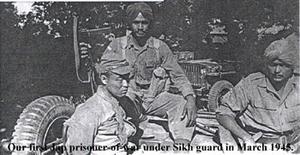
Our First Jap POW
Chapter 2.
As the spring of 1944 came, I found myself in Cocanada, on the East coast of India, training Royal Marines to carry out beach landing operations at night. Under other conditions, this task might have been a fairly straight forward assignment, but the shallows in which they had to land were home to venomous sea snakes. These often proved fatal to the local fishermen with their bare feet, and were discouraging to all of us, who had to do the night-landings. These risks were augmented by the fact that the landing-craft were being handled by men, now badged to the nascent Indian Navy, who had, no doubt, been brave soldiers, but who had little idea of watermanship.
Even in the very modest swell, which the beaches of Cocanada usually enjoyed, a significant number of the landing craft broached as they hit the beach, where the Marines had to clamber out, as best they could, with little help from the ramps, and usually into water up to their chests. The directing staff, of which I was lucky to be one, sometimes took the same risks; but, for most of the four nights a week we were conducting these exercises, we did so from one of the two DUKWs we held. These American six-wheel vehicles were amphibious, and had quite a good performance on a road, though with a much poorer performance on a beach; they had propellors which enabled them to move slowly, afloat, provided there was not too much foul tide.
The potential for technical development of these monsters was quite obvious, and was foremost in my mind soon afterwards, when I was attending a short "CRE's course" at the Indian School of Military Engineering (SME) at Roorkee. There, I met Tom Foulkes for the first time; he was a well-known figure in India, having been with the Royal Bombay Sappers & Miners for some 14 years. Being already a CRE, he was one of the more senior members of the course, and with his experience of Burma immediately before we met, he told us about the great rivers there, especially the Chindwin, the Irrawaddy, the Sittang, and the Salween, which we should sooner or later have to cross, when we started chasing the Japanese out of that country.
In particular, he mentioned the problems caused by the annual floods altering the course of the river, cutting the banks here, silting up existing banks there, and creating new shoals almost everywhere, so there was always a danger of ferries going aground, even in the middle of a great expanse of water a mile wide. Hugh Wakely was the instructor in bridging at the SME, and the three of us spent several evenings discussing methods of dealing with the problems presented by such big rivers.
I was able to offer some contributions, both as an experienced waterman myself, and especially as a result of my use of the DUKWs at Cocanada.
Together, we sketched out ideas for building decking over three or four of them to make a raft, suitable for use as a ferry, and to do so, after each DUKW had travelled individually to the site and had launched itself down the river bank into the water --- what a hopeful prospect ! The course ended, and I returned to Cocanada post-haste to find that it was to close its training role forthwith, and that I was to take 161 officers and men of 78 different corps and regiments of the British and Indian armies, with 87 vehicles of 29 different makes and types right across the breadth of India back to Juhu, near Bombay.
We drove this "circus" as far as possible each day, bivouacking for the hours of darkness wherever we could find a suitable space, and self-contained for rations in spite of all the ethnic prejudices and religious customs to be observed. After four days on the road, we reached Juhu and I found that I had already been posted to Burma, and was to fly there the next day; just imagine handing over my convoy and packing my kit that night.
Flying from Bombay, with stops at Dumdum near Calcutta, at Comilla and at Imphal, I was driven to Kohima in the Naga Hills of Assam, where the battle had just ended and my new job was already vacant, out on the Jessami track towards the Burma frontier. It was not to be a Sapper appointment at all, but filling the prestigious post of Brigade Major in 89th Indian Infantry Brigade, a part of 7th Indian Division. On the way there, I had reported to the Divisional Commander, Major General Frank Messervy, whom I already knew from his time as General Officer Commanding 7th Armoured Division in the Western Desert of Egypt. Just after I had left that formation in 1942, it had been savaged by the German General Rommel's sudden attack near Bir Hakim in Cyrenaica, and Frank had been lucky to escape with his life.
As I arrived at his Division’s HQ in Kohima, tired and sweaty after days of travelling, he greeted me cheerfully with the words, "Well, John, you may think I made a bit of a b**** of it last time, but you’ll find I know what do here." The General’s modesty and charm quite overtook me, and subsequently I enjoyed his many visits as Division Commander to our Brigade HQ, and later, during the battles in Burma, as Corps Commander. In the latter role, one of his more amusing, but rather distracting, habits was to insist on playing liar-dice, at the same time as I was trying to conduct the Brigade operations on the (wireless) Command Net, with my signallers cutting me into the Rear Link from time to time. I suppose it was his way of assessing my character, before contributing his opinion to the confidential report the Brigadier would have to write.
© Copyright of content contributed to this Archive rests with the author. Find out how you can use this.


 Recommended story
 Story with photo