

- Contributed by
- GliderPilotInHolland
- People in story:
- Staff Sergeant Bernard Black and Sergeant Philip Hudson
- Location of story:
- Holland
- Background to story:
- Royal Air Force
- Article ID:
- A5917179
- Contributed on:
- 26 September 2005
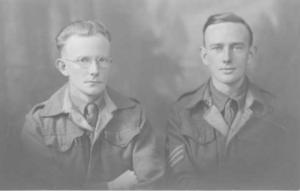
Bernard Black and brother Vincent
A Glider Pilot's Story (Part I)
(Introduction and Chapter 1)
By Bernard Black
INTRODUCTION
This book has been a long time coming. It is not just the result of a flash of sudden inspiration or a desire to jump on the band wagon, thus adding to the proliferation of war stories which are appearing with increasing frequency. The recent writings, researches and reminiscences of many others have to some extent been due to the accessibility of war records and files released under the thirty-year rule. These have probably contributed to the crystallisation of my OWN ideas and the decision to commit them to paper.
My thoughts have been germinating over a very long period. Often private; sometimes spoken of with close friends - mainly as anecdotes arising from light hearted or very serious memories. These memories are deep-seated; lasting impressions which have lain dormant though ever-present; occasionally brought into vivid relief either by some inconsequential occurrence or as in February 1953 by the disastrous storm floods which swept and devastated many parts o Holland and once more dealt a heavy blow to the people of Schouwen - Duiveland.
My friend, Joop Thuring, recalls how as a small boy he was lifted up by an elder brother in the fateful days of September 1944 and watched the Airborne Armada taking part in Operation Market en route to Arnhem. He has told me how every year he suffers from the "September Fever". I know how he feels - I suffer from ''Schouw Fever" or "Dutch Fever". Like earlier soldiers of the British Empire, I never know when next it will strike for while dormant it is always there, akin to the malaria which many of them contracted while serving in foreign parts. My fever (just as Joop's) was contracted at tile same time but the incubation period lasted from 18th September until 15th December 1944 during which time I lived (or should I say survived) on the island of Schouwen.
I don't know yet how these writings will turn out or indeed if they will ever be completed. It is doubtful if they will fulfil my intentions. I have long wanted to set them down but was always uncertain as to the form they should take. Obviously there will be much autobiographical recall but I have always wanted to do a great deal more than trot out another book of wartime experiences.
Over the intervening years I have had many more experiences of Holland. The first of these was in August 1959 when I revisited after an interval of 15 years. These experiences of Holland have not cured the fever. They have renewed and strengthened old friendships; led to new ones; occasionally dampened the furnace but more frequently fuelled the smouldering desire to find out more for myself and to inform others what it was really like. Although we live now in an era of communication and media, so many people (perhaps understandably) know so little of so many aspects of the war. From day to day we are informed of world shattering events - or are they the trivia of everyday news ? Today's news is tomorrow's history, but many facts of everyday life remain concealed and are rarely made known or understood.
I have often pondered over what might have happened here had we also been invaded and occupied in 1940. How would we have behaved? Who the friend and who the foe? Which of us who believes in liberty and justice would have compromised? How would we have judged or been judged? I would have liked this book to inform people in this country of what life in Holland was really like under German occupation. We know so little of it and yet there is so much to know. Professor de Jong and his staff at the Rijks Instituut voor Oorlogsdocumentatie have been gathering and studying information for more thirty-six years and so far some dozen or more volumes have been published covering different aspects of the occupation. The mammoth task is unending. Many individuals and groups are researching and writing but little of this is published or read in this country. Oh yes, there are many worthy stories and accounts of individual exploits and happenings. Sadly, some have been glamorised, commercialised or even televised and straying from the facts fail to give true impressions of wartime life in occupied Europe. My own efforts may also fail in this respect but will certainly, in so far as lies within my power, be founded in truth.
One of the difficulties is that of strict accuracy. Human beings are fallible and our minds are prone to distortion, exaggeration, and even to self deception. Sometimes we are just confused and forgetful. Although I have tried to minimise the possibility of error, the responsibility for any errors is mine. There are documented dates which give fixed points and then of course there are memories of others from which I have drawn. Where discrepancy or confusion has arisen, I have preferred to act as sole arbiter, and while many given dates are accurate, there are periods and episodes which though happening as chronologically reported, cannot be given absolutely fixed dates. Many people have stimulated me and encouraged me to write this story, among them Phil and his wife Pat, and Joop Thuring. Moreover, Phil and I, are very much aware of the rapport between us, then and now, and the overriding fact remains that this is also his story and that of my friends in Holland.
CHAPTER 1
We knew it was on. Yesterday morning we had seen the first lift on its way. Today it was our turn and we all knew that this time it would really happen. It was early in the morning of Monday, 18th September 1944. A typically autumn morning, it was rather still with quite a bit of mist about.
Disturbing the stillness there came all those sounds of preparation whose crescendo would gradually reach a sustained climax at about 1130 hours only to follow a diminuendo which forty minutes later would give way to an eerie silence as those left behind stood staring into the distance until the last combinations of tug and glider had disappeared from sight and sound.
Things had started at 1300 hours on the 16th in a way that was almost becoming familiar. The camp R.A.F. Keevil near Trowbridge was sealed and a briefing was called for all crews at 1430 hours. The plans were revealed. We were to take part in operation Market; the airborne part of operation Market-Garden. The intention was to seize the river bridges at Grave, Nijmegen, and Arnhem using the newly formed 1st Allied Airborne Army. This consisted of two American Airborne Divisions (the 82nd and the 101st), the British 1st Airborne Division, and the Polish Parachute Brigade. Then 21st Army Group would race along a narrow corridor, cross the Rhine at Arnhem, and would thus be poised for the final assault into Germany.
Some days earlier, we had attended a similar briefing for the aborted operation Comet whose objectives were broadly similar except that the forces did not include the two American Divisions .
So it was that the previous day we had watched some fifty Horsas, flown by pilots of D Squadron, the Glider Pilot Regiment and towed by Stirlings of 196 299 Squadrons, R.A.F. Their target was landing zone 'Z' to the west of Arnhem.
Our Horsa, DP956, loaded after the briefing with a Jeep and trailer, was in its place on the runway. It stood there with forty other Horsas in staggered pairs. Each one had its towrope already connected and snaking forward parallel with the others to a point at the side of the runway ready to be coupled to the respective tug when the marshalling was completed.
There were still some details to attend to but there was plenty of time. The pre-flight checks and an examination of the load to see that it was secure. A short brief of the passengers for their flight positions and stowage of kit. There were four of them: a driver from the R.A.S.C., a trooper from Para H.Q., a private from the South Staffs, and a Dutch Commando, Herman de Leeuw. Then of course there was my co-pilot Sgt. Philip Hudson and me, Staff/Sgt. Bernard Black.
Phil and I had met just before D Day. I had been posted to D Squadron at Keevil on the 1st June and we had been put together as a crew in 22 Flight. For the invasion of Normandy we had been listed as a reserve crew and had not been required. In the intervening period, we had been posted on detachments at Harwell, Sleap and Ramsbury, returning to Keevil after each occasion. The posting to Ramsbury was to an American Air Force Base and was for the purpose of taking part in operation Transfigure, a landing to the south-east of Paris. This operation too was aborted after we had stood to with loaded gliders for 72 hours. This time it looked as if we were going somewhere.
The marshalling was completed, most of the crews, glider and tug had spent some time outside their aircraft standing around chatting. Then it was nearly time to go. With good wishes all round we rejoined our aircraft; the tugs started up their engines once more and at the appointed hour, the towmaster gave the signal to the first combination, "Take up the slack". The Stirling lumbered slowly forward until the glider began to roll then at a signal from the towmaster, full power was given and the combination began to accelerate along the runway. At the same time the right hand combination had already started its forward movement and was beginning to accelerate by the time the first pair was airborne. "Another three to go": "Now two": "One more": "Now it's our turn!". We begin to roll forward and the towmaster waves his bat overhead and we are gathering speed along the runway; now we are airborne and flying just above the ground until the tug becomes airborne also.
The early morning mist had not completely cleared and as we climbed we gradually turned towards the north until we were over the Bristol Channel before setting course to the east. This early part of the flight was completely uneventful. The cable link was working well and giving good communications with the tug pilot. There was some chatting the tug crew and the pilot congratulated us on our station keeping, telling us that the glider he had towed the previous day had parted company near Norwich.
As we travelled eastwards, we could see combinations from other bases joining the Armada. We crossed the east coast and our main impressions were one of wonder and awe at the sheer size of the operation. As far as we could see in any direction there were combinations of aircraft. Ahead of us one glider came down in the sea and by the time we reached it the crew were on top of the wings and one of the many rescue launches was closing rapidly.
After we had been flying for about three and a quarter hours we were nearing the Dutch coast. The stream of aircraft began to converge and the air was becoming quite congested. Below us we could see the flooding with many farms and cottages surrounded by water. Then another combination going slightly faster than we were, began to overtake us just overhead. I called to the tug to tell him, then I hit the slipstream of the overtaking tug. Momentarily the glider was difficult to control; the port wing dropped and while I was trying to correct this, one of two things happened.
Either my tug hit the other tug's slipstream as it descended in front of us or my tug pilot chose that moment to take evasive action. Whichever actually happened, the result was the same - my tug dropped his starboard wing and began turning to starboard. This at the moment when I was swinging to port. This was the dreaded untenable situation for a glider on tow. The more out of position to the left that I should go, the more I would compel the tug to go to the right, by pulling his tail round. This situation only lasted for a few brief seconds and I took the only course of action for which training had prepared me - I released the towrope.
Then with Phil looking out for overtaking traffic, I began a cautious clearance from the stream of aircraft, gradually turning to starboard and also hoping to reach the mainland. The German gunners in three ships in the Keeten Mastgat had other ideas and began firing at us. While I was taking evasive action two or three Typhoons dived and strafed them. I was also busy turning back to port and looking for a suitable landing ground. One field was only muddy and while I was making my approach, I told Phil to tell the passengers that we were not landing where we should have done. We landed safely in this field (the surrounding area was flooded) which was part of the farm belonging to Keiser Romeijn near Nieuwerkerk, and we disembarked. In the distance we could see columns of smoke on the horizon in the direction of the ships that had fired on us. While we were sorting ourselves out, the Typhoons flew low overhead, waggled their wings at us and continued on their protective way.
© Copyright of content contributed to this Archive rests with the author. Find out how you can use this.


 Recommended story
 Story with photo