

- Contributed by
- Kent Libraries & Archives- Tunbridge Wells District
- People in story:
- John Towers & family
- Location of story:
- Bromley, Kent
- Background to story:
- Civilian
- Article ID:
- A6027374
- Contributed on:
- 05 October 2005
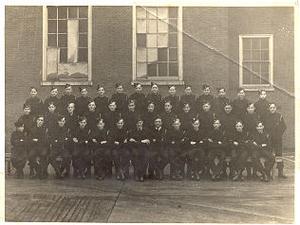
Civil Defence at Bromley Municipal Buildings 1943/44
This story was submitted by Rachel Barton (CSV volunteer) on behalf of John Towers and has been added to the site with his permission. The author fully understands the site's terms and conditions.
I was 10 years old when the war was declared having been born in Balham, South London 1929. I remember just before the war that we, that is the family, mum, dad, my brother and sister were on holiday in Hayling Island. Dad had to put the blackouts up at the windows of the bungalow we were renting. He explained to us about the Germans, the Nazi regime etc. But I do remember when we returned from holiday to our home in Bromley going to church on Sunday 3rd September 1939. I was a choirboy at St John’s Church in Bromley. The service started at 11am. We had sung the first hymn when the vicar announced that it had come over the radio that we were now at war with Germany. He asked us all to kneel and pray and then he ended the service just as the air raid siren started. I then remember running home from church with my younger brother as fast as we could.
As the weeks progressed everyone was getting prepared. Air raid shelters were going up in back gardens, home guard sand bag stations were being erected and then gradually the bombing started. At first we were all frightened especially my little sister. She used to cry all night in the air raid shelter.
I remember one night the bombing was very heavy. The German planes were coming over all night long. Dad was standing outside the shelter then all of a sudden he called us two elder boys to step outside the shelter and look towards London. The whole sky was lit up. Dad said that they were bombing Surrey Docks which was all around the Bermondsey area. Mum was worried because our Gran lived in Rotherhithe. One night we were so heavily bombed in Bromley, in fact we had lots of damage to the house. Windows were broken and there were tiles broken off the roofs down the whole road. During the night Dad had found out the road just round the corner, namely Tylney Road which was the road where our school was had been bombed and hardly a house was still standing. Next day a few of us boys went up to the top of Tylney Road to have a look but we weren’t allowed to go very far as the whole road was just a heap of rubble. Bricks and dust — it was terrible. The heavy rescue services were there digging to find people buried underneath the rubble. All I could see further down the road was the whole roof of the school which had been lifted by the force of the bombs on top of the heap of bricks in the middle of the road. It appears that his was all caused by 3 landmines that had been dropped within 100 yds of each other.
Although all this bombing went on we were not allowed to miss school. I had to be transferred to Bromley National School at Bromley North and my brother was located at the local church hall. I do remember that occasionally we had to have lessons in the underground shelters for many hours. As the months went by I joined the Civil Defence as a messenger boy. I suppose I was then about 13 or 14 years old. When there was a lot of bombing and the telephone lines were down (there weren’t any mobile phones) we were based at Central Control underneath the municipal buildings in Bromley. We were given the task of cycling during the night with our tin helmets on taking messages from one bombsite to another and back to Control.
There was one night when I was at home, Dad had called us to the front door to show us this plane going across the sky with flames coming out of it’s tail. We read in the paper the following morning that it actually was the first flying bomb (Doodle Bug) which had actually landed on a railway line in north London. From then onwards we experienced the bombing of London by flying bombs on a 24-hour basis. The raids got worse. So much so that we just got on with life. When we could hear a flying bomb we just stood and watched them come over. If the engine stopped that was the time to dive for shelter. Sometimes when the motor cut out they glided for miles and other times they just dived into the ground and if you were lucky you missed it. During the day sometimes we could see the spitfires taking off from Biggin Hill. It was fun watching them go alongside the flying bombs to tilt their wings to turn them away from London and back towards France. That was why so many never made it and crashed into the fields in Kent. One of the worst raids in Bromley was when one fell in London Road during the night. I was on duty at Central Control and was sent to the scene to take messages back but was collared by a warden or heavy rescue bloke who gave me instructions to crawl underneath a bombed house to find a man buried in the debris. They tied a rope to my leg to pull me out if I ran into difficulties. When I found him I had to give him an injection to deaden the pain.
During the war I also did a paper round getting up at 6am — Dad made sure of that! But it was good fun — better than sitting in an air raid shelter because we collected shrapnel as we were being bombed and the ack-ack guns went off during the night. We used to fill the paper bag up with bit of shrapnel; except for one morning I found something more than I bargained for! It was a cylinder about 18” long by 4” round. I put it in my paper bag and took it home with me and said “Dad, look what I’ve found” He recognised what it was straight away. It was an unexploded incendiary bomb. Well you can guess what he said! He carefully buried it in the garden and called the emergency services.
It was when I was a grammar school at Hayes Lane, must have been 1943/44, I remember going home to dinner a crowd of us were walking up Hayes Lane when we heard some planes but couldn’t see them. The someone called out “there they are” and you could just see these planes flying very low at roof top level. Then we recognised them as not being ours, but German Meschersmits. Wow. We all stood and watched them disappear towards Bromley High Street and on towards London. It was a good job that we did watch them as one of them turned back towards us. We all dived into various front gardens — funny how we all did the same thing at the same time! The plane came back and fired a few shots, obviously just to scare us and then it was gone. I and many others tried to find some spent shells but I was unlucky.
The flying bombs were getting worse. We had a few near ones — so much that the house once again suffered severe damage and thinking back it must have gradually got mum down. I can’t remember exactly when or how it came about but we were evacuated to North Wales. I remember we assembled in Bromley town centre where a convoy of buses took us to Euston Station. I don’t think any of us knew where we were actually going but after a long journey we eventually arrived at a town called Llanwrst. We were taken to the local school where we were given blankets to bed down for the night in various classrooms and hall. The next morning we were called together and then segregated into various buses. I went to one farm, my mother and younger brother and sister went to another farm and my other brother went to a third farm. The farm that I went to I was taught farming such as milking the cows, hay making, which was good fun, but then we had to go to school in September term. That was a different matter altogether as they only spoke Welsh! Both my brother and I were so unhappy with this situation that we decided to go home. How we travelled I don’t know, but I do remember arriving home in Bromley and what Dad said when he saw my brother Ken and I standing on the doorstep. I won’t repeat! By the time we had arrived home the flying bombs had more of less finished because our troops by then had invaded France and captured the sites but then the V2 rockets were next. I remember one of the worst direct hits was at a pub in Southborough near Bromley. It killed over 100 people.
I celebrated VE Day when I was at Bromley Art School in June 1945.
© Copyright of content contributed to this Archive rests with the author. Find out how you can use this.


 Recommended story
 Story with photo