

- Contributed by
- Ian Pavelin
- People in story:
- William Stanley Pavelin
- Location of story:
- Cramlington Lamb Colliery, Newcastle
- Background to story:
- Civilian Force
- Article ID:
- A4442474
- Contributed on:
- 12 July 2005
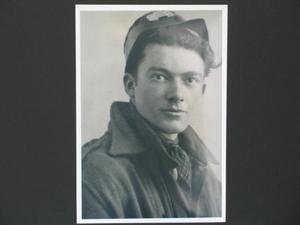
Bill Pavelin aged 18. Coronation Pit
A BEVIN BOY IN THE SECOND WORLD WAR 1939-1945
PREFACE
During the Second World War, 1939 -1945, a scheme to direct young men to the coal mines was introduced in the House of Commons on the 29th July, 1943, by Ernest Bevin, the Minister of Labour and National Service. Attempts to enlist new recruits by allowing men, when called up for military service, to apply for work in the mines, had failed. Experienced miners were joining the armed forces and leaving the coal industry. It was for this reason that Ernest Bevin introduced his scheme for directing recruits to the mines. The method of direction was to be made by ballot.
The majority of recruits came from the young men born in 1926 and due to enlist for military service in December 1943. The names of those born in the first quarter of that year were used for the ballot. William was born in March 1926, which indicates that he was among the very first of the young men who were to become known as the ‘Bevin Boys’.
The ballot provided 20,000 new recruits in all by 1945. At the time, there was a great deal of publicity regarding the ballot method of recruitment. Exemptions applied only to men in highly skilled occupations and those with skills vital for submarine or aircraft crew service.
The Bevin Boys made an important contribution to meeting the demands of war upon the coal industry. Although less than seven thousand of them were employed at the coalface, the majority of them were trained for work in other areas, thereby releasing eleven thousand miners in those areas to upgrade, through advanced training, to the coalface. In May 1945 the scheme of compulsory direction to the coal mines was abolished at the end of the war in Europe. Marie Pavelin.
1940’s
I WAS A BEVIN BOY BY WILLIAM PAVELIN
I was called for the mines in 1943, aged 18 years old. I had to meet a party of lads at the local station, which was Dagenham. I was serving an apprenticeship to a granolithic floor layer, travelling the country. I was shocked at being directed to the mines because I was exempt from military service. We were given warrants to travel from Kings Cross railway station to Newcastle Central station. We arrived in Newcastle in the early evening and were surprised to see very deep snow.
We went by tramcar to a large hall in town where an employment officer met us and took details of our call up. By this time we were tired and hungry. We then joined a huge gathering of other lads who were waiting to be chosen by the local women for billeting. Rather like being bought as slaves. Eventually a lady picked eight of us. We were then taken to a large house in Heaton, just outside Newcastle. There we were briefed by the lady of the house and given our first meal of the day. Mealtimes were a free-for-all. If you were polite and well mannered, there was nothing left to eat. There was never more, or a second helping. The lady of the house drew allowances for eight lads and she seemed only interested in making money.
The first day we had to wait for a coach to take us to a training centre at Cramblington Lamb Colliery. I had never seen a mine. At first it all came as a shock, but quite soon a way of life. We had to queue at the stores for our working clothes. We were issued with a blue boiler suit, steel capped boots, and a hard miner’s helmet. The inside of the helmet was cushioned with wide tape and sorbo rubber and was adjustable to size.
We had to go to school to learn about explosives of different types, how to test for coal gas, how to fit pit props, which meant two props and a plank every few yards to secure the roof of the tunnel. We also had to learn to dress the ponies in their harness by opening their mouths to fix in the bits, and fit the blinkers and reins. We also had to learn to control them for their daily work. The ponies worked well. Once shown, never forgotten.
After two weeks of training we were taken underground, which was quite frightening, seeing the cage for the first time, which carried four men on top and four men in the bottom section. We travelled at speed, passing different seams on the way down. Each level had a name, like Ruler Seam, Lower Level, Main Coal, and so on. The cage was lowered down the shaft on a very thick steel cable. Above the pit head was a huge wheel. The cable ran over the wheel, into a shed that housed winding gear that wound the cable round a big drum, lifting and lowering the cage.
After some weeks at the training centre, we were all sent to outlying villages to different coal mines. I was sent to a place called Westerhope, about five miles from Newcastle. Our digs had been previously arranged. I was billeted with an elderly widow who already had two other Bevin Boys. I already knew the other boys, so we settled quite well. The landlady was quite good to us, but not too clean in the house. The beds appeared clean and comfortable but we were awake most of the night, delousing the flea-ridden beds.
We were fed quite well; the menus were unusual, like leek pudding, pot pie, boiled tongue and stotty cake, which was huge yeast bread cooked in a very large earthenware dish. Dishes and saucepans were left in the sink until needed.
I was sent to a mine called Coronation Pit, owned by the ‘Throckley Coal Company’. My pals were sent to a mine about a mile away called Wall-bottle Pit. Wall-bottle was a modern mine, which had pit- head baths. After each shift, I walked the mile to change clothes and bathe there. Most miners had a bath in front of the fire, usually in a tub or tin bath, looked on by the rest of the family. That was not for me.
For quite a few months I worked on the bank. The term ‘bank’ meant pit head. I had to unload pit props and planks and stack them, ready to send below ground when needed. It was always freezing cold and deep snow. Night shifts were a nightmare, starting work at 2.30 a.m. until 10.30 a.m. Lunchtime was something to look forward to. We had large jam tea-cakes and a bottle of tea. The bottle was made of tin, which was clipped to your belt for carrying water when working below.
After a time I was put on haulage work. The coal was brought to the surface and wheeled from the cage in small steel trucks, weighing about eight hundredweight. The trucks were pushed onto narrow gauge railway lines, about twelve trucks coupled together. They were then sent to another mine two miles away by a steel cable called an endless rope, and was pulled by a hauler. The coal was sent to the next mine to be screened and graded. Once emptied, the trucks were sent back. The two mines and the screening and grading facilities were all part of the same coal company.
I was finally sent below ground, working at the shaft bottom for a few months, pushing full trucks into the cage and pulling out the empties. There was an old pony called Duke working below, forty years old, who used to like chewing tobacco. After a while I was sent to work at the coal face and I was trained by an old miner who was about sixty.
We worked alone in old workings. He was quite tough, with bowed legs and chewed tobacco all the time. Most miners chewed to keep the mouth moist and to prevent them swallowing coal dust.
I was shown how to drill the coal and how to place the gelignite for blasting. The shot firing was by a deputy who checked the area and cleared it for blasting. The face working was between eighteen inches to three feet high, sometimes dry and dusty, other times with water pouring through the roof, caused by underground streams. We had to lay flat to be able to work.
There were large stables in the mine with a stable keeper who looked after twenty ponies, some ponies worked nights and some worked days. Each pony had a name like Tiger, Speed and Fly. Fly became my pony and, as time went on, he was Fly by name and nature. At lunchtime, he would take a bite from my sandwich when my head was turned away! The ponies were used for haulage work and the men who worked the ponies were called putters. I was a putter. There were six putters working, pulling out full trucks of coal from each miner, working each gateway and replacing with an empty truck. The full trucks were pulled away from the coal face on rails.
The trucks were coupled together, shafts fixed to the ponies harness, coupled to the trucks. The putter would sit on the shaft between the pony and the front truck. The pony would trot through the low tunnels and when we came to a turn in the rail, I had to get off, pull the trucks round the turn and climb back on the shafts before the next low tunnel. Sometimes the trucks came off the rails and you then had to lift them back on.
The trucks were driven to a landing where all full trucks were coupled, fixed to an endless rope and hauled to the shaft about a mile or more away.
There was no lighting in the mine so the putters wore a cap lamp. A steel cased battery was fixed to the belt cable, which was running up your back, and a small lamp was fixed on your cap with the cable secured at the back. The miners carried a large lamp.
The wage at the time was three pounds a week for an eighteen year old. Sometimes a small bonus was paid for extra output. If you took time off you were fined. I took two days extra leave on a two-day Christmas holiday in !944.I had to appear before the magistrates at Moot Hall Police court with 7 other Bevin boys charged with offences under the Essential Works Order.
The prosecuter for the Ministry of Labour said that all the accused were charged with absenting themselves without reasonable excuse over the Christmas holiday period.
It was stated that the men at the Coronation pit were allowed nine days holiday. Despite this they took extra days .Imposing fines of two pounds per day Sir Ralph Mortimer, chairman, said;"It seems
So pitiable. Have any of you thought that our men are fighting for us? By your action
you are handicapping those men."
W.S. Pavelin.
William worked in the mines until four months after his marriage in 1946
He was then called to the Royal Air Force.
Previous to becoming a ‘Bevin Boy’, William served in the ‘Home Guard’.
© Copyright of content contributed to this Archive rests with the author. Find out how you can use this.


 Recommended story
 Story with photo