

- Contributed by
- Frank Yates
- People in story:
- Frank Yates, General Ross, Ken Kenway, Tich Williams
- Location of story:
- Kevelaer, Bocholt, Winterswyck, Ibbenburen, Hoya, Westen, Hamburg
- Background to story:
- Army
- Article ID:
- A7404473
- Contributed on:
- 29 November 2005
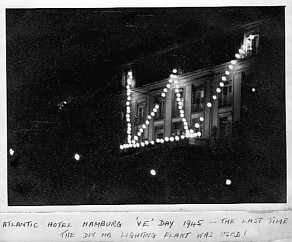
The Atlantic Hotel Hamburg VE Day 1945. The last time the Div HQ lighting plant was used.
Memories of Frank Yates Chapter 39
We returned to Kevelaer for a few days, during which we popped across the few miles to the Rhine to watch the airborne assault across the river. The Yanks had secured a bridge head at Remagen, further south, and there was little opposition in our Xanten area so the airborne drop was probably not needed, but I suppose that it was better to go ahead with the arrangements, rather than to cancel, involving the unfueling of thousands of planes and the standing down of thousands of troops, all ready to go. The sight was awe inspiring, the last parachute and glider attack of the war, watched, on the eastern side, by amazed farm labourers, and, on our bank, by Mr Churchill and Montgomery. The local story was that Churchill, much to the horror of the strait laced “Monty”, unbuttoned his fly and urinated on the German soil, saying “I’ve waited a long time for that!”
On March the 25th we crossed the Rhine at Xanten on a class 40 floating bridge and holed up for the night about a couple of miles from the river. I took the opportunity to inspect a couple of Horsa gliders, among dozens of them, scattered and badly damaged, littering the landscape. Most of them were being used as convenient bivouacs by our troops
There was sporadic resistance, and in two days our HQ was established in the small town of Bocholt, an attractive place completely empty of Germans, if there were any they stayed indoors! Then on and across the border to Holland, a bit of which encroaches into Germany at the small Dutch town of Winterswyk. The Boche put up a fight here and the column was held up, just north of the town. The General was feeling adventurous and, frustrated by the lack of movement ahead, he ordered me to escort him, in his armoured car, up the road. The held up vehicles were well into the side of the road and we caused some interest as we passed, with a red hatted general, standing up in the bin-like turret of the car. I was carefully following the map, but he suddenly asked if I knew exactly where we were. I told him that I did and wondered what he was worried about; after all we were still following the only road, with a line of troops at our side. Eventually we reached the end of the column and found that the hold up was a huge crater, blown in the road, by the retreating Germans, which was being filled by a detachment of engineers. The General prudently sat down in his turret, probably thinking that he was a bit of a target! Turning round was a bit difficult, as we went back to Winterswyk.
Ken and I were billeted on a Winterswyk couple. They were more than hospitable and we were treated regally by them. They were both dentists and I regret to say that I cannot remember their name, even though, months later, they motored down to the Ruhr in their Mercedes car, to fetch Ken and Me to a “Posh” Dinner Dance in Holland. As they were both dentists, they had a system whereby an emergency, in the middle of a meal, required the toss of a coin to decide who was to treat the patient! During our stay with them, the wife set off for Leyden University for a refresher course, it being compulsory every two years.
We were sorry to leave Winterswyk, and they were sorry to see us go. General Ross was presented with the freedom of the Town on the anniversary of its liberation. I believe that we were invited to the “Do” I mentioned, in connection with this celebration. General Ross had already received the Freedom of ‘S Hertogenbosch, on the special anniversary of its liberation.
During the first few days of April, we advanced, with slight opposition, northwards, following the German side of the Dutch border, passing close to the large Dutch town of Enschede, to which Ken and I made a detour, It seemed a grim place showing the signs of five years of German occupation.
Then the advance was eastwards, across Germany and the end of the war, but unexpected and fierce opposition was encountered at Ibbenburen, The Germans, desperate for reinforcements, formed a battalion of Hitler Youth, some as young as thirteen, and old men, some as old as fifty five. They were officered by Luftwaffe personnel, now redundant, and they fought, like all Germans, with great ferocity and skill.
Another “swan” ensued as we bypassed the large city of Osnabruck, in which the German defences were still active. 25 miles in a day to Hoya, on the river Weser and about 10 miles south of the city of Bremen, which is at the mouth of the river.
The river is very impressive and is, I suppose, best known because of the legend of the Pied Piper of Hamelin, and the famous poem of Robert Browning. I didn’t see any drowned rats floating down the stream!
On April 10th we crossed the river and made our HQ at a very well heeled mansion in parkland between the Weser and the Aller. “Tich” Williams had chosen the house and a few of us accompanied him on the recce. We lived in the house for 5 days and our stay was very eventful.
The gardens were adorned with marble statuary and the owner was obviously a very rich man. When we looked in the huge library, we could not fail to notice that the room was lined with mahogany cabinets, fitted with narrow drawers. These were lined with etchings and woodcuts, protected by special interleaved preserving paper and when we opened them, names like “R Van Rhyn”, “Albrecht Durer” and “Lucius Cranach” astonished us. While we were opening the other drawers, all full of etchings, a Dutch liaison officer, looked over our shoulders, leaned over and took a very small, gilt framed painting off the wall, slipped it into his pocket and walked out. I have often wondered what it was.
The value of the etchings was obvious and they were there for the taking and they were taken. I remember a jeep which, for the rest of the campaign, had a parcel of Rembrandt etchings, underneath its driving seat. I left them alone, not because I was honest, but because I realised that such items are well documented and could never be sold without questions being asked. I might add that there were some etchings, particularly by Rembrandt, which were, by today’s standards, pornographic!
On that first pleasant, April evening, three of us, looking for something to do, borrowed a Daimler scout car and went hunting hares. We had noticed the hares, earlier and found that the Daimler car, equipped with the Daimler fluid flywheel, was ideal for the sport because it could smoothly change from forward to reverse without stopping, so if, the beleaguered hare resenting being shot at by two pistols, suddenly changed direction, we could follow it. The hares always escaped unharmed, but it was, to us, pretty good sport.
One of the targets led us through a gap in the hedge, surrounding the huge field, into an even larger field where we stopped in amazement. Dispersed round the perimeter were dozens of Focke Wolfe 190’s, with no human being anywhere in sight. Over the tops of the trees, in a nearby wood, rose the tail fins of about 20 Junkers 52 transport planes. Why they were there is a mystery, shortage of petrol being the most likely explanation but I suppose that the transports were ready for the next German airborne operation, now never to take place. Contemplating the F.W. 190’s, we wondered if they were equipped with cameras, but decided that sliding back the cockpit canopies was a risky business, They could be booby trapped. Out of pique and bravado I fired some bullets, from my Smith &Wesson, through the swastika painted on the side of the nearest one. A pointless and childish action, which must have given me some pleasure at the time! When we got back to Div HQ, we reported our find to the RAF but I never bothered to find out what had happened to them.
We remained in this upmarket HQ for several days, during which preparations were made to cross the River Aller. When the floating bridge at Westen was about to be completed the G1 told me to go to the bridge site and report the progress. When I informed him that I had no radio on my jeep, he told me to borrow his.
Arriving at Westen I found a line of tanks ready to cross and a lot of engineers, beavering away on the last pontoon on the far side of the river. The buildings ran right down to the water’s edge and many troops were ready, behind the houses for the assault. The sappers finished the bridge and the first tank rumbled across. Before it reached the far shore, the heavens opened and shell and mortar fire descended on the village. Hiding behind a house, where I had parked the jeep, I got on the blower to the G1 with a conversation on these lines:-
“Sunray speaking, what news?”, “Our friends are over the hurdle, but things are getting a bit warm here”. “Well, bring my b****y jeep back pronto!”
After the crossing of the Aller, on April 15th, a few one night stops took us on a breakneck progress to Soltau and then across Luneburger Heide (Luneburg Heath), to the mighty Elbe which we crossed on May 2nd. Momentous days, indeed, as we stopped in Bergedorf, on the approaches to the great city of Hamburg, the brief halt was to make sure that the entry to Hamburg would be unopposed. Interestingly, the owner of the tall house in which we spent the morning, had had a connection with the German Navy, because, in the sideboard drawer, was a Leica 3, engraved “Kreigsmarine” It was everyone’s ambition to get hold of a Leica or a Contax, the World’s best cameras. Someone else got his hands on the navy camera!
So on May 3rd. 1945 we made our entry into the devastated Hamburg, bombed incessantly by the RAF and the victim of the notorious “Firestorm” when the fires were so huge and intense that the oxygen was removed from the air so rapidly that thousands of people suffocated. It was noticeable that the debris from the bombings had all been neatly stacked up so that there was a semblance of order about the city
In the middle of Hamburg is a large and famous lake, called the Alster. On the shore is the Atlantic Hotel, of International De Luxe category. Into this gilded palace walked the HQ staff of the Welsh Division, after the occupants, mostly fur coated women with pet dogs, were turned out. It was here in Hamburg, that I enjoyed, probably, the most interesting few weeks of my life.
The opulence of the hotel was beyond my limited experience. All taps, bidets etc were gold plated and the plasterwork in all rooms was in pink and gold. I was allocated a room where I found that my batman had unrolled my canvas bedroll, which had accumulated the grime of three years, onto the top of the bed, which had been freshly made with white sheets! Having sorted that little matter, I went down to find that the hotel lounge had three German generals, wearing bright red lapels, drinking our coffee and talking with our senior staff. It was evident that the end of the war was imminent! The news came, on that first day. Montgomery had signed an armistice with the Germans, in a marquee, on the Luneburg Heath, passed by us a couple of days earlier. The relief was unbelievable and there was much popping of champagne corks, from bottles in the hotel’s cellars, I was in the ops room when the G1 sent for the two sappers, who had, since Normandy, lit up Div HQ with their diesel lighting set. They were ordered to deploy their lights across the façade of the hotel, facing the Alster, and to make a huge “W”, the Divisional sign. And so the citizens of Hamburg saw the Bardic Crown emblazoned across the night sky, as an impromptu firework display of tracer bullets and Very lights signalled the end of the war.
© Copyright of content contributed to this Archive rests with the author. Find out how you can use this.


 Recommended story
 Story with photo