

- Contributed by
- actiondesksheffield
- People in story:
- ARTHUR WARD, Cliffe Teale, May Burnie, Gnr. Goodhall, Norman Harrison, Sgt Burkett
- Location of story:
- Wydale, Malton, Catterick, Otley, SALISBURY PLAIN, Halifax, Galasheils, Scotland, Selkirk, Aldershot, Plymouth, BREST, Leval, Rennes, Le Mans, Alencon, Cherbourg
- Background to story:
- Army
- Article ID:
- A4348073
- Contributed on:
- 04 July 2005
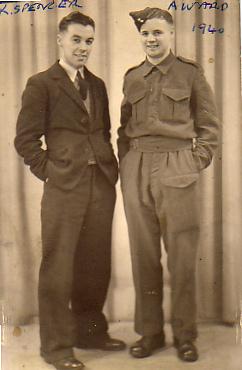
1940 — Photograph of Arthur Ward taken, at the Fred Shaw studio in Rotherham, with Keith Spencer of Swallownest. Keith was later to join the Royal Air Force and become a Flying Officer.
This story was submitted to the People’s War site by Roger Marsh of the ‘Action Desk — Sheffield’ Team on behalf of Arthur Ward, and has been added to the site with his permission. The author fully understands the site's terms and conditions.
Refer to Chapter 1-- A4345544 -for links to other chapters.
LIFE IN THE ARMY
by
ARTHUR WARD
Chapter 3 — A Trip to France to “Save Paris”
We had quite a few recruits who lived in 'The Gorbals', which had a reputation of being a very rough district in Glasgow, but they were "the salt of the earth" as mates and we all got on with them very well.
One man who I remember very well, was called REA and pronounced 'Ree-ah'. and what a laugh it caused when his name was called on parade, as he was a gunner, hence "Gunner-Reeah".
Another incident at Wydale when one weekend, some of our officers took part in the local 'hunt' for foxes.
We were all disgusted when a fox ran into an outbuilding only about 6'-0" x 3'-0" and several dogs piled in after it. The screams from the fox upset us all.
The dogs tore the fox to pieces and it did not have a chance. The huntsmen in their red coats thought it very amusing and the young ladies with them were just as bad, one of them proudly carried away the fox's tail which was covered in blood. Our officers who took part lost our respect for quite a long time.
MALTON
Whilst at Wydale, we had a run in a truck to Malton, where we visited a cinema to see a concert organised by NAAFI.
Here we learned the words of 'Land of Hope and Glory', which we sang with great gusto at other concerts and usually after a good night in a pub!!!
April 11, 1940
CATTERICK
We travelled by truck to Catterick camp on a very wet and miserable day, and for the first time we fired rifles with live ammunition on the firing range.
I was never much good with a rifle!!!
I was also in trouble with the Sgt. Instructor when I asked a question about the rifle, and at the same time pointed the rifle at him. We soon learned that in the army, it is an unforgivable sin to point a rifle at anyone, although in this case it was not loaded and the safety catch was in the 'on' position.
WYEDALE BOYS
We also learned to sing the 70th Field Regt. Regimental song which was sung many times (usually after a good night out!).
The battery was formed at Otley, which is in the Valley of the river Wharfe. The song was sung to the tune of the American Navy Song 'Anchors Away' and the words were:
We are the Wharfdale (or Wyedale) boys
We man the guns, We'll go to France one day,
To blow those bloody Huns away,
We'll hang old Hitler's mob,
On the Seigfreid Line,
We'll meet in Berlin soon,
So fight to the last man,
Fight, fight, fight
NOTE: Seigfreid Line: Concrete defences built by the Germans between Germany and France.
Huns: British name for German or Jerry.
After our episode in France (to be described later), we were a bit shamefaced about singing this song after a 200 mile retreat.
April 14, 1940
SALISBURY PLAIN
Parade at 0530 hrs in full FSMO (Full Service Marching Order) kit - this was the
kit we have to wear when in action. We marched to Sawdon Station and boarded a train complete with guns, and travelled via York, Sheffield and Nottingham to Aymesbury, then to Bustard Camp, Larkhill on Salisbury plain. Here we slept 8 men in a 'bell tent'. At this time I had a part time job for 2 hours a day looking after 2 Sgt. Majors, as a kind of batman. This excused me a few parades and fatigues.
April 19, 1940
Another first - we went out on the plains and fired live ammunition. At first we were frightened to death with the loud explosion when the gun fired, but we soon became used to it.
Our gun fired 15 rounds of high explosive (HE) and 10 rounds of smoke (this was to hold me in good stead at a later date when my last gun alone fired 8,000 rounds in a few months in Italy).
Another tiring job at this time was making camouflage nets. The nets were about 20 feet square and we had to thread rows and rows of jute about 3" wide and coloured black and light brown, in and out of the squares of the nets and then they were draped over the guns and vehicles, so that they were difficult to see from the air.
I had a pal from Horsforth called Cliffe Teale - he was a cook and he persuaded me to work with him in the cook house. I was not too keen but the advantage was that we were able to have extra grub, and I was a very big eater!!!
We had a visit to Artillery HQ at Larkhill where we saw many of the guns used by the British Artillery.
May 02, 1940
Cleaned up the camp ready to move.
I learned that we were moving to Yorkshire and I saw the route to be taken by the road party. It was due to pass our house in Swallownest and I pleaded with the Sgt Major to let me travel with them, but he would not allow me to do so (I had to travel by train with the main party of gunners). I learned later that the convoy had stopped for a meal on Aston Common and my No. 1 (Sgt Burkett) had been talking to Mr Armstrong (my old boss).
My mother and dad (with the majority of people in the area) had watched the guns drive past without knowing at the time that it was my Regt.
HALIFAX
We arrived at Halifax and were billeted in a chapel in 'Winding Lane' (Sion Chapel).
May 05, 1940
Church Parade at Halifax Parish Church.
May 07, 1940
48 hours leave. I took my rifle and ammunition home for the first time to the great dismay of my mother.
During our stay in Halifax, Bill Turner's mother, dad and sister came for a day when we went to the pictures, then for a drink.
May 13, 1940
GALASHEILS
Travelled in front of a truck on a road convoy to Galasheils, Scotland.
We went to a dance at the Town Hall and I met May Burnie, a nice looking girl who made quite a few of my mates envious.
We only stayed in Galasheils (which was a very nice market town) for 2 weeks, then we moved a few miles to Selkirk.
This was my first visit to Scotland and I still remember how goad the local people were to the soldiers; we were often invited into local houses for meals and very often for a drink of their favourite whisky.
SELKIRK
At Selkirk we were billeted in an empty mill on Burchurch Road called Haugh Mills Bridge on the River Tweed.
This mill was overrun by rats which we did not like very much.
During our short stay in Selkirk, May Burnie came over on her bike to see me and she brought with her a friend who was a blonde girl about the best looking girl I have ever seen!!!
My mates were all interested in her and she went out with Gnr. Goodhall, but we only ever saw her that once.
At Selkirk, I had a new experience as on one moonlit night, about 2 am, we sneaked off to the River Tweed and from a bridge we hung a rope into the water with a hook attached and we caught 2 large salmon. It took 3 of us to haul them in and they were used for dinner in the officers' mess.
In Selkirk it was a common site to see a man running through the town with a sack over his shoulder and a salmon inside. They caught the fish, then sold them to one of the local hotels for the use of their guests. Of course this was poaching and a large fine would have to be paid if they were caught by the bailiff.
In all, I went salmon fishing 3 times and the fish we caught weighed 6½ to 8½ lbs.
We had dances at the Town Hall, and May Burnie came to these several times and usually on her bike.
(Note: In 1977 whilst touring on holiday in Scotland, we spent a few hours in Selkirk, but were surprised that we could not find the river, but a local woman told us that it had been diverted as the water was not required for the woollen mills (which had been shut down).
Quite often we had a swim in the river but it was very cold.
We paid several visits to the local institute club and had a hot bath which cost 6d (sixpence(2½p) - This was real luxury.
June 05, 1940
Packed ready to move, Reveille at 0530 am. Left Selkirk by truck at 0600 hrs to Melrose, where we boarded a train. We stopped at Newcastle for a meal then on to York, Mexborough, Swinton, Rotherham, Darnall, Woodhouse and Beighton where we stopped with all lights out due to an air raid alarm.
Here we were only a couple of miles from home. We stopped for ½ hour but did not hear or see anything of the air raid. I soon fell asleep and woke at Banbury, and finally arrived at Aldershot where we were billeted in bell tents at No. 47 Emergency Camp, Beurley. We found out that we had been in Scotland ready to travel to Norway where an advance party had gone, but they had been overrun by the Germans and all captured, so our plans had been changed and we were waiting for a new destination.
ALDERSHOT
The first night here, I was on guard and some of my pals went into Aldershot town and came back with tattoos, so fortunately I missed out on this.
We knew we were going abroad, but we were able to write home when I let my dad know, as I had arranged a special code with him. On my letters, if I underlined the date it meant that we were in the fighting. Little did I know at the time that I would be underlining the date for many times in the next 6 years.
My address now was: Gunner A Ward 954330
279 Bty
70 Field Regt. RA,
c/o Army Post Office.
June 09, 1940
We paraded at 2215 hrs.
Boarded trucks to Aldershot station.
Boarded train via Salisbury, Exeter, Plymouth where we arrived at 0745 am and marched to the docks.
PLYMOUTH
A brass band comprising of 16 men was playing on the Quayside and tables laid
out with plenty of food, which we tucked into with great relish. We had tea, bread, lettuce, luncheon meat (Spam), and then we boarded a Belgian cargo ship called El Monsour, which was anchored out in the bay.
We had our first experience of continental toilets - a hole in the floor with 2 pads either side to put your feet on before squatting over the hole, also 2 handrails which we had to hang onto when the ship started rolling.
At 2015 hrs we left for an unknown destination in a convoy with another ship full of troops, 2 destroyers and 1 aeroplane circling above. We had to sleep on deck in very crowded conditions.
June 10, 1940
Reveille 0615 hrs. France was in sight at 1010 hrs. We docked at Brest. We disembarked as quickly as possible and marched to the outskirts of the town.
BREST
On this march the streets were lined with cheering French people who thought that we had come to save them from the advancing Germans. Boy scouts and Girl Guides gave us fresh strawberries and bunches of flowers.
On reaching the station we boarded a typical French train which was a very long one, with a steam train pulling and one pushing at the rear.
I was one of the lucky ones as we were in a carriage which was pretty basic, but it did have seats. Most of the train comprised of wagons which were still marked 'Chevaux 8 (8 horses), Hommes 40 (40 men), as relics of the first world war.
On land adjoining the station were many barrels of red wine. Some of the troops broke them open and we all had a taste. I thought it was terrible and I think it was just raw vino, which had not matured. Some of the lads had too much to drink and Norman Harrison, one of my mates from Barnoldswick, drank so much that he went wild and it took several lads to hold him down until he 'slept it off'. Before this, he had lashed out with his fist and made a hole in the train compartment, right through to the next carriage. Fortunately for his fist, it was only thin plywood!!!
At 1615 hrs, we left Brest and travelled via Leval, Rennes, Le Mans (later the home of Le Mans car race track), and arrived at Fresnay Sur Sarthe (Fresnay on the River Sarthe) at 1100 hrs the next morning during an air raid alarm.
ALENCON
We marched 6½ miles in heavy rain to Alencon, where we were billeted in a hay loft on a farm.
Later we found out that the town of Rennes (including the station) had been wiped out by German bombers and 4,200 people had been killed only 24 hours after we had passed through.
The guns and quads arrived at 2015 hrs, I was on 24 hour guard the first night, which was awkward as we had not had time to get our bearings properly before dark.
However, on my own, about 2 o'clock, I was in a very dark area of the farm yard, when I heard a noise (which just about frightened me to death) and I shouted "Halt, who goes there?" twice - there was no answer, only more rustling noises, so I fired a shot and a very frightened horse ran away into the fields. I realised that I had missed it from a few yards away, so my hands must have been shaking. I do not know who was scared most, the horse or me!!!
At the time, the skyline was being lit up by flashes and we could hear the gun fire so the front was not far away.
Another incident on this farm was Sgt Burkett waking up when it was getting light, to find that a snake had been sharing his bed. His shouts woke everyone up, so it was an early Reveille. The snake was killed by a rifle butt, but was said only to be a harmless grass snake.
I forgot to mention that we went to France with the 52nd Scottish Lowland Division and our object was to "save Paris".
The evacuation at Dunkirk had taken place about 2 weeks previously. The trucks came up with our spare clothing and equipment and we were not very pleased to find out that most of our kit had been stolen by the French people who were fleeing from the German advance.
Our orders were that we were going up to the front line on the next day. Then more different orders until they were all disorder, and finally our instructions were to get to Cherbourg as quickly as possible to be evacuated.
We learned that Paris had fallen and the Germans were advancing towards us at high speed.
We were delayed at times by the local people carrying all their belongings whilst trying to flee from the advancing Germans.
June 14, 1940
Reveille 0500 hrs. We set off in Quads pulling the guns to travel 240 miles to Cherbourg at 0545 hrs.
At first we were advancing towards the front line, but we swung north through St Lô and finally arrived in a wood about 4 miles from Cherbourg about 12 midnight.
June 15, 1940
We tried to grab a few hours sleep, but the noise of gunfire and dropping bombs was almost continuous. A great deal of shrapnel was flying about amongst the trees.
June 16, 1940
During the day we counted 17 separate air raids on Cherbourg as ships tried to get away with troops on abroad.
We had carried out over 200 miles in retreat without firing a shot.
Now organisation went mad!!!
We were told to take up defensive positions to hold off the advancing Germans, then prepare to evacuate. Cancel, prepare positions then bury all ammunition, then dig it up again. Then stack it ready for demolition by Royal Engineers. The idea to bury the ammo was that we could use it when we came back to the area!!!
Some hope.
I think in the end, we just left it where it was.
Pr-BR
© Copyright of content contributed to this Archive rests with the author. Find out how you can use this.


 Recommended story
 Story with photo