

- Contributed by
- kingcup
- People in story:
- Albert Edward Wilkins
- Location of story:
- Winnersh and Burghfield, Berkshire
- Background to story:
- Civilian Force
- Article ID:
- A7532372
- Contributed on:
- 04 December 2005
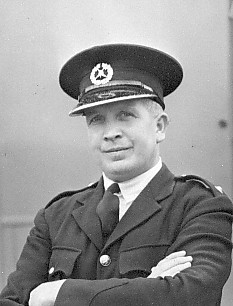
2nd Officer Albert Wilkins, Burghfield - My Dad.
I was five when war was declared and listened to the radio with my parents who were very solemn. Before moving to Earley in 1939, my father had been training for the Auxiliary Fire Service at Winnersh, Berks under a new act which made county boroughs and districts responsible for local defence, including fire services. By September, he was one of about 15 local men, now part of the AFS - volunteers in their spare time.Wokingham Rural District Council hired premises at the Winnersh Cross Roads garage for the fire station, at a cost of 10s per week. The cost of heating and lighting would rank for an Exchequer grant
Most of 1939 was taken up by exercises, and in 1940, some incendiary bombs did fall in the area. By 1941, the Winnersh AFS had attended fires in London, Portsmouth and Birmingham. My father was at the London docks for several days, and when he finally came home, we did not recognise him! He was completely black, and mother had to soak off his helmet which had stuck to his head.We were very relieved to see him.
We had evacuees, and one lady and her son stayed for some time. Her husband was in the Royal Navy, so we all listened to the radio very carefully. He did survive the war, and later was Lieut-Commander on HMS Vanguard when the King, Queen and the Princesses sailed to South Africa
As the councils organised their own fire brigades problems arose with equipment, and with no sign of the war ending, the Home Secretary established the National Fire Service (NFS) in May 1941. By Septenber, the AFS had disbanded and members went their various ways. My father was over the enlistment age, and was offered and accepted the post of Second Officer in the fire brigade at the Ordnance Factory at Burghfield
We had to let our house at Earley, and moved to a bungalow on the outskirts of the factory site. He worked a shift rota but was on call 24 hrs a day.There was a bell in the hall for when he was needed - no phones then! It was all very secret and instilled in me that I must not mention the factory, where it was, or shine any light that might be visible. 70 years later, I still cannot shine a torch upwards!
The clay soil did not suit me, and I had much time off school. It was hard for my parents as each visit from the doctor cost 5s. plus the cost of medicine. We often had the doctor from Queen Wilhemina's household, who helped our local doctor - the Queen was at Mortimer during the war. Once when I was ill in bed, a German plane flew so low over our bungalow that we could see the pilot in his cabin. Later in the war Italian prisoners worked in the field across the road. They waved, but we were not allowed to wave back.
My father would have liked to stay on at the factory after the war, but felt my health more important,
I wish he had been able to stay - it was something he really enjoyed,
© Copyright of content contributed to this Archive rests with the author. Find out how you can use this.


 Recommended story
 Story with photo