

- Contributed by
- marchback
- People in story:
- James Badcock
- Location of story:
- Germany
- Background to story:
- Royal Air Force
- Article ID:
- A4520972
- Contributed on:
- 22 July 2005
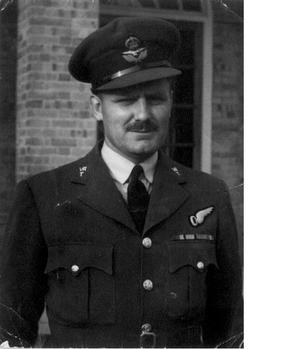
James Badcock
Chapter Six
As we left the bathhouse we spotted three young Germans wandering round as if lost. They were, in common with most of the others we had seen, indescribably dirty. They were all dressed in the uniform of the Wehrmacht, complete with greatcoats, which were many sizes too big for them. They were obviously very young - just kids in fact and I noticed one of them - the biggest - was limping rather badly. We called them over and they came, stood before us, saluted and waited. That they were scared stiff was obvious. I suspected that they were on the run and had got into the back of the camp by mistake. We spoke to them and told them we were not going to shoot them. We offered them a bar of chocolate each and this did the trick - we could have been their friends for life. We then got their story.
The youngest was just over 15 (or so he said but I thought he was a jolly small boy for 15) and he had been in the army for 6 weeks he had seen some action, mostly on anti-aircraft guns I think, but certainly wouldn't have frightened many of the enemies of the Reich. He was dirty, hungry and should have been at home running errands for his mother.
The second professed to being 16 and said he had been in the Wehrmacht for nearly a year. He had been in the infantry and seemed to have been on the retreat most of the time - he still didn’t seem to know what it was all about.
The eldest of the trio was nearly 17. He had been a soldier for 18 months and had actually been in action on the Ost front against the Russians. He was far more wary than the other two and it took us longer to break him down. We had a look at his leg. He had a nasty wound which was covered by a dirty dressing and obviously needed treatment. He said he had been shot, but I doubted this - it looked more like a very bad cut inflicted by barbed wire or something of that nature. Anyway, it was a nasty angry-looking wound. We told him we were taking him to the Revier so that the Doctor could see his leg. He seemed terrified. We assured him nobody was going to hurt him and in order to placate him we said we would take all three down to the Revier - I thought it wouldn’t do the other two any harm to have a Doctor run them over as, goodness knows, how long they had been on the run - they were certainly underfed. What a tragedy. Three kids who ought to have been doing their homework -fully-fledged 'soldaten' it showed the awful depths that the Nazis had reached.
We handed the three kids over to the medical authorities and whilst we were at the Revier I asked permission to visit one or two of our chaps who were still seriously ill. Normally we didn’t go into the Revier any more than was necessary because the staff were so busy with all the sick they had to attend to that we would have been in the way. However, whilst we were there we thought we would make the most of it. I spoke to one or two who I knew quite well, answered a few eager questions about when were we moving out etc and then came across two chaps, both aircrew, who I had known very well indeed and who had both been with me since my very early days in captivity.
The first was a young Canadian wireless operator, who I still call Danny. He had always been in my barrack, and was a really nice kid. He had been taken prisoner when he was shot down on his first operational mission - shortly after his 18th birthday. He had adapted very well to Stalag life and was very popular. He had been taken ill some days before we finished the march but we had managed to get him into the camp. He had been in the Revier since we arrived It was obvious that he was desperately ill but I think he recognised me, As I was talking to him one of the Orderlies gave me the thumbs down sign so I knew Danny was pretty bad.
I left Danny and went on to see Jock, a Scots navigator, who I first met when we were in solitary in the cells at Amsterdam SS gaol - we had both been captured on the same day. He had been a fitness fanatic whilst he was in the Stalag - a finely built chap, a little on the slim side, who really looked after himself. He didn’t smoke or drink any of the 'jungle juice' we produced from time to time. He certainly looked a bit better than Danny did, even so, it was obvious that he was very ill. He recognised me, alright, and I sat and talked to him for a bit. We talked of going home and I pulled his leg, and reminded him he had got to get out when I did because we had both got in together and had been through the lot together. Although he was so very weak, he was quite cheerful and I promised to drop in and see him again. I was glad I did - I was unable to see Danny any more because he died that same evening - just about 21 years of age, thousands of miles from the home he loved - killed not by a bullet or in a crash, as you would expect an airman to die, but killed by a nasty little germ called dysentery. I went in to see Jock on the Saturday, to tell him we were going home on Sunday or Monday. He didn’t seem to be much better and was just like a skeleton lying on that hospital bed. He was fully conscious, however, and quite cheerful when I left him. He died on the Sunday - the next day we came home.
Truly the war is not over when the shooting stops and there are many other ways of dying besides stopping a bullet. Ways which are slow and much more painful - in these two cases and many more like them, which need never have happened. Both those boys could have been saved with proper medical treatment when they were first ill - but this had been denied to them by our brave Nazi captors.
There was really only one more outstanding event - apart from our actual journey home - and that was the visit of a broadcasting unit from the BBC who came into the camp one morning. I remember that the commentator, or interviewer, was Bobby Reid who I have listened to many times since. He talked to several of us and finally asked one of the padres and myself to record our messages, along with one of the Yanks. This we did. The incident had an amazing sequel. Apparently about a week later, on the very night I reached England, the BBC broadcasted the recording. Apparently the BBC, in their wisdom, decided to cut the recording and all they put out was a short message from Bobbie Reid and what the padre said. The rest of us they cut out. The padre's contribution was a particularly harrowing tale of what he had seen in the camp. (he was NOT on the march with us - I don’t think he was even a POW) and of the terrible conditions we were in. He mentioned that most of us were people who had been on the forced march. My wife was listening to the broadcast - she knew I had been marching but had no idea where I was - it must have been pretty upsetting and if the BBC had only broadcast the complete tape she would have, at least known I was alright. However, after a miserable night - she heard my sweet melodious voice the very next morning, when I telephoned her from London.
Arrangements were now well in hand to evacuate us and on the Friday we were told we were being taken out on the following Sunday. It was quite some task as there were some 1377 Britishers (including 35 chronically sick men) and about the same number of Americans. Around 3000.men take some transportation and we were still quite close to the front line. On Saturday evening we had a setback - we were told they could not move us out until the Monday, owing to lack of transport. The French were to go the next day (Tuesday). However, we managed to stifle our disappointment - after all just one day didn’t make all that difference and we would rather be safe than sorry.
We spent the Sunday clearing up all our kit etc. and leaving anything we didn’t want for the Russkis. We also managed to go through the de-louser, just as a precaution. We tied up the final details at H/Q and had all the transport lists ready for an early start.
On the Monday morning - 9 April l945 - we were all up with the lark. It was the only morning in all my time as a Barrack Commander and then as a Compound Commander, that I had no trouble in getting everybody out. We all had a good breakfast i.e. those of us who could eat through the excitement and were paraded all ready for departure at 06.45 hours - we were scheduled to start at 07.00 hours and we had visions of lunch in England. 07.00 came and went, so do 07.30 but still no transport. You can imagine the situation - gloom and despondency growing deeper every minute, questions from all sides. The delay gave me the chance to go back to my old barrack to get my greatcoat which I had forgotten and the weather had turned much colder. We had left all the barracks scrupulously clean with all the stuff we had to give the Russians neatly stacked on the bunks. That was less than an hour before. When I went into the barracks I was astounded. There were Russkis everywhere, that wasn’t very surprising they were prize scavengers - but what shocked me was the state of the barracks. Instead of just taking the stuff we had left our Eastern allies had just plundered the whole compound - fittings had been ripped from the walls, tables overturned, and the whole place was a shambles. Needless to say I did not find my greatcoat.
However, at around 08.00 hours our troubles were eased - the transports began to arrive. I had 1341 bodies to get loaded on to the trucks (and that little lot took 51 trucks) and 35 seriously ill men plus an orderly to go by ambulance. Fortunately, everybody was sensible and all filed quietly, if somewhat eagerly, on to the trucks, as their names and numbers were called. I said goodbye to Major Morton and my other American friends and at last we were on our way. As we reached the first village we saw the first signs of war - a disabled Nazi tank at the entrance to the village - and all the bedroom windows festooned with white sheets.
Hereabouts began one of the most hectic journeys of my life. I thought there was a bit of a thrill to be had in flying a bomber on operations, what with the night fighter and the flak, but that had nothing to compare with the thrills(?) of speeding down an autobahn in an American army truck with a negro driver as the 'jockey'. I was riding in the cab so I could see what was going on - and I was terrified so goodness knows what the chaps were like who were in the back of the truck and couldn’t see anything. On second thoughts perhaps they were better off - they could only feel the sensation - I could see it as well. I know Hitler built the autobahns so that aircraft could land on them - I am sure our driver was determined to prove that you could also take off from them - in an Army truck. Mind you, the driver was a cheerful soul - he entertained us with some beautiful singing, - the way he drove I consider we were very lucky not to have ended up hearing the angels singing, let alone him. I had never had an experience to compare with it - and I certainly haven't had one since - thank goodness.
We stopped a couple of times to find out where we had to go - nobody seemed to be too certain. That at least gave us a chance to get our breath back. As regards our eventual destination I would not have been at all surprised if we had gone right through the German lines and landed up in Berlin. Eventually, we arrived at a place where there was an array of huge marquees. We were puzzled - it did not look like an airfield - it wasn’t - it was a Field Hospital. In each marquee there were rows and rows of beds - all fortunately empty. An American doctor told me they had expected heavy casualties as the 3rd Army pushed forward. Fortunately, the Jerry had not stopped to fight so the beds weren't needed.
After a stop of an hour or so, during which time the transport people finally found out where the British contingent were to go, we were on the road again. After another hectic ride we eventually turned into what must necessarily be described as an airfield - though goodness knows why! It was dreadful. I couldn’t see how even a small plane could get down on it. However, to our delight there was the RAF - all ready and waiting. It was the first time I had seen the famous Douglas DC-3 - the Dakota. There was a very good type acting as Air Transport Officer - a Squadron Leader. He was anxious to get cracking as it was now evening and he wanted all the aircraft off the deck before dark. - I couldn't blame him, really, I wouldn’t have liked to try to take off in broad daylight with no wind or other hazards. I told him how many men we had got and here came the bad news. To cater for all that lot we needed 56 aircraft. He had got only 51. Under safety regulations he dare not put any more bodies on any one aircraft than 25. As the evening was closing in it meant the aircraft could not make return trips. There was only one thing for it - some of us would have to wait (it turned out to be 117 in all).
© Copyright of content contributed to this Archive rests with the author. Find out how you can use this.


 Recommended story
 Story with photo