

- Contributed by
- Jillleyland
- People in story:
- Hilary Travers Burges, Marjorie Nicholson
- Location of story:
- Exeter and Bath
- Background to story:
- Civilian Force
- Article ID:
- A8156171
- Contributed on:
- 31 December 2005
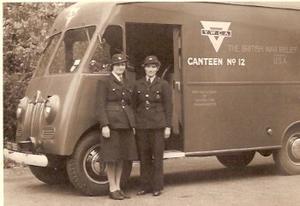
The Mobile Canteen in the story. My mother is on the left and I think the other person would have been her colleague, Marjorie, Nicholson, mentioned in the story.
This story was written by my mother, Hilary Burges, a Civil Defence Ambulance Driver, just after the trip she described when she and a colleague took a mobile canteen to Exeter and Bath to provide food and drink to those affected by the bombing. She left these papers to me after her death and I have rekeyed the story exactly as she wrote it.
MOBILE CANTEEN
2nd May 1942
Marjorie Nicholson and I — both Civil Defence Ambulance Drivers — were delighted when we were asked to take a Y.W.C.A. Mobile Canteen-Kitchen to Exeter last Sunday evening. The Canteen is a 30 h.p. Ford Van Ette, the gift of the Citizens of Greater Lynn, Massachusetts, U.S.A. It is a lovely vehicle, complete with oil-cooker, sink, draining-board, water tank, cupboards, etc. and has a left-hand drive. It looks enormous but is remarkably easy to drive and handle.
Before leaving Bristol we loaded up with stores at the Y.M.C.A. depot at Colston Street. Shortly before dusk we reached Northbrook House, a Hostel on the Southern outskirts of Exeter, and reported to Mr. Downe, the Reinforcement Officer. He is responsible for the housing and feeding of all reinforcements that are summoned to Exeter, and also for the Mobile Canteen Service, and his organization is beyond praise. He told us not to go out until 7.30 a.m. the following morning, unless there were a raid during the night.
The Women’s sleeping quarters were furnished with bunks and thick, comfortable mattresses, blankets, pillows and pillow-cases. There was also a bathroom with a supply of clean bath-towels and constant hot water. Before turning in we were given a supper of bread-and-butter and cheese, tinned pears and pineapple and cocoa. As we had quite expected to have to “kip down” in some hall or shed, or even sleep in our Canteen, it was a pleasant surprise and relief to find such good food and accommodation.
Next morning we got up at 6.15, and after a breakfast consisting of bacon and sausages, bread-and-butter, marmalade and tea started off according to Schedule, guided by an A.R.P. messenger on a motor-bike.
We visited many different streets which had been bombed, where Demolition Men or Soldiers were clearing away the rubble, and in some cases still digging for bodies. The population came crowding round the Canteen; in many streets there was no gas and hot tea was much in demand. Food and drink and cigarettes were all given away. With a gap for filling up with petrol this went on until about 3 o’clock, when we went to the Central Kitchen to replenish our food and tea. Mr. Downe was there when we arrived and introduced us to the lady in charge, Miss Adams.
Halfway through the morning our motor-cyclist guide had been replaced by Bob, a 6ft. 16 year old Polytechnic schoolboy. Said school, originally evacuated from Peckham, had been temporarily closed and the pupils were doing useful work for the City in innumerable ways. John, a school mate of Bob’s, helped us to reload our van. He was full of admiration for it; “My word, Bob is lucky to get a job on a Mobile!” he exclaimed.
We did not have to start off on our next round for another hour, so wandered about the town and had tea at Deller’s. We were fortunate enough to be able to buy some face powder. Marjorie had come without any and I only had very little in my flapjack (powder compact).
Then we returned to our Canteen and started off on our next round. In one badly bombed street the Mayor, Mayoress and the Town Clerk came up to us and had tea and biscuits. They thanked us profusely for the work we were doing and were full of admiration for our Vehicle. In fact our Van soon became very well-known in Exeter and was referred to as the “Streamlined American Canteen”.
Back to Northbrook to refill and this time we took cocoa instead of tea. Before we started off another Polytechnic schoolboy came to us and announced that he was to be our guide. (Mr. Downe had arranged for four of them to sleep at Northbrook, Bob was in digs in the town itself.) Our new guide was called Denis and wore Air Training Corps Uniform, he was about a year younger than Bob. When the latter heard that Denis was to supersede him there was almost bloodshed, “If you pinch my job, I’ll lay you out!” he cried. Marjorie, with great presence of mind, sent them to Mr Downe, saying that it was nothing to do with us. Finally both came with us and we were to drop Bob in the town. With both of them in the Canteen the atmosphere was tense, jealous possessive male wasn’t in it and we quite expected a fight to break out any moment. Bob stayed with us until our round had finished, and we heard that his landlady had hectically rung up everywhere to try to find out where he was. She said that she had heard that he was out with a Canteen with some ladies and was told that as long as they were ladies he would be all right!
This was not such a big round as many people had left to sleep outside the city. However business was brisk when we met a company of Home Guards, who had just been dismissed after working hard clearing away ruined buildings. It was dark by the time we returned to Northbrook. Helped by the Polytechnic boys we unloaded our Van and swept it out. We had a good supper consisting of cold meat and salad, tinned pears and pineapple, bread-and-butter and cheese and tea. Then a hot bath and so to bed.
For Tuesday, Mr Downe had things organized slightly differently. All the Mobile canteens were to be stocked and dispatched from Northbrook and there were to be three or four rounds each day, starting at 7.30 a.m., 12.30 p.m., 4.30 p.m. and if necessary 7.30 p.m. We were given a district a list of damaged streets and told to reconnoitre.
That day we kept hard at it, though I must confess that as we did not have to fill up with petrol we found time for some coffee at Deller’s in the middle of the morning. We did not have to do the evening round, and finished up about 8.30 p.m. Supper was not until 10 o’clock, and while Marjorie wrote letters, I strolled about the park and garden. Northbrook estate is between 60 and 70 acres, part of it has been developed, but there is still a large park with a salmon river running through it.
Mr. Downe was very pleased with our commodious Canteen; he kept careful records of everything taken out and apparently we visited more streets and disposed of more food and drink than any other Mobile Canteen. He kept on praising it, and added that the personality behind it also helped! The food we took out consisted of sandwiches, pies or sausages or Cornish pasties, cakes, biscuits, cheese and on one occasion bread-and-butter pudding.
At this point I must digress a little and say rather more about Mr. Downe. He was a born Organizer and thought of every smallest detail, did lots of the donkey work himself and it was positively uncanny how he always seemed to be wherever he was wanted. On one occasion when we wanted to telephone him Marjorie went into the Central Kitchen to do so and found that he was already on the other end of the ‘phone talking to Miss Adams. He had not slept properly for many days and merely managed to snatch a few hours rest on the couch in his office. In spite of his many responsibilities he thought of every little detail that would add to our comfort. For instance when we arrived there was no mirror in the Women’s Quarters, but on returning to Northbrook on Monday evening we found that one had been put in our bathroom. When we told him that a fairy had remedied our one small need, he admitted that he had made a tour of the building to make sure for himself that everything was all right, and had noticed that deficiency.
To return to our Canteen. Both Bob and Denis were nice lads, intelligent and quick in the uptake. Marjorie and I bullied them rather and kept them up to scratch, opening up and closing down the Van, pouring out the tea, washing up and fetching and carrying for us. On one occasion Bob filled our water tank with cold instead of hot water, so we made him do all the washing up on that trip “to teach him to think!” Denis always referred to his forage cap as “me topper”. He was terribly proud of being seen by his schoolfellows driving about in the Canteen. Once one called out to him, “Hullo, Denis, are you in charge of this outfit?” He replied in the affirmative. It was a great moment in his life when once or twice Marjorie and I let him do the serving, and we ourselves stayed in the background doing the chores. I feel sure that Peckham Polytechnic will not be allowed to forget that in a hurry.
Wednesday was much the same as Tuesday, except that by then we knew our way about sufficiently well to dispense with our guide and did not have time for elevencies or tea at Dellers. We also had a “suicide squad” (Bomb Disposal Squad) added to our clientele, by far and away the most cheerful lot of customers we had. I suppose it is childish, but it is pleasant to drive down a street marked “Road Closed”.
This account would not be complete without a description of Pop, a very fat, elderly Demolition Worker with steel-rimmed spectacles, dressed in a dark blue coat and trousers, grey pullover and a bowler hat. He waddled along rather slowly, was rather deaf and kept himself to himself, always retiring to his own private heap of rubble on which he sat to eat and drink — slightly turning his back on his mates as he did so. When he brought back his cup on Wednesday evening he remarked to Marjorie, “I know you and you know me,” and helped himself to a second cigarette.
Thursday morning disappointment awaited us. We were told that at midnight there had been a telephone call as from the Regional Commissioner’s office at Bristol, telling us to return as the Canteen was needed at Bath.
We were sad at leaving Exeter, a city whose inhabitants had all been so kind, helpful and hospitable to us, and where some policemen signalled us on against the traffic lights.
At Bath we reported to the Y.M.C.A. Mobile Canteen Depôt, a large yard off Charlotte Street, and as Marjorie had an Uncle living at Batheaston from whom we could get hot water for our urns, it was arranged that we should do night work.
We collected our sandwiches; to make these the paste and margarine were mixed up together, spread thickly on one piece of bread and not at all on the other. This method saved much time. Covered with a damp cloth they kept very fresh.
During the afternoon we eased off and at 7.45 started for the junction of the London-Bradford roads. It was a bus terminus, and people were streaming out of the city to spend the night in the various rest centres or even in the woods. We were kept busy for a couple of hours and then drove on to a wood where we had heard that people were sleeping. They flocked round the Canteen and it was getting on for midnight before we got back to Batheaston.
Next morning we were back at the same road junction before 6 o’clock. It was bitterly cold, the ground was covered with frost and there was ice on the chickens’ drinking water. The sight of so many homeless people, many carrying babies or bundles of bedding, waiting patiently for the bus, was pathetic. Our first customer was a man who had carried his 3 year old daughter a mile. We made them sit inside the canteen while they ate and drank. He had lost his home and had to be at work by 7 a.m. During the day he left his little girl with friends and each night took her out to the country to sleep.
One woman told us she had lost her husband, a merchant seaman whose ship was among the first to be sunk in convoy, had been bombed out of her London home and subsequently gone to live with her sister in Plymouth. She was bombed out of Plymouth and went to her married daughter’s at Bristol, but again was bombed out. She then went to Bath only to be bombed out a fourth time. In spite of everything she was bright and cheerful.
When the flow of people returning to Bath ceased we went back to Marjorie’s Uncle’s house, and had baths and breakfast. After that we drove to the Mobile Canteen Depôt and were told to return to Bristol.
It had been a grand trip and we both felt we had done worthwhile work, although I must confess that it was pleasant driving about in such a conspicuous Canteen.
Hilary T. Burges
© Copyright of content contributed to this Archive rests with the author. Find out how you can use this.


 Recommended story
 Story with photo