

- Contributed by
- actiondesksheffield
- People in story:
- See Part One
- Location of story:
- South Atlantic Station 1939-41
- Background to story:
- Royal Navy
- Article ID:
- A5409371
- Contributed on:
- 31 August 2005
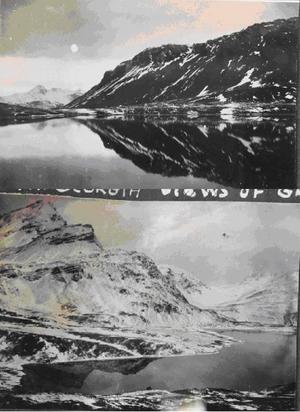
Grytviken, Island of S, Georgia.
This story was submitted to the People’s War site by Bill Ross of the ‘Action Desk — Sheffield’ Team on behalf of Brian Armstrong, and has been added to the site with his permission. Mr. Armstrong fully understands the site's terms and conditions.
================================================
We arrived at Port Stanley on Thursday 16th January and settled down to some ease. We might have known better as there was no peace for anyone. What with two lieuts. on board all the time and an officer ashore in charge of the patrol each night, it gave us each one clear night ashore. Still it was a break. On Sunday night the fun started. All night leave was suddenly cancelled. The patrol rounded everyone up, ships orders had been changed and we were off, very much so. Early on Monday 20th we sailed for South Georgia. A raider had worked in amongst the whaling fleet and we were to go down south and find out what was what.
Arriving at Grytviken in the Island of S. Georgia, 48 hours after leaving Stanley, we collected what information there was to be had. Embarked a Norwegian skipper from the whale catcher who had sighted the raider and pushed off for the whaling grounds in the South Orkneys for a start. S. Georgia was quite a sight. Glaciers and snow covered peaks and all the trimmings that go with that climate. It was quite an experience to even sight the island, and to make the port of Grytviken too was a thrill.
We found the whale factory there and didn't she stink? They were very pleased to see us though and I collected a couple of very fine whale's teeth as a souvenir. Our stay was short as we had to get down to the whaling grounds with speed, at the same time escorting an Argentine supply ship to South Orkneys. The Queen of Bermuda will certainly break records this trip. I'm sure she's the biggest ship to enter South Georgia and she'll certainly be the biggest ship to enter the Antarctic Circle. There were lots of fun and games. Everyone seems much more cheerful since the spell at Stanley. People are not so irritable, even the old man is shedding a little charm; still that doesn't cost him anything.
At the moment (23.1.41) we are heading south, convoying the supply ship and all being well, we should reach the So. Orkneys on Saturday morning, a 48 hour run if there is no fog or snow. What a difference from the tropical skies of a few days back.
Friday 24th Jan bound SSW towards the So. Orkneys and going along steadily at about eleven knots with the weather getting cooler and plenty of ice about. At 15.30, a message was received from Grytviken that a strange ship was entering the harbour and it was suspected that this might be the raider. So we left our charge and turned back at full speed. The first time that the ship has been on full speed since we left England. The question is now; is it the raider? We will know something about it by breakfast time in the morning at the latest. The old box is rolling along merrily now, creaking in all her joints and making a good effort to make the land at daylight. The weather is right for that too.
Our party did not materialize after all. We crashed back at about 19 knots and closed up at action stations at 4 pm in very doubtful visibility; very trying. Luckily however the weather cleared as we approached the coast and nothing was sighted. Coming up towards Grytvicken, the weather again shut in and we finally crawled into the harbour ready for anything, but it was a complete flop.
11am saw us in the harbour in the clear and it was just as we'd left it. No sign of the raider or anything else, so why the alarm was given no one knows Still there it was and at 1pm, we pushed off again back to the southward and out to catch our pal who is some 500 miles ahead by this time. I hope we lose the fog when we get a bit further to the southward. It's most unpleasant now.
Thursday Jan.30th After an uneventful voyage back to the southward, apart from the usual run of icebergs and other Antarctic exhibitions, the first thrill was picking up the South Orkneys on the afternoon of Monday 27th, a very bleak, desolate and barren group of islands consisting of black rocks and glaciers. We expected to meet some of the whaling fleet there, but were disappointed. Sailing in to some of the large bays there, we saw no trace of whale factories or supply ships, but had a marvelous view and scratched around amongst a lot of heavy ice. We spent the night dodging along the coast and resumed our voyage to the southward the next day, and eventually sighted what proved to be the "Southern Empress" on Wednesday morning. She was in company with her supply ship which we had previously escorted. They were delighted to see us and we made our first close acquaintance with the "Blue Whale". There was quite a gathering what with whale catchers and what not. The factory had a wire round her propeller, so we remained with her until it was cleared, then in the afternoon, carried on to the westward in hopes of picking up another factory. This we failed to do as she had shifted her position, but by carrying out a search, we eventually located both factories in a much more southerly position. At the time of writing we are all dodging around so what will happen in the next hour or two remains to be seen. The expert view is that we will shift billet to another whaling ground where conditions are reputed to be better, however that will come in time. Today has been wonderfully fine. According to our Norwegian whaler the temperature remains low however and that’s the chief snag.
This evening (still Jan 30th), I made a trip over to the whale factory "Svend Foyn". It had its funny side. I met the Captain, Chief Officer and Chief Engineer. When we just came in sight they were very doubtful of our good intentions and when the first whaler, in which I made the trip was coming alongside, they thought that the number of officers coming over looked rather ominous. Thus when one of our lifeboats left with 50 or 60 hands they were quite resigned to capture or anything, as even if they overpowered the supposed or presumed enemies, the ship could still blow them out of the water. However on our arrival, they were greatly relieved to find it was the British Navy which had arrived and not someone else.
After yarning for a while up in the Captain's quarters I asked the Chief Officer if he'd mind us having a quick look round the ship just to see what was doing. He replied that there was nothing doing at the moment as his ship's company were so relieved to find we were real friends, that the crew had all ceased work and were showing our fellows all round the factory. It certainly was a funny reaction as most of the factory crew were Norwegian and definitely uneasy at the situation that had brought us to the to the Southward for whale factory protection, and our arrival had made them much more confident, so back to work they went with a will, and the next three days were spent dodging between the "Southern Empress" and "Svend Foyn" with a trip to the southward to investigate the pack ice on the Barrier.
Monday Feb. 3rd, a fortnight away from Port Stanley this morning and a week in the ice. The routine seems to vary like the weather. I've never seen so many changes in a day as we get here. The wind will go all round the compass in 24 hours. At the moment we are playing with the "Southern Empress" and "Ernesto Tornquist", but I hear that we go off and have a look at the "Svend Foyn" tomorrow if the weather is fine. What with snow and fog and wind all in rotation it's not a dull job keeping tabs on the whalers but it must be a lousy job working in them in all weathers. Somehow I don't think I'd care for the job; much too messy and smelly. We got a few whiffs of the Empress today and she's pretty ripe. Perhaps they get used to it on board but it must take a long time.
Friday Feb. 7th, We spent some hours alongside the Southern Empress yesterday for oil fuel and stores. She was a stinking object with her decks streaming blood. Still apart from the awful stench, the experience was interesting, watching the whales being hauled on board and scientifically cut up; yesterday was her biggest day. She dealt with 31 whales in the 24 hours. Not bad going .It was quite a sight to see the two ships alongside and to watch the performance.
Today we came along and played with Svend Foyn and had a look at the big berg that forms her breakwater. It is a monster, some 7½ miles long and a typical S. Atlantic flat topped berg. A party went off in the afternoon to have a look and take some pictures. I hope they are good. The light was all right for photos.
Sunday Feb. 23rd. Got the news today that we are down here till the middle of April. It was originally the 7th March but orders have come through that the season has to be extended and some stores are being sent down. We are getting pretty low all round just now and unless we get something soon we'll be very much in the hole. The last fortnight has been spent between the two ships. Southern Empress and Svend Foyn.
At present we are down at the edge of the ice with Svend Foyn and we are to take water from her in a day or so. It's very cold and I suppose it will get colder as time goes on. By the middle of April we'll be having more darkness than daylight. It's remarkable how the nights are lengthening even now. When we came down first there was no real darkness, just twilight which lasted about 4 hours. Now it's dark about 9pm and doesn't get light till 4 am; quite a difference.
We did a shoot the other day, which wasn't so bad considering it wasn't exactly the same as a tropical one, we used an iceberg as a target and succeeded in knocking a few chips off it. I believe the weather gets a bit better in March. I hope so as the last fortnight has been more bad weather that good. We've had one good blow and lots of fog. Still as most of the time is spent off a factory ship it's not too bad, but it's a very different job further north. We'll probably hold the record for a spell at sea after this little lot - eleven weeks.
Saturday March 1st, today has been the coldest we have had in the ice; temp 10°F. We met Thorshammer today and took oil and water from her. The latest reports are that we return to the Falkland Islands via Deception Island, where we have some demolition to do. That ought to be interesting and very much out of the ordinary.
Tuesday March 4th, we arrived off the island yesterday afternoon but it was blowing too hard to make an entrance to the harbour. After beating up and down outside all last night, we made a burst and got through into the anchorage. The entrance is tricky as it is very narrow and there is a reef which extends half way across and there is always half a gale blowing in it so the passage has to be taken at speed. The entrance is called Neptune's Bellows!! Once inside there is plenty of room and very deep water. Deception is volcanic and the whole island is covered with lava dust. There isn't a scrap of vegetation to be seen anywhere and comparatively little snow in view of that or the surrounding islands.
The island is roughly horseshoe shape and the whaling station, which we had to put out of action, was just inside the entrance.
So far as we could gather, the place was abandoned some eight years ago and was last visited by Discovery ll in 1938, and apart from the natural rot due to machinery being left unused and exposed, the plant seemed to be in very good condition. The living quarters were very fine indeed and no sign of dust in the huts, which had been exposed to the weather due to broken windows etc.
There was a vast quantity of valuable stuff lying around. Hundreds of tons of metal that had never been used. There is a small fortune waiting to be picked up by anyone willing to send a ship down there. Much of the machinery had never been used and there were large numbers of spares. However we blew up the main parts and put the whole plant out of action.
When it was in operation it must have been a very well equipped station indeed but in a most depressing locality. There seems to be half a gale most of the time. We commenced our operations after breakfast and the job was completed by 4 pm. A few souvenirs were brought off and everyone was more or less satisfied. Had the weather been better and the ship not in such a hurry to get to the Falklands, we could have collected a lot of loot, but taking everything into consideration we did quite well.
We arrived at Stanley on Saturday March 8th. and proceeded to oil and store right away. Our future movements are uncertain. No one knows yet where we go from here but it is generally expected that we will return to the Antarctic for the rest of the whaling season. That will be pretty chilly I should think.
================================================
Continued in part six: A5409443
Pr-BR
© Copyright of content contributed to this Archive rests with the author. Find out how you can use this.


 Recommended story
 Story with photo