

- Contributed by
- Rickoh
- People in story:
- Robert George McArthur (Sergeant) / Elisabeth (Ibby) McArthur
- Location of story:
- England, Canada, Northern Ireland, Iceland.
- Background to story:
- Royal Air Force
- Article ID:
- A8947164
- Contributed on:
- 29 January 2006
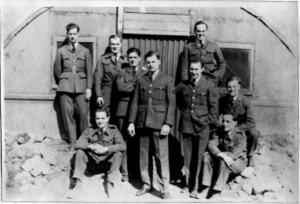
Dressed in our best — ready for home.
And next day I entrained and enboated for the sunny shores of Northern Ireland, in fact, Aldergrove, where the squadron had moved on 6th May 1943, and it rained and it rained and it rained. Later on that year I saw that someone had painted on a hangar door, "We had Summer, last Thursday!" So I reported to the Guard Room and was directed to a leaky shed some distance away where I collected my (very wet) blankets and went to my designated billet or hut. As a newcomer you were always allotted the privilege of sleeping in the bed furthest away from the central stove which, as all who served at that time will know, was the social and sometimes the spiritual centre of our world. The ceiling above was hung with our washing and our wet clothing, our boots steamed happily round its base, and the hut storyteller was usually to be found telling tall and usually unrepeatable anecdotes while some, if not all, played imaginary fiddles in the background to indicate he was being somewhat economic with the truth (to echo a later phrase). The next day I reported to Squadron headquarters and was allocated my station bicycle. This, I believe, might have been an armourer' s privilege as the armoury and bomb dump was at the other side of the aerodrome. It was always thus. The general consensus of opinion was that we were a lot of loonies who might blow things up at any moment and the further away the better. Sometimes I thought they were right.
When I arrived at the armoury, l reported to a singularly unpleasant corporal who seemed to be in charge and was told to join a bombing-up party that was just about to fix eight 250lb depth charges to a Coastal Command Consolidated Liberator. This, I thought, was where I should see in action one of the specially-designed hoists we had been shown in training school and I looked forward to seeing the expertise with which it would be deployed. The tractor arrived carrying the depth charges and someone shouted "Hop on, Mac. (I was fortunate in my surname as it abbreviated neatly, and I was spared the indignity of being "Tosh" or "Smudger" or "Dusty" or, even worse, a nickname which referred to some sexual organ or practice.) So, on I hopped and clinging happily to a handy depth charge we careered round the aerodrome to where V for Victor stood waiting, bomb doors open. We stuttered to a halt, disconnected the bomb trolley and wheeled it under the aircraft, "Now for the winch", I thought. Two men wrapped their arms around the-nose and tail of the bomb and lifted it off the trolley. They staggered to the bomb bay where Jack, a tough former steelworker crouched low. "Hup" they said and lifted the depth charge on to Jack's shoulders. He slowly straightened his legs and the bomb rose to where its hooks awaited. One, or was it two, clicks and the bomb was fixed. And soon were the other seven. No-one echoed Punch's words and said "And that's the way to do it!" but long practice had made any sort of machinery redundant. In time, I was allowed to take my place as the lifter, a fact I strangely remembered many years later when I was recovering from a hernia operation and a young and rather lovely female therapist was instructing me on how I should lift heavy objects.
And so the days passed. We bombed up, we debombed; we stripped and cleaned the guns; we rearmed the planes with varied coloured ammunition red for tracer, blue for armour piercing, etc; we cursed the aircrews when they had shot away all their ammunition in practice flights over Loch Neagh for the guns had to be completely stripped down and cleaned; we did daily inspections on all the aircraft, except when a white screen was around the nose of the plane. We were kept well away from the planes which were thus shrouded while a fitter, usually from the Royal Canadian Air Force, worked inside the plane. Our Liberators were unusual in that they had been stripped of the nose gun and the upper turret. In the upper turret position there was what appeared to be bomb-aiming equipment and the nose gun turret was blanked off with a white surround. Years later, I learned that this was the top-secret Radar installation installed on the long distance Liberators for use during their 15-hour anti U-boat patrols in the Bay of Biscay and beyond.
And still it rained. Life was becoming routine and tedious when I discovered that there was a Station Dramatic Society open to all. As I had acted a little pre-war in school plays and the Croydon Histrionic Society, I went along for an audition and was given a part in the next production, "The Two Mrs Carrolls". I can remember little of the part now, (some of those who have been unfortunate to be on the stage with me would say "T'was ever thus") but it provided a useful antidote to the weather. After that was the Christmas Pantomime, "Cinderella and the Ugly Squadron Leaders", and then the Society renamed itself and became a sort of revue called "The Blue Coastals". I wrote some words for a song or two and played various bits and pieces while the show revolved around a Sergeant from the Ops Room named Chilvers, a sort of actor-manager manqué.
"Resting" as they say between shows. I was sitting in the hut one day when an orderly from the Station Office came in and said "Telegram for you, Mac". It was from my mother-in-law, It said "Thank you for a baby grand-daughter born on my birthday January 13th". I applied for leave but had to wait several weeks before it was granted. I travelled home to Croydon, where lone German night raiders were still causing damage and anxiety, to discover my newly-born daughter rather small and rather wrinkly sheltering under a table in the shored-up hall, in which we had taken refuge from the nightly bombing raids during 1940 and 1941. Each night, the skies over Croydon were lit up by searchlights and anti-aircraft fire while the insistent drone of the night-bombers overhead hardly ceased. It brought back earlier memories to me of riding back on my bicycle from Ibby's house to my own and sheltering under the trees whenever an anti-aircraft shell burst overhead, hoping not to be hit by the shrapnel. This was before I Joined the RAF and my almost nightly journey home was spent wondering if that glow in the sky was my parent's home. I was, at that time, working in the City of London and can still remember crunching through the broken glass and seeing the burning buildings and the wreckage of the previous night's raid. Ibby' s mother was an Air-Raid Warden and only the other day, I rediscovered her Warden's book in which, amongst many other emergency procedures, she had noted how to seal a room against poison-gas attack. It may be difficult to believe now, but these were everyday matters to the people of Britain, who were almost equally concerned about the amount of the meat ration or whether to spend or save the clothing coupons.
So, with my leave nearly over, I was delighted to be told that Ibby had been offered a teaching post in a boarding school in Shropshire where she, her mother and Joan Margaret, my newly-born daughter, would be comparatively safe from the bombs and the other nightly perils.
I returned to Northern Ireland, but this time to Ballykelly near Limavary and Lough Foyle where some planes were on detachment. Here in 1944, I was to see some real fighting but this time it was between the newly-arrived Americans and the British sailors in Londonderry. You did not stay too late in the bars in those towns because at some time or another some disparaging remark would be made by one of our allies about the other, such as Brits saying "So what kept you?" or our allies saying "So you can't manage on your own?" and then you made for the doors or got under a table.
All leave was suspended at this time as preparations for D-Day took top priority. Eventually, the initial success of the invasion meant this rule was relaxed and I went off to Shropshire to see my wife and Jo. It was a halcyon time... for two days. Ever the proper airman, I had left the Shropshire school's address with the RAF in Northern Ireland. The telegram read "Return to your unit immediately” which like a good lad I did, and found I had been posted to Reykjavik in Iceland.
The British had invaded Iceland in May 1940 because it was seen as of strategic importance to convoys and later as a base for war against the U-boats. There had been little resistance and the Icelanders were asked to treat the invaders as visiting guests. Later in 1941 the Americans offered to take over control, an offer which Churchill gladly accepted.
It sounds cold and it was. The buildings in Reykjavik were heated by the water from the thermal springs and we were even allowed some of the plentiful hot water for washing and shaving in the buildings traditionally known as "the abberlootians". Tile huts were still heated by a central stove, however, and most nights men with their faces blacked would attempt to raid the central coal dump where convenient gaps in the wire had been made by successive raiders. There was, as always, great camaraderie in the huts and I cannot remember any serious disputes or fights taking place. We argued, of course, mostly about what would happen in Britain after the war, some prophesying a communist state with all power to the workers; some hoping there would be enough jobs for all; some hoping their kids would not have to go down the mines; some just wanting to go back to normal, and a particular friend of mine hoping to go back to his job in the Royal Observatory.
Shortly before falling off!
There were still guns to clean and bombs to tend, but this time wearing three pairs of gloves as any bare flesh instantly froze to the metal. I learnt to ski, not very well; played Rugby for the RAF on a ground with the thinnest layer of grass I have ever seen covering the bare rock; treated the Icelanders with care as they were still hostile to the invaders; visited Thingvettlir the earliest-known Parliament; threw the oblational bar of soap into the Great Geyser to make it spout; and waited for the European war to finish, which, as I said somewhat earlier, happened as I was filing away at a depth charge.
Then we started to clear up. Day after day we tipped ammunition and depth charges (carefully defused) into Reykjavik Harbour, burnt up as much of the coal as we could manage and waited for the boat home. It finally arrived and I remember sitting on deck in mid-ocean listening to the Tannoy broadcasting system. Something mysterious called Atom Bombs had been dropped in Japan on Nagasaki and then Hiroshima. The Japanese had sued for peace. It was over.
I returned to England and heard of a scheme called Educational and Vocational Training for which Instructors were wanted. I volunteered and on the course, for which we were sent to the extra-mural Department of Manchester University, I gave a talk for my test piece on Modern Poetry and wrote, as we were invited to do, a satirical poem about our lecturers. I felt I had really come home, and was delighted when I found I had passed, was now an EVT Instructor and had been immediately promoted to Sergeant!
I was posted to Melksham, put in charge of the Library, learnt the delights of the Sergeants' Mess, taught a number of cooks the basics of reading, took discussion groups on Britain after the war, and gave lectures on current affairs in the Camp Cinema. Fortunately, there were available some excellent booklets on these topics published by the Army Bureau of Current Affairs which provided much of my material.
Finally, I was de-mobbed in September 1946. I was kitted out in my civilian clothing, including a sports coat in a particularly violent shade of blue, which I wore with some pride until I saw two identical coats in Victoria Station. Not long after returning to civilian life, my wife, who was teaching in Mill Hill, asked her headmistress if she knew of any teaching vacancies locally. She told Ibby to talk to Arthur Roberts who was the headmaster of Belmont, the Preparatory School for Mill Hill School. Arthur, dear man, said “Send him along” and after the briefest of interviews I was engaged to teach English and Maths to the 9-13 year-old boys.
So, after three years at Mill Hill, I trained once again, but this time as a teacher. I was to spend the next 38 years teaching in one of the brave new towns built by the Government after the war. For 28 of those years I was a headteacher and so, I suppose, have influenced, for good or ill, many thousands of pupils. Shakespeare, who usually got it about right, wrote "There's a divinity which shapes our ends, Rough-hew them how we will". Perhaps teaching was always meant to be my destiny. I hope so!
© Copyright of content contributed to this Archive rests with the author. Find out how you can use this.


 Recommended story
 Story with photo