

- Contributed by
- Gordonleathers
- People in story:
- Lester Schrenk, 92nd bomb group 327 sqd
- Location of story:
- Poddington, Northamptonshire
- Background to story:
- Army
- Article ID:
- A8262164
- Contributed on:
- 04 January 2006
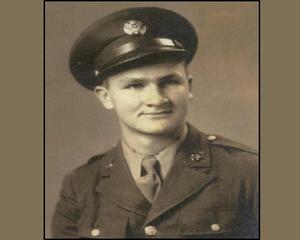
Lester Schrenk, 8th Air Force, 92nd Bomb Group, 327th Squadron, POW for 15 months.
My name is Gordon Leathers and I am Headteacher of Stoke Ash Community Primary School. Lester Schrenk is an 8th Air Force veteran. He has been invaluable to my school’s recent VE day project which commemorated the contribution the USA made towards the defeat of Nazi Germany in 1945. His story is quite amazing and his strength of character, determination and courage whilst held as a POW for 15 months perfectly illustrates how the strength of the human spirit can overcome devastating cruelty and maltreatment. Les has given me permission to publish part of his story. I have edited this article down from a 48 page testimony. He was based with the 92nd Bomb Group at Poddington, (now the Santa Pod race track).
The figures are staggering: on the ten missions flown by Lester Schrenk, 391 aircraft were lost. Seventy-six went down on that tenth mission alone. The odds against the B-17 crews were not in their favour! Quite a statistic for a 19-year-old fresh off a Minnesota farm to face.
The numbers continue to be astounding. After his interrogation at Dulag Luft, the German Intelligence Centre ten miles north of Frankfurt, he was one of 2,411 Army Air Force NCOs held in the three compounds of Stalag Luft VI near Heydekrug along the old Prussian-Lithuanian border.
When they left the camp on July 15, 1944, they were packed 76 to a boxcar that at best was designed to hold 40. Moved by ship and again by train to the small town of Gross Tychow, they had six kilometres to walk to Stalag Luft IV. But they didn’t walk.
Lester describes very effectively what happened when his group reached the station nearest IV. On Tuesday, July 18, 1944, at 1:30 p.m., 2000 American sergeants, in groups of about 500, stumbled out of boxcars where they had been jammed for a 24-hour ride. It was incredibly hot under a blazing mid-day sun. Some of them stood there for almost an hour; others were ranged toward the camp. A short, redheaded captain named Pickhardt jumped up on the loading platform and yelled, “Macht schnell!” “Quick march!” and then “You fellows are going to run from here to the camp!” And so began what came to be called “The Heydekrug Run,” or the “Heydekrug Sergeants’ Run.” Those who did not run or fell behind were prodded with bayonets. Talk about incredible statistics: Two of the men received more than 50 bayonet wounds each before they reached the camp. At the camp, they were held outside for 24 hours while they were searched, beaten, kicked and pistol whipped.
7,089 Americans were held at Luft IV. The Red Cross delegate who reviewed the camp found none of the huts properly heated. The five distinct parts were separated by barbed wire fences; compounds A, B and C contained Americans only while D combined Americans and British and the mixed remainder were housed at the fifth compound.
The representative’s report continued: “This prisoners have no means of washing; there are no shower baths . . . fleas and lice are in abundance; no cleansing has been done.” When they left VI, each man had a proper outfit, Red Cross parcels and other belongings. These were lost or discarded or taken from them along the way. The report noted “a great many prisoners from Luft VI have not been able to change their clothes for over a month and have been deprived of their toilet requisites,” The conclusion: “Luft IV is a bad camp, although the situation, the accommodation and the food do not differ from those in other camps . . . “
Then came the last of the startling statistics. On February 6 1945, with the advancing Russian army drawing closer, about 6,000 men set out from Luft IV on foot, divided into groups of 250-300, on a march they were told would last three days. 86 days later, after walking on foot for 600 or more miles, those who remained alive were liberated. Many had gone from weights of about 150 pounds down to 90 pounds. Several hundred, perhaps even over 1000, died. A memorial to all of these men now stands on the Polish ground where Stalag Luft IV once stood.
Lester received two Purple Hearts, two Air Medals, a POW medal, a unit citation, a Good Conduct Medal, European and American Theatre ribbons, and a Victory Medal. Even those do not begin to reflect what he did, what he endured, or what the impact of all these figures was.
If you were to meet Lester today, you would not begin to imagine what he experienced. His sense of humour, his talent as a wood carver, his clear enjoyment of life, and his ability to tell this story are testaments to his strength and courage.
Lester picks up his story:
It was on our tenth mission on which we were shot down after bombing the target at Aalborg, Denmark. We were already 20 minutes from the nearest land and were over the English Channel, headed for home. We were attacked by a group of JU 88 fighter bombers and our no. 4 engine fuel tank was set on fire. Periodically, there would be at a loud explosion and we were trailing a plume of fire about 20 to 30 feet long. This was February 22nd, 1944. During the winter months, the water was (and still is) so cold that we could not bail out and expect to be rescued. The pilot headed the airplane back towards Denmark. We never thought that we would possibly make landfall before the wing would be blown off. There was a loud explosion every few minutes and they kept on getting louder and louder. During this time I had ample time to get out of my turret and put on my parachute.
On February 22nd, the day we were shot down, we lost 76 heavy bombers from our bomb wing. Our pilot put the plane in a shallow dive so as to reach land sooner. We were just over the coastline of Denmark when there was a very loud explosion and the wing of the plane blew off. At this point, we bailed out. We’d had about 20 minutes to realize we would be bailing out and not knowing what to expect. I am sure that I was numb with fear, but to this day I do not recall it. I do remember my biggest fear was that my parents would go through much agony, not knowing if I had been killed. Somehow, what my parents would be going through overshadowed my real fear. I never, ever doubted that I would survive, but I did do a lot of praying.
While we were descending with our parachutes, the enemy planes were flying very near us, making passes. I don’t really know if they were trying to kill us or spill our chutes. There also was enemy ground firing at us while we were coming down. When we reached the ground, we were immediately captured by the Germans and taken prisoners. I was barely twenty years old; little did I know, I would “celebrate” my 21st birthday in a POW camp with no recognition of the event. I would be a prisoner for the next 15 months. I thought combat had been hard; but it was nothing compared to what was ahead.
The B-17s had a reputation of being a very tough airplane. This certainly turned out to be true with the plane we were flying. Our plane was named POT OF GOLD and was a B-17G, serial #42-31377. This airplane and my parachute certainly saved my life that day when were shot down by a JU 88 twin-engine fighter.
Nine of us parachuted to safety. Unfortunately my pilot, Lt. William Lavies, was killed. He was one of the best pilots I have ever known. I feel very indebted to him. Soon after I was taken prisoner, I was asked to identify our pilot. To this day I'm not exactly sure in what manner he met his death. I am inclined to believe that he tried to control the aircraft so as to give the rest of the crew time to bail out and in so doing he didn't bail out in time. He was the kind of person who would always place the safety of his crew above his own. I have never met a man that I hold in as high regard as I do this man. The Germans had me identify him as our pilot, but they would not let me examine him as to cause of death. I did rush over to touch him, but was quickly kicked away.
The next morning, the Germans took us to a train station. That day was spent traveling to Hamburg in a very over-crowded boxcar. They unloaded us and took us to a bombed building which had been a jail, but all that was left of that building was the basement. They locked us into a very small room, with no chairs, tables or beds, only the bare room with water on part of the floor. It was pitch black with no light. We spent a very uncomfortable night. The next morning we were again loaded on another train in a boxcar and taken to Frankfurt for interrogation. This place was called Dulag Luft, and it was a terrible place. Our men were badly burned and injured in every imaginable way, but were given no medical treatment of any type.
Interrogation was dreadful. We were in a room that was very crowded. The Germans would take one POW out at a time, and that was the last we would see of him. In the background we could hear screaming, sounds of beating—and more. Even the German guards would make us wonder. I can remember the German guard who took me was a very short squatty-type of person. He only had one arm and a huge scar across his cheek. In his remaining arm, he carried what we called a burp gun. It is about the equivalent of the Thompson machine gun. When I entered the room, there was a German lieutenant who acted as if he were my best friend, until the interrogation started. All I would give was my name, rank, and serial number. I did give the address of my parents, however, so that they could be notified that I was a prisoner of war. After arriving home I found that my parents had a telegram dated March 8th, 1944 by the War Department stating that I had been missing in action as of February 22nd, 1944, but they did not receive further word that I was a prisoner of war until well into May 1944.The Germans seemed to know all about us; they named my parents by name, even before I did. I was slapped around and beaten, but not too badly. I certainly was relieved when the short squatty guy kicked me in the rear as I made my exit. I later learned that if I had given even the least bit of information, they would have beaten me to a pulp to gain more.
A day or two later we were again put on a train. Our shoes and stockings were taken away from us to keep us from escaping. The weather was very cold, and there was snow on the ground. I do not remember exactly how many days we were on this train, but I believe it was about four or five days. The name of the camp was Heydekrug, but it was better known as Stalag Luft VI.
Here we were issued clothing, most of it used. Part of mine was American, the other part English. That clothing, though, was very inadequate, as the weather was very cold. Food was very minimal. The Germans also had a habit of puncturing canned goods with a bayonet, leaving them to spoil, and then giving them to the prisoners. We were eating rotten fish that would bubble and ooze. The cans of fish were the remains of codfish after the oil was extracted and included fins, heads and entrails. It was a gray, stinky pulp. The Germans canned the fish, then punctured the cans so the fish spoiled. Of course, we got severe dysentery. We were constantly hungry, also suffering from the cold. We were so hungry that we would eat anything. I remember holding my nose take a bite and swallow very quickly. There was a very large pink stone in the compound. It had a very salty taste, so we used to pound and scrape bits off of this stone and eat it along with rotten fish. It was so salty, that it would partially mask the taste. Like I said, this was a huge rock, half gravel, half salt. By the time we left this camp, it had long ago been consumed.
The prison camp at Stalag Luft VI was very large; there were both British and American prisoners, but they were kept in separate compounds. There were approximately 50 people to a room. I was in room G-3. We were made to stand in formation twice a day to be counted; sometimes it would be hours before they let us back into the barracks—and it was very cold inside, too. We always wore all of our clothing.
Sometimes, in the middle of the night, we were forced out by the dreaded SS troops. They were very arrogant. If we did not have all of our clothing on while sleeping, we were made to go out as we were. We always slept with our shoes on.
Beds were most uncomfortable. The mattress was a huge gunnysack, filled with a small amount of wood shavings. The bed had a wooden frame and for supports there were four boards, running crosswise, one board for the head, another for the shoulders, hips and feet. Very uncomfortable, to say the least.
When the SS raided, we were out in the cold, standing in formation for hours, with snow on the ground; the temperature could be below zero—it didn't matter to them. When we were allowed back inside, everything was in shambles: mattresses slit open, contents in one huge pile. If we had food, it was mixed in with the debris.
There was no sanitation in the rooms—no running water, only a large bucket, which would be overflowing by morning. At 3 PM we had to place shutters on the windows, and the shutters could not be removed until 8 AM the next morning. No one was allowed to leave the rooms during this time. One day one of the men left about 10 minutes early and he was shot.
The latrine was quite a distance from our barracks, and it had only cold water. It is not too pleasant taking a bath in an unheated room with cold water. We were allowed only to bathe two times at this camp. It also was almost impossible to wash clothing. We had only one set of clothing, which included under clothing. If I washed any of my clothing, I went without until it dried. With no heat, and bitter cold,
one can imagine.
One of the German rations was bread, but it was no way near to what we think of bread. The only thing in common with the bread we think of, is the shape of the loaf, and that it could be sliced. The first thing was its weight. For an equal sized loaf of our bread, their bread would be about five or six times heavier. The color was very dark brown. It was made with no yeast, so it was almost solid. After the war, I saw the list of ingredients. The bread contained about one-third saw dust; and the balance was mostly rye flower and also some sort of vegetable, like ground rutabagas. I’ve since seen in the POW magazine that the ingredients for the bread were 50% rye, 20% sugar beets, 20% sawdust, and 10% straw and leaves. Surprisingly, the taste was not that bad.
We looked forward to receiving the bread. Most rations were a loaf of bread to six men issued at approximately once a week when I first was captured. Near the end of the war, the rations dwindled to most nothing. This was one staple we could hoard, and we never ate it all at once, but rather saved it for such times that the Germans would withhold rations. Withholding rations happened often, like when someone would do something stupid, such as one day when someone desecrated a photo of Hitler. Also, when the Allies would have a big victory, or when we were on the march, or on the ship when we would not have anything else to eat for days. The bread was so firm that it could be sliced as thin as 1/8 inch, and this we did. It is surprising how such a small piece of bread could partially take away the hunger pangs, which we had constantly all the days of our imprisonment. The bread we received almost always had some thing wrong with it, like an unbaked center. Some had big cracks from drying out, but we made it do, and it filled in when we would have suffered even more without it.
We were supposed to receive Red Cross parcels, one parcel per week, to help with a very inadequate diet. We never received one parcel per week and each parcel had to be shared with three or four men, and many times up to nine men had to share a single Red Cross parcel. Even with this, there were many weeks with no parcel at all.
© Copyright of content contributed to this Archive rests with the author. Find out how you can use this.


 Recommended story
 Story with photo