

- Contributed by
- actiondesksheffield
- People in story:
- Arthur Ward, Gnrs Punt and Jones, LA Kitching, Sgt Percival, Bill Turner, Ted Grimley, Mr. Holland, Tom Finney.
- Location of story:
- Italy, Fauglis, Palma Nova, Grado.
- Background to story:
- Army
- Article ID:
- A4769364
- Contributed on:
- 04 August 2005
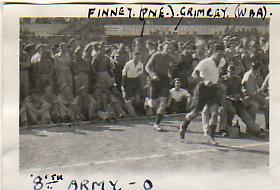
July 1945 — Udine Stadium, Italy the 8th Army Team coming out the goalkeeper is Ted Grimley of West Bromwich Albion followed by Tom Finney of Preston North End. Ted Grimley pre-war had played for Swallownest Miners Welfare F.C. Arthur Ward’s father took him to WBA to sign on.
This story was submitted to the People’s War site by Roger Marsh of the ‘Action Desk — Sheffield’ Team on behalf of Arthur Ward, and has been added to the site with his permission. The author fully understands the site's terms and conditions.
Refer to Chapter 1-- A4345544 -for links to other chapters.
LIFE IN THE ARMY
by
ARTHUR WARD
Chapter 28 - ‘V-J Day’ the End of the War in the Far East
June 06, 1945
I was Orderly Sergeant and I had to put Gunners Punt and Jones C on a charge as they
had been missing from roll call.
The supply of mail is still very poor. We were now organising day trips to the seaside at Grado.
We were allowed to take a 3 ton truck with about 6 Sergeants, a dozen gunners and some of the local kiddies. This was a great treat for them as it was not far to the Adriatic Sea, but most of them had never been before.
The kids usually aged 8 to 12 had a great time on the sands and in the water. We provided them with food and I think we enjoyed it as much as they did.
LA Kitching and I befriended an Italian family in the village and we were invited to their home - they did not have much but the house was spotless. They had 2 little girls who called me Sgt Arthur. When we left, their parents gave me photos of them dressed up for a special occasion at church in their best Sunday clothes.
Also in Fauglis, several of us at night walked about 2 miles to a nearby village where there was an ice cream parlour. There was nothing like this in England at that time.
All they sold were different types of ice cream and everyone sat at tables like a cafe. The ice cream was better than any we had every tasted before.
I was still on the dance committee and we organised quite a few dances.
We started to charge for entrance, a fixed charge for soldiers, but civilian men had to bring 2 girls each so that our lads could have partners. This worked very well and we would have had many more dancers than we could cater for, as we had to restrict the numbers for safety's sake. The 9th Lancers had a dance band and they came once.
June 16, 1945
An extra special dance; we had to trim the hall up and we managed to get some
trimmings and a few balloons. I went to Palma Nova and organised a well known Italian band. There would be 15 players. They were expensive and charged us £8-10-0 (£8.50p) and we had to supply the transport both ways for them.
One day the Italian authorities in the village organised a dance, a travelling dance floor came - it was quite a large dance floor with a canopy over, and top and railings all round with a pay box. The system was that for each dance the man had to pay a fixed amount to go through the gate with his partner and the floor was cleared after every dance. Not many soldiers were able to dance as all the local men only brought their own partners, also it was expensive. However we enjoyed watching and listening to the band which played good dance tempo music.
We saw a few films at Palma Nova and once we visited the theatre in Grado and saw a live show with Patricia Burke and Gabriel Burne in 'Kingsway Calling'.
Leaves to England and also demob schemes were being started. Sergeant Percival was the first to go home for good.
Demob leave was called Python, and the first to go had had to have served a minimum of 4 years abroad.
LIAP leave was extended; this was for one month's leave in England, then return.
June 18, 1945
I had a letter from Nessie which was the first I had had for three months.
We visited Palma Nova to watch football matches and I saw:
2nd Armd Brigade 3 v 56th Division 3
2nd Armd Brigade 2 v 10th Indian Division 3
June 20, 1945
Sergeants' Mess meeting - I was elected to the mess committee.
For the time in Fauglis we played many football matches, cricket at times, we had a Brigade Sports Day and there was a course for men to learn how to ride horses, but I did not go on that.
We had a scare one night when there was a terrific thunderstorm, and whilst I was visiting the guard on the gate from the house to the main road, a thunderbolt came down and travelled horizontally right down the main street. It was like a ball of fire with flames and smoke following it, and it left a scorch mark on all the houses which were in one long row down the street and as they were all whitewashed, it left a black mark all the way down.
It certainly frightened us all to death. We thought the war had started again.
We had been in Fauglis from 19 May, but on 27 August, my turn came for LIAP leave, Bill Turner went home on 8 August.
First I forgot to mention that one day, we travelled to Udine and saw a football match; 8th Army 0 v 5th Army 1. There was a very big crowd there and Udine were in Italian 1st Division.
We couldn't get into the grand stand so we had to stand by the touch line. I realized that the 8th Army goalkeeper was Ted Grimley, who before the war, had been goalkeeper for Swallownest and my dad, who was secretary to the club, had taken him to West Bromwich Albion and had him signed by them. He had played several times for West Brom before being called up.
I went up to him as he knew me and he asked me if I knew that Mr Holland, who was on the Swallownest committee, had died as I had a letter with the news on the previous day. We had a chat for a few minutes at half time and I took his photograph.
Also playing was Tom Finney (Preston North End).
The 10th Indian Division band played and marched at half time.
Also whilst in Fauglis, we visited a large open air swimming pool at Torre Del Zuino where we also held a regimental swimming sports day, although I was only a spectator.
At Grado we hired tents to get changed in. They were all brightly coloured and there were lines of them on the beach.
There was also a cafe on the beach which we visited many times, and from there we hired sailing boats with which we were able to sail right out into the bay, then swim from the boat, which was smashing as the water was very deep, and very calm; we could see right to the bottom. The water was very clear, and with it being so deep and calm, it was quite easy to swim, as we had extra buoyancy.
Whilst here we were still not sure what was to happen to us, as usual in the army, rumours were very rife. Some said that men with 4 years overseas were going home and the remainder were to go to the Far East where the war was still going on. Then we were to go to the Middle East, as there was some animosity there. Then many troops were needed to police Austria and Germany, and of course the arguments with Marshall Tito and Yugoslavia were still not settled. Then in August we heard that an atom ("A what?" we asked!!) bomb had been dropped in Japan, so would that alter the plans?
A few days later, we heard that another Atom bomb had been dropped and Japan had surrendered unconditionally, IT WAS ALL OVER, so now new plans would have to be made.
What feelings we had now, the wine flowed freely, we were just getting used to the idea of peaceful nights, no bombs, shells, no whistling machine gun bullets, no nerves on edge in the dark when different sounds could mean so much, not to mention nights on end with no sleep, bloodshot eyes peering at watches in the dark when firing a barrage, no wading in mud, dragging vehicles out of the mud, no fitting tank tracks while shells fell all round, no stinking carcasses of cows, sheep, horses, dogs, no men’s bodies covered in flies, no desert sores, no malaria, no weeks on end without a word from home, no lack of visits to friends and relations instead of the same old faces of mates for months on end, no lack of female company, no uncomfortable train journeys many hours at a time - sometimes days without being able to dismount. No endless hours screwing up our eyes looking at the sun for dreaded Stukas and ME's. No back breaking hours loading up with ammunition, no smell of cordite and the choking smoke screens. No flares in the night making us feel so naked to the enemy planes lurking above. No feelings of absolute terror when we heard the Nebelwurfers being cranked up, knowing that we were about to be showered with rocket shells. No carrying of gas masks in case the enemy used gas, thankfully they didn't as it would have been mass murder if they had!!!
No feeling sick on plunging ships in the rough sea with the thoughts of submarines stalking us in the darkness. No boat drill on the ships, perhaps stood for long periods not knowing whether it was for real. No sleeping on the mess decks being covered by other men’s sweat, no crossing the equator and watching the beetles and insects climbing over the ship's pillars, no climbing up steep ship's staircases. No sticky sweaty feelings on board ship with no water to drink or even wash. No dashing to the side of ships to be sick and sliding about in places where men had not made it. Gone would be the continuous headaches we had on ship due to all the portholes being closed and lack of fresh air. No more long journeys on rough country on tanks or trucks with only short stops to refuel. Then the worst thing of all in the army, going to a toilet!! On board ship just rows of holes in a long wide board, all sat within touching distance from each other, shortage of toilet paper, going for a walk with a shovel especially in the desert, that is walk a few yards away from the other men and squat down, no privacy and the toilets in camps where we could queue for ½ an hour at a time for a small number of toilets.
Long train journeys where the very few toilets were usually full to the top.
Then the flies - I hate flies, in the desert we all had desert sores on our arms, always covered in flies, flies on dead men, flies on dead and live animals, flies in the food, flies in the water. Then other hazards, the scorpions with a deadly sting, snakes in the grass and rocks in Sicily and Italy, the terrible smell of sulphur on mount Etna.
Then the heat, hot enough to fry an egg on the metal of a tank, then cold enough the same night to freeze your socks off!!! Then in the cold, in the mountains of Italy, sleeping in a bivvy and waking up frozen with the canvas frozen solid, trying to brew up with frozen fingers. Weeks of rain, rain and more rain, wet through to the skin and no change of clothing. Trying to cook in pouring rain, the frightening electric storms in the desert with no thunder or rain. The thunderstorms in the mountains much worse than any in England. Then the snow, trying to fight and fire guns in snowstorms, fortunately not very often!!
Then through it all, not knowing what was happening at home.
During our time in the army we had many jabs, i.e. inoculations and vaccinations, some were not very pleasant and had after effects, but all very necessary. On reading my summing up of army life, perhaps the time in action may not sound so bad but no-one who has not been through it can understand the terror of shells landing all around and machine gun bullets whizzing past and shrapnel from bombs filling the air.
THE GOOD THINGS
We had a lot to be thankful for, if we managed to get through the war alive or without being wounded. I think we were more than just lucky. We usually had enough food, plain, but food to give us energy and keep us going. At times it was bully beef and biscuits but we had to learn all kinds of tricks to make the food more tasty and variable. We were usually able to make tea, we did not have a lot of fresh milk or sugar but we could make do.
Pr-BR
© Copyright of content contributed to this Archive rests with the author. Find out how you can use this.


 Recommended story
 Story with photo