

- Contributed by
- Heather Margaret Leybourn (nee Godber)
- People in story:
- Percy Godber
- Location of story:
- Sidcup, Kent
- Background to story:
- Civilian
- Article ID:
- A8953563
- Contributed on:
- 29 January 2006
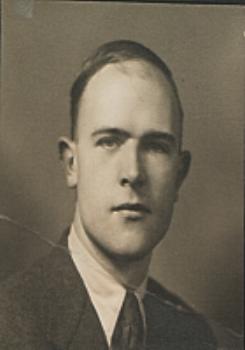
Percy Godber, born 11 May 1912 at 3 St Stephen's Terrace, Stockwell, South East London
My father is Percy Godber and he was born in South East London in 1912. I was born in 1949, 4 years after the end of the 2nd World War. I went to primary school in the 1950s and when I reached junior age, one of the topics of conversation in the playground was what everyone’s father had done to serve their country during World War II — ie whether they had been in the army, navy or air force.
This puzzled me because there had never been any conversation at home about which armed service my father had been in. So one day I asked my mother what my father had done in the war, and she tried to explain to me that he had not gone into the armed services because he was in a ‘reserved occupation’. I didn’t really understand at the time, but relayed this information to my school friends. They didn’t really understand either, and I felt as though I was a bit odd, having a father who had been in something called a ‘reserved occupation’.
Once I became an adult, I understood the situation much better. My father was an industrial chemist, and he was engaged in scientific work that contributed towards the war effort. In 1940 he went to work at Standard Telephones and Cables in Footscray in Kent, which produced radio valves serving a variety of functions in communication systems (this was before the advent of transistors). He was involved in experimental work, in the course of which he developed a process which improved the texture of cathode coatings which in turn improved valve performance.
In 1943 he moved to A C Cossor Ltd in Islington where he worked in a large research laboratory. This company manufactured radio valves and other components for radio, and oscilloscopes for radar. Some of the engineers working in this laboratory did some notable development work on radar. Amongst many tasks assigned to my father, he was given the job of finding a solution to prevent the metal screen falling off radio valves in high humidity, a fault which rendered radio equipment useless in the far eastern war. Scientists in the USA, Canada and Australia were also working on this problem. My father was the scientist who found the solution first. This was patented and sold to the USA, Canada and Australia.
I am now very proud of what my father contributed to the war effort. Although he was never in armed combat, he was doing vital work in England to support the armed forces. I feel that he is one of the many unsung heroes of the war who did not win any medals but nevertheless worked very hard in the united effort to defeat the enemy.
He is now 93 years of age and still going strong!
© Copyright of content contributed to this Archive rests with the author. Find out how you can use this.


 Recommended story
 Story with photo