

- Contributed by
- Frank Yates
- People in story:
- Frank Yates, Major Hardy, Peggy Bottom
- Location of story:
- Norwich, Sheffield
- Background to story:
- Army
- Article ID:
- A7146263
- Contributed on:
- 20 November 2005
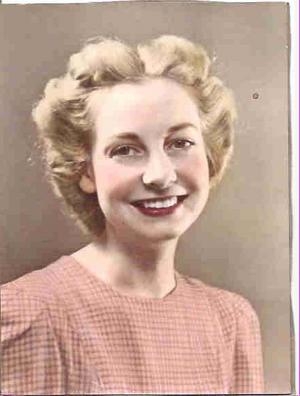
Peggy Bottom, eventually to become Mrs.F.Yates.
Memories of Frank Yates CHAPTER 6
During that hot, sunny, summer of 1940, life at Stoke Holy Cross went on fairly quietly, most of the fun being confined to the south east. A stray Dornier, however, on one unexpected morning, could be seen over the Boulton and Paul factory, in Norwich, and, even after the realisation that the target was wildly out of range, Sgt. Bond engaged it. Never before having heard a Bofors fired, I was a bit taken aback by the loudness of the reports and the strange feeling, as my trouser bottoms lifted an inch or so with each bang. I could see, over the top of the predictor that the shells were self destructing, well before reaching the plane, but it was a morale booster, and at least we knew that everything worked! Changing the barrel and cleaning it, by pouring boiling water through it, before drying and oiling it, was a new and useful experience.
In my role as No 1, it fell to me to be responsible for the daily checks on the predictor. I found that, instead of it being left on a “Stand by bearing”, it was pointing somewhere else, and on looking through a telescope, I found that the “target” was the bedroom window of a council house, on the nearby Beccles Road. The teenage schoolgirl, the object of the interest, was clearly aware of this high tech. surveillance and, I was informed, often gave them something to look at. She never did when I was looking!
We spent many idle hours playing poker for halfpennies, sitting comfortably in the cookhouse. I liked the game and played it very often during my life in the Army. On one particular afternoon, happy in the knowledge that there was always an air sentry in the gun pit, ready to ring a gong if any suspicious aircraft was seen, we heard a plane pass close overhead, a common occurrence, Norwich being the centre of a group of airfields. Ten minutes later, a housewife, from the nearest council house, came up our drive to tell us that her 7 year old boy had come running into the house, shouting that a big, flat aeroplane, with black crosses on its wings, had just flown over. CONSTERNATION!! The result of this episode, apart from the recriminations, was that, from then on, the gun was always manned by a team of three, with a round on the loading tray, ready for instant action.
After Buster’s departure I took my Norwich passes alone. The YMCA had opened a very nice hostel, with comfortable beds, in separate cubicles, for one and sixpence a night and I used it on a couple of occasions. I had a reputation as a very heavy sleeper, but on the second of these visits, I exceeded my previous efforts, waking up in the morning to find that, during the night, a stray bomb, on the waste land behind the hostel hut, had wrecked the end of it, without disturbing me, fast asleep, at the other end!
Major Hardy, a WW1.veteran, who had lost a leg, but had escaped from a German POW camp, been recaptured, and escaped again and had written a book, called “I escaped”, was a frequent visitor to our gun site. One day he stomped up to the gun pit, sat on the sandbags, and had a long chat with me about the Universe and what lay outside it and where would you get to if you kept on going? I told him that I had read somewhere that you would come back to where you started. He didn’t understand it any more than I did, but, when he went off, I realised that I, a mere one striper, had had an interesting conversation with a real live Major and a hero at that!
A week later, Major Hardy arrived again, carrying a coil of rope and asked me to go into the hut and find a bottle, which he put between the double planks which formed one of the roof rafters. He threw the rope over this bottle “pulley” and handed me a fixed noose, which had been tied at one end. He invited me to tilt my head back and put the loop behind my head, with the knot over my forehead and eyes. Wondering what was going to happen, I was given the other end of the rope and challenged to pull myself up. This was ridiculously easy and I was soon up there with my eyes a few inches below the beam. Then came the surprise; the good major told me to let myself down again and I found it absolutely impossible. Try, as hard as I could, there was no way that I could allow that rope to slip by even a millimetre. There is a psychological block which stops the brain from putting the body in danger when the situation is a new experience. Major Hardy got a chair and put it under my feet, chuckling all the while. “Got my groom up in a fifty foot barn” he confided, “Had to call the b*****y fire brigade to get him down”!
Then later on, in October, my high ranking friend turned up again and told me that he was forming a new battery, and he would be very happy if I was to join him as one of his detachment commanders, with the rank of sergeant. Not that I could have refused! I was only nineteen and felt quite flattered!
In the September we reached the culmination of the Battle of Britain and, on that last Sunday, I was in the “local” when we heard on the wireless of the enormous German losses, (exaggerated, we now know). “Mine Host” announced “Drinks are on the house, gentlemen”, the first and only time I ever heard those magic words!
I was given an interesting trip on a Sunday in September. A chassis mounted gun had arrived on our site and the static mounted gun had to be delivered to a site in Grantham. Presumably the battery was to take on a mobile role. Even though the gun was to be moved by a local engineering firm, as it was WD property, it had to be accompanied and guarded by the military-Me!
The low loader, fitted with a winch and a reinforced tailboard, arrived early on Sunday morning and the driver and his mate unscrewed the holding down nuts, using a very large spanner. Then the gun was winched up the tailboard, using rollers, and roped down into the floor of the truck. I sat with the other two chaps, in the front cab and enjoyed the trip through Kings Lynn and Spalding to Grantham, and, on arrival, bolted the gun onto its standbolts, ready prepared in the concrete. I can only surmise that the bolts were part of a steel plate, concreted into place, when laying the base. Anyway the holes matched perfectly, and after unloading the spare barrel and the tool kit, I got a receipt document from the troop commander, and accepted a mug of tea to wash down our sandwiches. Then off back to Norfolk. The weather was very hot and the road very dusty, so my new found friends called twice, at hostelries, on the way back. When we eventually arrived back at the gun site, the troop officer was there and received my receipt documents. He looked suspiciously at my red face, caused by sitting in the Sun, in the front of the lorry, for hours on end. I believe that he thought that I had been drinking and moaned about “Taking our time”!
During that pleasant period, at Stoke Holy Cross, I had done all the maintenance jobs on the gun and the predictor and, apart from lacking firing experience, I was knowledgeable about them. When I said farewell to the lads on the site, before going on leave, I was a much more confident 19 year old, and certainly a better poker player! I was told to buy sergeant’s stripes and given a rail warrant and documents, ordering me to report at Chester station, seven days hence.
I believe, that it was during this leave, when I visited the Rover Den, a favourite wartime meeting place, that I first became interested in Peggy Bottom, who was, three years later, to become my wife. Peggy had nothing to do with the Scout movement, but accompanied Mavis, and other girls, who were, or had been, in the Rangers.
I realise that, in my narrative, I have not mentioned army pay. When Don and I were called up, the pay was 14 shillings a week, out of which we made an allotment of 7 shillings to Mum. When I was a Lance Bombardier, I was a little better off, and now, having reached the dizzy heights of Lance Sergeant I think my pay was about 35 shillings a week. Riches indeed! Except for the early days of the war, in Sheffield, “Pay parade” was held on the gun site, the Paying Officer, taking only a few minutes, but on the occasions when a large group had to be paid, I always had to wait for ages, my name coming at the bitter end of the alphabet. At a later firing camp, when the whole battery had to be paid, I suggested, politely, to the officer, that it might be a good idea, on alternate weeks, to start at the other end of the alphabet. This was taken up, and much later, when I was doing the paying, I sometimes started in the middle!
© Copyright of content contributed to this Archive rests with the author. Find out how you can use this.


 Recommended story
 Story with photo