

- Contributed by
- cofepow
- People in story:
- Frederick Austin 'Bunny' , Ernie Payton, Peter Rivron, 'Blondie' Dearman, Jim Arnold.
- Location of story:
- Shornecliffe, Kent then to Malaya
- Background to story:
- Army
- Article ID:
- A5055563
- Contributed on:
- 13 August 2005
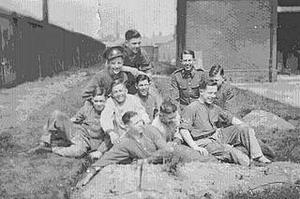
1937 East Surrey Band Boys Colchester Peter Rivron, Bob Forshaw, Pte Scovell, Tommy Maclarty, Frederick Austin, Cecil Warn, Jock Bryce, Ronnie Woolard, Pte Philips
There came a time when the battalion had to go down to Salisbury Plain to join in the annual army maneuvers, I suppose it would be called war games nowadays, so off we went to our camp, which was at a placed called Horsebridge. All the men were in tents, the boys had small round ones, and slept six to a tent, with feet pointing to the centre pole.
When the men went out, for days, on maneuvers, the boys took over the camp duties, such as cookhouse, police, sanitation etc. On this occasion, four of us were sitting in a large marquee peeling potatoes, (spud bashing it was called).
We had a huge sack of potatoes, and a big tin bath of water; it looked as though we would be spud bashing until the early hours of the morning.
After a while we got bored, and someone, I don't recall who it was, threw a potato with such force into the water that we were all splashed. Well, - that started it, before we knew it, two of us were at one end, and two at the other, pelting each other with spuds as hard as we could go, and having a great time, much more exciting than peeling the darn things. Now this is where things started to go wrong. Captain Gingle (Jingle to us) the Battalion Quartermaster, just happened to be passing the marquee as our war was beginning to hot up.
He went over and pulled apart the two tent flaps (that were held together by rope) just enough to get his head through. One of us, (once again I don't know who) yelled outlook, someone's looking in, let him have it". So the four of us started to attack this head, not realising it belonged to the Captain Quartermaster. Suddenly, when he could speak, he roared at us to stop, and we began to realise we were in deep trouble.
He came into the tent where the four us stood to attention, shivering in our shoes, waiting to see what was going to happen. He was so angry, pacing up and down among the spuds that were littered all over the ground
He threatened us with being tied to a wheel, which they used to do way back in the dark ages, but was now of course discontinued, but we didn't know this at the time. Eventually he calmed down, and sent us back to our tents, and told us to be back on parade, in full equipment, in an hour's time when we would be inspected and then marched out to our battalion, which was about twenty miles away.
During the inspection, he asked us if we had filled our water bottles, as we would certainly need water to refresh us after the twenty-mile slog. Suddenly he dismissed us, and we realised we were not going on this long march, and thought we had got off lightly. But when the battalion arrived back into camp, we found ourselves up in front of the Commanding Officer, who ordered us to pay for a large sack of potatoes, and seven days CB (confined to barracks) which entailed doing fatigues, so there we were, back in the cookhouse again "spud bashing".
Before I leave our time on maneuvers at Horsebridge, I must tell of another exciting time I had. One weekend it was decided to allow everyone a weekend forty-eight hour pass, which meant that from Saturday morning until Sunday night we were free to do as we wished. Now my pall, Ernie Payton and I were fed up with camp life, so we decided to go somewhere, we didn't care where it was, as long as we got away from the camp for two days.
So off we went to the railway station at Horsebridge, shot all our money onto the counter of the ticket clerk and said, "How far will that take us?". He counted it up and said "Just about enough for a return ticket to London". So we accepted the two tickets, got on the train, next stop London.
When we arrived at Paddington Station we had a look around, had a few rides up and down the escalators, then we decided to go out into town.
I don't remember where we went, but we covered a few miles and really enjoyed ourselves. You see, in those days, people didn't often to up to London, so it was quite a treat for us to be in the big city.
However, by the time evening came, and it started to get dark, we realised that we had nowhere to stay the night, so we decided to go round to the nearest police station. They listened to our story, and then took us in a police car, round to the Union Jack Club at Waterloo; this was a club for service people. They then arranged for us to stay the night. In the meantime, they, (the police) would contact Ernie's father who would wire the money through, by morning, for our train fare and to pay for our stay at the Union Jack Club.
Now for you to understand the rest of the story, I must tell you about Ernie's mum, and my mum. They both knew each other and were good friends, so we thought, when the money comes in the morning, we'd go down to Ernie's house and see his mum and dad, who lived just a few stops down the line from Canterbury in Kent. I also knew that on this particular weekend, my mum, brother and sister, were staying for a holiday with another one of my uncles who lived at Sandwich, about twenty miles from Canterbury.
So the next morning after having a good sleep and a hearty breakfast, off we went. Now when the train got to Canterbury, I thought, instead of going the few stations to Ernie's house, I would get off and hitchhike from Canterbury to Sandwich, a distance of about twenty miles.
When I arrived at uncles' I found that my mum, brother and sister had on that day, decided to go over to see Ernie's mum and dad, so that twenty mile hitchhike was a waste of time. Eventually we all got together and Ernie and I tucked into a large Sunday dinner. Afterwards we had a few hours together, and then it was time to make the long trek back to our camp on Salisbury Plain.
We arrived quite late, and tired out, and although we hadn't had a lot of time with our mums, we had got away from the horrible camp life for a while, had a couple of slap-up meals, and seen a little of London night life quite an adventure really.
I did enjoy my stay at Colchester, but all good things come to an end, and after being given twenty-eight days embarkation leave, also all the necessary inoculations for the Far East, we marched out of Goojerat Barracks on the 1st September l938, to St Botoiph's Station, at four o'clock in the morning, for Southampton, to join His Majesty's Troopship "Lancashire" which sailed that day for Shanghai, China.
Life on board was hectic for the first few days with boat drill, fatigues, musical practice etc., but we soon got used to it, but going through the Bay of Biscay was no picnic, most of us were seasick. When we reached the sunnier climate of the Mediterranean Sea, and the evenings got hotter, all the boys were allowed to sleep on deck and it was so enjoyable to go to sleep to the sound of the sea, with the bright stars and moon as your roof. The only drawback to sleeping on deck was that you had to be up an hour before reveille at six o'clock, as the East Indian crew, (lascars) washed the desks with the hoses at five o'clock every day.
The situation in Europe was becoming very grave as we progressed eastwards, and as we reached Singapore, due to the Munich Crisis, when Mr. Chamberlain met Hitler, and returned waving his silly piece of paper saying "There will be peace in our time", we were ordered ashore to join the garrison.
After we had motored for about an hour, we were billeted at some barracks at a place called Changi, where we spent three enjoyable weeks before setting sail on a Royal Navy submarine depot ship, H.M.S. Medway, for Hong Kong. I had pleasant memories of the Changi beaches, but in a few years time my next visit to Changi changed all the pleasant memories for good.
The five days journey to Hong Kong was uneventful; the Royal Navy made our journey a very happy experience, and was an excellent host. We were to stay in a tented camp half way up Mount Nicholson, on a plateau looking down on a Catholic monastery, and overlooking the harbour, a beautiful location. In those days, 1938, there were no huge skyscrapers in Hong Kong, no tall buildings at all, so we used to sit up on the hillside, with a full view of the whole of the harbour, a wonderful sight, and especially at night Hong Kong harbour was rated as one of the finest in the world.
We spent about a month in Hong Kong and during that time we used to spend a lot of our time in a club called "The Cheerio Club", where you could get English meals and there was plenty of entertainment available.
After our stay in Hong Kong we set sail on the final part of our journey to our original destination, Shanghai. For this journey we sailed on a British India cattle boat, called "S. S. Santhia". We were housed in holds, to sleep we had palliasses (straw filled matresses) on iron decks, the smell was terrible, and apart from the discomfort, the food was inedible. Luckily we hit the tail end of a typhoon in the South China Sea, and most of us were too seasick to bother with the mess dished up by the laskar crew.
We steamed up the Whanapoo River and docked at Hongkew Wharf~ then after disembarking, the Pipes and Drums of the Seaforth Highlanders, who were the only other British Regiment in Shanghai, marched the battalion to our barracks.
The Regiment was split, with three companies in the main barracks (with wooden huts) in Bubbling Well Road, and two companies in Jessfield Park, (also wooden huts). I must mention here that Shanghai has a tropical summer and an arctic winter, with annual flooding in between. We were to stay in Shanghai from l7th November 1938 to September 1940.
It amazed me to see Shanghai looking so western and modern, with large buildings and right in the centre of the city was the racecourse. They also had a few modern cinemas, I first saw "Gone With The Wind" in a cinema in the French concession, and many films from Hollywood could be seen months before they got to London.
The triumphant Japanese forces surrounded Shanghai, but now they were relatively quiet after the battles between the Chinese and Japanese in and around Shanghai in 1937.
The city was divided into four concessions, British, American, French and Italian, known as the International Settlement, and each guarded their own part of the perimeter, which consisted of a high fence of barbed wire, with the Japs on one side, and us on the other.
Near our part of the perimeter was Soochow Creek, a filthy, smelly, dirty waterway, and many times a body, all bloated, would drift down the creek. The Japs often killed, or raped Chinese women and threw their bodies to rot in the creek. Life was cheap during those days in China, and disease and starving people were everywhere.
The city was full of White Russians, they were the families of the people who
left Russia for protection from the Communists during and after the Russian
Revolution. The name White Russian denoted Loyalists instead of Red
Russians, and not the colour of their skin.
There were reputed to be about 33 different nationalities living in the International Settlement, and after a while it became overcrowded. So many people, with no food and nowhere to sleep. When we used to return to our barracks at night, we had to step over bodies lying on the pavements, many of them dead, especially during the arctic winter, thick snow everywhere.
Early in the morning, they used to go with lorries collecting all the bodies, of men, women and children, to take away to be burnt, and if the wind was blowing in the wrong direction, well, the stench was unbearable.
Now for a lighter side of the city. We used to go to the cinemas a lot, and to the dance halls, which were many, but the place I really enjoyed was the Foreign Y.M.C.A. It was a large building that housed two swimming pools, two gyms, large restaurant, coffee bar, shops, snooker room, and lecture rooms, and it was the first time I saw a bowling alley. As you can guess, it became very popular with everyone. Shanghai also had two roller-skating rinks, one in the British concession, and the other in the French. I'm unable to remember which, but one had good skates but a poor rink, the other just the opposite, a good rink, but poor skates. We used to use the British one because in the centre of the rink they had a basketball pitch, so we used to play basketball on roller skates, really good fun.
If you wished, you could go to the many dance halls and bars in the city, and there were many, especially the Rue-Chu-Foo-San in the French sector. Everyone knew this as "Blood Alley" because there were always fights breaking out among the different nationalities; in fact, they used to have, besides the Military Police on patrol, an ambulance standing by at the end of the street. I, and some of my pals, went down there a few times, but, as soon as we saw trouble brewing, we got out as quickly as possible.
Sometimes I would go and listen to the Shanghai Municipal Orchestra, and I got to know the timpanist, but the only trouble was that he was a White Russian, and me being English, we had a language problem, but we managed to get by using sign language.
Off the famous Bund, ran the Nanking Road, the heart of Shanghai, teaming with humanity, on foot, bus, tram, car, lorry, rickshaw, cycle, sedan chairs and wheelbarrows, plus coolies with their loads at each end of bamboo poles.
I have many happy memories of this exciting city. I played a lot of football, and we had a very good swimming relay team, so we entered many galas
I remember our team consisted of Peter Rivron swimming breaststroke at No. 1, then "Blondie" Dearman doing side stroke (they didn't do butterfly in those days), Jim Arnold at No.3 did back stroke, and I finished with the front crawl. The first three, Peter, Blondie and Jim, were such good swimmers, I found when I entered the water on the last leg, and I usually had a commanding lead. I also managed to get into the water-polo team, you didn't have to be fast at this, just have plenty of stamina.
© Copyright of content contributed to this Archive rests with the author. Find out how you can use this.


 Recommended story
 Story with photo