

- Contributed by
- TORRANCE Duncan Leitch
- People in story:
- Duncan Torrance
- Location of story:
- Mediteranean
- Background to story:
- Army
- Article ID:
- A7571261
- Contributed on:
- 06 December 2005
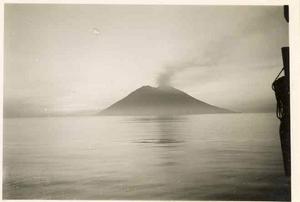
Stromboli. 'The lighthouse of the Mediteranean.' From H,T. Empire Arquebus.
CHAPTER X111 - Part Two - A LIFE ON THE OCEAN WAVE
Our doubts about us leaving the ship were confirmed in the morning by signal. So, as well as embarking a full load, we had to wind up the ledgers, pack our stores and so on.
The last trip was my first with a padre on board. We had three. Sure enough, the old seaman's story about having ministers at sea bringing bad luck proved true.
I was filled with mixed feelings when a charming padre walked into the orderly room and offered his services. Again, the prophecy proved itself. The first night out from Toulon, one of the boilers broke. Our speed dropped from fourteen to ten knots.
After the experience of last time, the skipper decided to fOllow the calmer, but more difficult route, through the Straits of Messina. In complete contrast to our previous trip, we had wonderful weather. A flat calm and beautiful sunshine such as the nobility at home pay pounds to have in the winter out here. The prece de resistance' was passing Stromboli, another active volcanoe.
We looked first at the wreck of an American ship, which we could only just discern at the base of the volcanoe. We saw a tiny village which struggled for an existence on the near vertical sides. One's eyes traced the rivers of lava, now solid, up the side to the mouth, from which a pillar of smoke was curling upwards.
It was with heavy hearts that we met the pilot at Port Said. Even he, instead of getting us in the normal hour, took three hours to do the job. When the Embarkation Staff Officer stepped on board, before we asked about mail, we beg_n inquiring whether there were any ships in wanting staffs. No, came the dreaded answer.
We always had the hope that a U.K. bound ship, or better still, a far East boat would loose its adjutant due to sickness. This would have created the wonderful opportunity of an emergency shift from a local to a long distance boat.
Hope came the next morning, when we woke amid the clatter of hammers. Already they had started to convert her for carrying pilgrims from Suez to Jedda, the port serving Mecca.
We saw in the next berth but one from us the 'Cape Douglass', strait from UK without any staff on her. In the afternoon we collected all our kit and left. As we pulled away, fresh hope loomed as the 'Collerado Springs Victory' nosed her way in. An ugly ship, but without a staff.
That evening I went across to H.Q. Movements. I crossed the port in a launch, I saw the Arquebus gracefully edging her way down towards the Canal. This was the last time I was to see her, and some of the best friends I ever had. Certainly the end of one of the happiest months of my life.
Nobody at HQ Movements would tell me anything except that I was wanted at GHQ. I said I would like confirmation, and, if possible, details as to what was going to be discussed. I had a feeling in the back of my mind, that my friend was only giving me the opportunity of spending a few days in Cairo, which I did not want.
My OC had been posted onto one of the three ships used for the evacuation of illegal Jewish immigrants from Haifa to Cyprus. The boat was held back in Port Said after a limpet mine attack on the 'Empire Rival' as she lay moored in Haifa.
The OC described the awful quarters and the state of his ship the 'Empire Heywood'. He invited me to come on board and see for myself. The team of three boats were all berthed in the Avant Port, a good half hours sail in a launch. The companion way up the ship's side was the first thing - an extremely insecure affair. Even before this, I could smell the coal and feel the dirt from the bunkers.
The OC's cabin was shared with the ship's medical officer and allowed so little room that they could not both get dressed at the same time. An OC troops is entitled to two cabins, and the ships doctor to one. The rest of the staff's quarters were as bad. The orderly room was a hot, dirty, smelly hole. The ship was without air conditioning.
When on board, the guard of eighty were accomodated in dirty poorly lit decks. The sanitary arrahgements were poor. Two huts were provided, one on each side of the ship. One was the latrine and had seats with pipes disgorging directly over the gunwale of the ship with no means of flushing. The other was the cookhouse manned by Army Catering Corps cooks.
Forward of the bridge was set aside for the illegal immigrants. The area was surrounded by a 12 - 15 foot barbed wire fence with steel framed doors. The Jewish illegal immigrants, up to 1,200 of them, were accomodated in the hold.
Apparently these Jewish immigrants had been recruited on the continent, shipped across the Mediteranean in small, often unseaworthy boats, picked up by the Navy, and finally landed at Haifa.
I was told that they would sit on the dockside and refuse to move, the women often crying and tearing their hair. Many of them came scantily clad or threw their clothing away on the dockside. A stock of Army and ATS clothing Was kept for issue.
A steel cage was used so that any particularly difficult people could be contained and swung on board. The holds were battenned down after embarkation. Detainees were allowed to exercise on the deck within the compound under guard. At night everyone was below deck. Large spotlights assisted the guards in their duty A supply of tear gas was carried for use in emergency. This was a necessary safeguard.
All this is what I was told. But those were bitter days. Disasters like The King David Hotel in Jerusalem, blown up by Jewish terrorists, killing 95 people. I am only thankful that I was never posted to one of those boats.
Back at camp, the postings came through for the other ranks. Then heartbreaking news was given to me. Ships in the Middle East pool would no longer have adjutants. This was a War Office ruling. My job had gone.
As well losing this job, I had been precluded from the job as vehicle inspector in Benghazi. It was with a heavy heart that I loaded my kit onto the train and returned to the stink and din of Cairo.
I was very rude at GHQ. But they had already had two other ships adjutants that morning.
Where did I want to go? ESO (Embarkation Staff Officer) Port Said without any doubt. I had become friendly with one of the ESO's there, and the job was still connected with ships.
?You will go as Military Forwarding Officer, Cairo District?. More distasteful than ever, an office job in Cairo.
© Copyright of content contributed to this Archive rests with the author. Find out how you can use this.


 Recommended story
 Story with photo