

- Contributed by
- John Inman
- People in story:
- Anthony Inman
- Location of story:
- England
- Background to story:
- Royal Navy
- Article ID:
- A8035760
- Contributed on:
- 24 December 2005
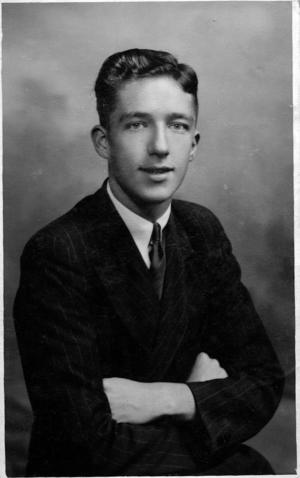
Tony Inman 1940 A wartime civvy
A View from the Back: The Recollections of a Fleet Air Arm Observer 1941-1946 by Tony Inman
Part 1 of 14 (Sep 39-Dec 41)
Chapter 1: Introduction - A Wartime Civvy
It is 60 years ago now and my memory might not be as sharp as it was closer to the time and the timing and the dates are a little bit vague, so I hope you will bear with me. When the war was declared on the 3rd of September 1939, I listened to Chamberlain's broadcast and then got on my bike and went down the beach. That was on the Sunday. On the Monday I spent most of my time filling sandbags because at the time I was working at Poole hospital, which was not the enormous edifice it is now but a single story building and I was working in the secretary's office. We filled sandbags and built walls round the entrance and windows; I am no fonder of manual labour than I am now and I was exhausted.
In November 1939, I left the hospital and started working at the sorting office of the Post Office and this continued on through Winter 39, which was snowy, and then when it got round to the Spring 40 the Post Office wanted volunteers as roof spotters and I thought that might be good for a skive so I put my name forward. I had been interested in aeroplanes for a good number of years since I was a lad; I knew all about the planes that were in the 1st World War and not much about those in the 2nd - but I was willing to learn. We spent a lot of time with the Observer Corps who had a post on Canford Cliffs and there we picked up a lot of information about aircraft, studied the silhouettes to get to know them, and used Observer Corps binoculars to spot the aircraft coming over and try to identify them.
When the battle of Britain started later on that summer, after the hoo-ha of the battle of France and Dunkirk and all that, a fair amount of the battle came along the coast as far as Bournemouth. The idea was that the roof spotters would go up on the roof and if there was imminent danger - presumably if we saw some bombers making a direct approach - we would sound some bells and all the staff would rush down into the basement. I'm not sure they would have had time to do it, but that was the idea. This system was brought in because before that, every time the sirens went off everyone went into the basement and consequently this meant that much of the work was not done. If you know anything about air raids you know that the siren goes off and nothing comes near you for hours and hours - if it ever does - and, as a result of everyone being down in the basement playing cards (which is where I learned to play Nap), mails were missed and post was late. This would never do in the Post Office of those days; I don't know what it is like now.
That summer was long, and it was hot, and it was sunny, and from the roof of the post office in Bournemouth I saw quite a few aerial battles across the channel and along the coast down towards Weymouth where there were a couple of RAF fighter stations, including one near Dorchester. I was not one of those who were filled with a mad desire to rush off and join the Colours when war was declared, but the time was coming when I would have to. The system operating was that certain age groups were required to register for National Service at the local Labour Exchange.
It was well known that if you wanted to avoid being conscripted into any old Service you needed to have volunteered for the Service of your choice and have been accepted. The government had brought in a law that all those who had been called up for the forces would be given their old jobs back at the end of their time/the war, but the Post Office - although it went along with this - would only accept people back if they had actually been called up or had received permission to volunteer.
As the time was approaching when I would have to register I tried to decide which branch of which Service I would like to join. I didn't fancy to join the Army because I felt there was too much walking about. You know I'm a bit idle. I had an interest in flying and I wondered about joining the RAF but it seemed being an airman was a bit dangerous, and so I thought about the Navy. I really couldn't make up my mind but in November 1940 there was the Battle of Tarranto when the Fleet Air Arm did its stuff, and whether this triggered or directed me towards the Fleet Air Arm I really can't remember. I read sometime later that the propaganda after the battle brought a great number of volunteers for the Fleet Air Arm and one of them might have been me if only because the advertisement saying that volunteers for naval aircrew were commissioned sounded rather attractive. If I was going to go into the Forces I might as well be an officer, if I could.
So I found out about this and got permission from the Post Office to volunteer and they granted permission pretty readily because it was known that my age group was likely to have to register early in 1941. I suppose there must have been forms to fill in which I did and I was eventually called for an interview which took place somewhere in Portsmouth. I rather think it was HMS St Vincent in Gosport, although I am not at all certain. The interview consisted of about 5 people including a captain and a lieutenant commander wearing pilot's wings. They asked me various questions and got me to identify various models of aircraft, which I was able to do from my roof spotting days. The only specific question I can remember is the airman chap asking me what I thought about the tricycle undercarriage, which was just coming into vogue in those days. I hadn't given it a great deal of thought and I blurted out that I thought it wasn't very good because it would upset the centre of gravity of the aircraft and make it more likely to fall over. After he had listened to my spiel he rather abruptly said that it was considered to be the biggest step forward in aviation so far. Er...squash. On the same day I had a very stiff medical, detailed eye tests, ink blot tests and one to test that your eyes had equal depth of focus, as well as heart, lungs, reflexes etc. And then I went off to consider what would happen next.
In the New Year (1941) I was notified that I had been accepted for a course of pilot training and was required to go to Southampton to sign on, get my number and all that. So off I went to Southampton where I was sworn-in and awarded the official naval number, which I remember to this day was FX 88802. We were then sent away to await call-up, which would be when there was a course to start our training. Just after this, the time came to register which I did, and told them I had been accepted for the Navy, but that didn't stop the usual wheels turning of course and I was asked to go to Dorchester which was for another medical.
There were hordes of people there all milling round and having these short medicals; there were some lads there from the Borstal which was at Portland in those days and they spent their time trying to cadge money off everyone, not that I had anything to give them. Pay on joining was 2/- (10p) per day. Half of this went on allowances to my mother so there wasn’t much left for riotous living. The Post Office also made up my service pay to P.O. pay so I expect my Mum had that as well.
Chapter 2: Learning to Fly
The spring and summer of 41 went by and then I received a summons to join the Navy at the end of Sep 41. I had to go to Lee on Solent, HMS Daedalus. All naval air stations have a ship's name and they are named after birds except of course HMS Daedalus which is named after the chap who tried to fly to the sun but the wax melted in his wings and he fell down into the oggin, poor chap. I can see to this day gangs of people straggling down the road to the gates at Lee on Solent where we were received, perhaps not with open arms, but certainly received. As the days went by we were issued with our kit, if it fitted you were fairly lucky. There was a hatbox (which contained or would hold 2 hats) with our name stencilled on the top - I've still got that - and a kit bag also with our name stencilled on it and a attaché case which I used after the war to carry my cricket kit about until the handle fell off.
I suppose I wasn't the only one to feel extremely homesick the first few nights, but we soon settled in after a fashion, got used to queuing for food, washing our knives and forks in a dirty bowl of greasy washing-up water and, if we were hungry, “going round the buoy” which was naval slang for going round again and collecting your food because it was cafeteria messing at Lee on Solent. We were in the charge of two old CPOs, I say old they seemed old to us then, chaps who had done their time in the Navy retired, joined the Reserve, and then been called back in wartime. They introduced us into the joys of where the quarterdeck was and what you had to do, falling into divisions, marching, square bashing, who to salute and who not to salute. We had to go down to the butts and do some firing, we fired a rifle down there and I hated it because it went bang too close to my face.
The course contained the usual mixture of people you get called up in wartime in a bunch, but there were a lot of well bred public school gents, some with double-barrelled names who would not answer to a single name. There was one chap called Brice-Buchanan (a hyphenated name) and he would not answer when the name Buchanan was called - it had to be Brice-Buchanan. Another chap there was reputed to be the relative or descendant of the poet Walter de la Mare who turned up on parade the day after we had been down the butts with his boots absolutely caked in red mud. When rebuked rather harshly by the CPO, he asked if he really had to clean the boots himself. He disappeared from the course after a week or two and I don't know where he went. There was some story that he had been transferred to the Marines. We didn't come into contact with any officers at this time, only the CPOs.
After 8 weeks we moved to HMS St Vincent in Gosport where we joined a group of New Zealanders. While at St Vincent we had overnight leave and an alternate Sunday. The first liberty started at 12 midday and finished 7am Monday. I found that if I was out of the barracks at 12, I could catch a bus to Fareham and then a train (coming from Brighton) which arrived at Bournemouth West at 2 o’clock where I would be ecstatically received by a certain loved one. Getting back was more complicated. I caught the Night Mail at Parkstone Station at 11.15pm (so I had a good 8 hours at home) changed trains at Southampton and arrived in Portsmouth Dock Station about 3 am. There was a Salvation Army canteen there where you could get a cup of tea and sleep in a chair or on a table. Portsmouth is separated from Gosport by an arm of the harbour and I had to wait for the ferry which started running at 6 am just in time to be back by 7 am. But it was worth it.
This was a stone frigate - that is a naval barracks. It was one of the places that in peacetime had been used for training boy seamen and there were traces of this still about: for example the washing area where the lavatories were didn't have doors on so it would not be possible for naughty sailors to get up to rude things with these boys. Embarrassing at first, but when you are young and amongst a lot of people you get to accept this sort of thing and after a while we thought no more of it.
We were now a pilots’ course, I can't remember the number, there was also an observers’ course and I think another pilots’ course, all going through at the same time although they were in advance of us. We stayed in St Vincent's for about 8 weeks. CPO Wilmot was in charge, a smallish man with a ferociously raucous voice. He used to wear his cap pushed back on his head and had a face full of discoloured teeth. I reckon he could be heard 3 miles away. He had been awarded the BEM for shooting down an enemy aircraft with a Lewis gun which he held in his arms, so the story went, and at this time (the autumn of 1941) there was a fair amount of air activity over Portsmouth, which is only just across the neck of the harbour from Gosport where St Vincent was.
One of the earliest things he explained was our programme - we had a programme that told us what we were doing every hour of the night and day. On Saturday morning we had block cleaning. The blocks were three stories high, the top two were dormitories and the ground floor was the mess where you lived when you were not in the dorm, had meals and sat around and talked. The meals were prepared in a central galley and that part of the duty watch designated as mess cooks would go off to the galley and stagger back with these great big ‘fannies' as we called them - containers - and you would cluster round with your plates and they would dish it out to you. Anyway Wilmot was going to explain what block cleaning was so he leaned back and said: "On Saturday mornings you will see that you are block cleaning. I will explain this". Then he shouted with great delight: "Naval airmen, if left to themselves, would live in filth and squalor! So this is what we do so you don't live in filth and squalor". Block cleaning seemed to consist of going up to the top floor and pouring water onto the floor, then with stiff brooms brushing it all out of the dormitories so that the water cascaded down the concrete steps to the first floor where it was repeated, water all over the floor then all swept out with these stiff brooms - mobs of you pushing and shoving and sweeping the water out so that it all cascaded down the steps again. That was block cleaning.
The PO allocated to our particular course was PO Oliver. He was a gunnery rate and gunner's mates in the Navy at that time on shore stations wore leather gaiters as well as their naval uniforms. These gaiters came up to his shins and he would strut about. He was excellent, a good instructor with a sense of humour. He would chase us around and he initiated us into square bashing. Part of the kit we had been issued was a pair of boots and by the time we had square bashed around the parade ground at St Vincent's for about 6 weeks they were as comfortable as a pair of old slippers. Being officer cadets we had to know how to instruct so we had to take turns in ordering the squad about. Well, some of the evolutions were difficult to do yourself and trying to tell other people to do them was very tricky especially with PO Oliver-Wilmot ever ready with a sarcastic comment.
He had some sayings. He was explaining the mysteries of the Vickers gas operated machine gun. This is long obsolete now but there was part of it (the breech mechanism) which gas blew back and forth which he described as going in and out like a 'donkey's walloper'. Well I didn't know what that meant, in fact I still don't think I know, but it sounds funny. We also had to learn about rowing a boat - a great big 20 oared whaler - and this is one of these things where sometimes you pulled and sometimes you were in charge and had to give the orders. We were tied up alongside and the fellow in charge (not me fortunately, I was just pulling) gave the order: "Cast off!" at which PO Oliver nearly went berserk: "Cast off, cast off", he said, "Cast off what; cast off yer bleedin' clothes? The order in the Navy is: 'Let Go'". I think we all remembered that afterwards.
© Copyright of content contributed to this Archive rests with the author. Find out how you can use this.


 Recommended story
 Story with photo