

- Contributed by
- actiondesksheffield
- People in story:
- Maxine Woodcock (nee Stuart)
- Location of story:
- Felixstowe, Suffolk and Chelsea London.
- Background to story:
- Royal Navy
- Article ID:
- A4552760
- Contributed on:
- 26 July 2005
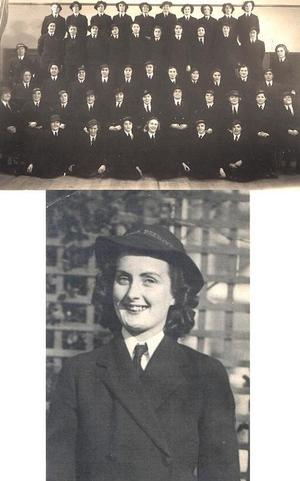
W.R.N.S. at Felixstowe
This story was submitted to the People’s War site by Bill Ross of the ‘Action Desk — Sheffield’ Team on behalf of Maxine Woodcock, and has been added to the site with her permission. The author fully understands the site's terms and conditions.
I joined the W.R.N.S., based at Felixstowe, Suffolk in 1940, where I worked for the naval pay department, on small ships, Motor Torpedo Boats (M.T.B.’s) and Motor Launches (M.L.’s). I was drafted to Chelsea in London, which was a shore establishment.
I was a C.P.O. (Chief Petty Officer). When the small ships were sunk, we had to stop their pay at once. We were inspected in Chelsea by H.R.H. Princess Marina of Greece. She spoke to me as the person in charge of the Pay Corps. I was in the centre of the group and also the smallest (only 5’2”, which was the limit of the enrolment). Felixstowe was H.M.S. Beehive, a shore establishment. I took the C.P.O. writers’ exam in Felixstowe whilst ships were firing at the enemy in the North Sea.
I saw the first Doodlebugs whilst in Chelsea; we all cheered! We thought it was one of the German planes going down. But when we were taking cover in the cellars of Shelley House which was on chelsea embankment, a Doodlebug hit a wrenery just past the Old Chelsea Pensioners' Home. Some WRENS were killed by it.
We usually had to sleep in the basement of our unit (Shelley House) although there were times when we used the London Underground (Tube) during the blackout. Most Londoners, especially the eastenders, slept on the platforms, so when we had to cross London, we had to step carefully on the edge of the platforms.
The West End carried on as usual (was Hitler saving it for himself?). It was easy for the Germans to bomb us, they only had to follow the 'good old' Thames which shone in the dark, although we did have barrage balloons over the city.
As chief, I was put onto the top floor and had to lug my mattress down into the cellars every night, and back to the rooms in the mornings (my place of honour was the coal hole).
We were issued with our uniforms on joining the service: thick navy blue serge suits, coats and jackets, white shirts, black ties, awful underwear, knee length elastic navy blue silk knickers. The enterprising ones among us promptly cut off the legs and, hey presto: trench knickers!! We kept one pair intact for inspection though.
When we joined, we had to take a medical examination. I remember the S.B.A. (Sick Berth Attendant) taking my height measurements. I stood on the scales and kicked off my modest high heeled shoes. "Och, no lassie," he said in a broad Scottish accent, "keep them on. You'll ne'er get through!!" So I qualified at 5'2" - nobody ever queried it.
H.M.S. Copra was also based in Chelsea by the branch. When I became a C.P.O. I had to wear a tricorn hat, based loosely on Lord Nelson’s headgear, so I never got to wear the round sailor’s hat, which the girls in the navy were later issued with. I had always wanted to wear one. I could never understand why female officers were titled “3rd Officer”, “2nd Officer” and “1st Officer”, just like in the Merchant Navy.
The war was changing and combined operators came into force. We had to pay them a fixed amount, the balance to be worked out later.
I was demobilised in 1945 and offered a commission to stay in the Royal Navy, although I wanted to be in civilian life for a change. I declined the offer and have regretted the decision ever since.
Above all, I remember Winston Churchill's wartime speeches. He inspired all of us. We were so proud to be Brits!! He offered nothing but "........blood, sweat and tears." We loved it; we kept our radios on all the time to listen to him: "We will fight them on the land, we will fight them on the beaches, we will never give in!" What a leader. We have never had such leadership; Margaret Thatcher came the nearest to Churchill. Pr-BR
© Copyright of content contributed to this Archive rests with the author. Find out how you can use this.


 Recommended story
 Story with photo