

- Contributed by
- dalbywelsh
- People in story:
- RUBY WINIFRED BURROWS
- Location of story:
- Ostende, Belgium
- Background to story:
- Army
- Article ID:
- A6992959
- Contributed on:
- 15 November 2005
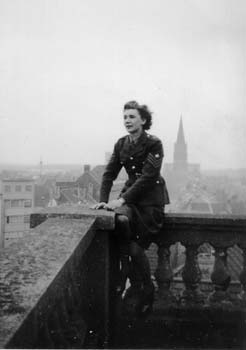
Ruby Burrows relaxing on the top floor of her 'digs' in Ostende
R W BURROWS — W/72235
I think it was 1939 when I did my first war volunteer duty — that was fitting gas masks.
Then in 1941, I volunteered to serve in the A.R.P. (Air Raid Precautions) as a First Aid Attendant on the ambulances.
In the summer of 1941, I entered the A.T.S. and left home for the first time, reporting to my training station at ‘Brine Baths Hotel’ at Droitwich. This hotel had been taken over by the Army. Here we were drilled, disciplined, inspected, kitted out and generally lectured to.
From Brine Baths Hotel, I was posted to Highgate in London to attend the Northern Polytechnic in Holloway Road to train in the ‘Army Kinematograph Service’ (AKS) as an instructor as I was one of 6 selected for this ‘new’ section for A.T.S. There were already Army personnel but they needed to be released for other duties.
We, the chosen six, lived in a lovely house in Highgate that had been requisitioned. We travelled by bus daily to the Polytechnic. I can’t remember how long the course was but we learned simple optics and sound and the function and maintenance of 16mm projectors. We also had one or two lessons on the real thing, 35mm projector.
When we were ready to instruct, we had one or two trial experiences ‘on the job’ and were then posted to Wembley (part of the stadium) to receive our students. We all lived in requisitioned houses (about 3 semi-detached with all rooms turned into bedrooms with one kitchen and one dining room in one of the houses). We paraded every day down to our place of work with drill in the road twice a week.
It was all right teaching the A.T.S. but it was a different thing when we had toughened men of the 8th Army that were invalided out and who had come to learn how to operate a projector. They made it very difficult for us by asking embarrassing questions.
After a time, the A.K.S. had enough units for the job so we went on the road doing the job ourselves. I was posted to Cambridge and Glen Coe in Scotland to do this.
Eventually, it was decided to send an A.T.S. unit to Belgium to give shows to the troops over there. We were the only complete A.T.S. unit not to be attached to the Army in the war. We were sent to Bletsoe Castle in Bedfordshire to muster and prepare for embarkation. It was quite an unforgettable experience. We had a freezing winter with lots of snow, which made it difficult for going to various locations to pick up our equipment and vehicles; projectors, generators, 15cwt trucks and one 3-ton lorry. Eventually the time came to embark on our journey to Ostend.
The sea voyage took three days because the harbour at Ostend was heavily mined, so we spent many a long hour staring out at to sea, with just tins of corned beef and tea as food. The only bright spot was to identify well-known celebrities who were travelling with ENSA on the ship. This was a great thrill, but of course they were not there to entertain us.
We eventually arrived at our new headquarters, which was a tall block of dingy apartments. There were no bathrooms and apart from bedrooms, just a kitchen and dining room. There are many tales to be told about living here, too many to mention, but we survived. Why the R.E.’s chose the top floor to set up a bathroom I shall never know but we had a Belgian man (civilian labourer) who spent his day carrying buckets of coal up to the top floor to keep the fire going under the two big water containers. He eventually was run out of the house because he spied on the girls as they bathed.
The locations that the girls were sent to were in some very remote places, only to be found by map references. Here they had to get their generators going and give the show, sometimes to some very rowdy troops. Coming back at night was very hazardous with ditches and dykes and, of course, no lights, but in all our trips only one van turned over in a ditch. I stayed on a few months after the war ended. We moved to Ghent to wind up the unit.
Once the war was ended it was a common sight to find the Belgians seeking out the collaborators, burning down their properties and persecuting them; for example cropping the hair off the girls. There were continuous brawls in the street.
This was when the NFS (our Fire Service) just stood by to protect British property. It was also the time when the trains arrived in Ostende with the survivors from the concentration camps in their striped overalls and cropped hair, terribly thin and weak. It was a very touching scene — seeing friends and relatives as they waited anxiously in hope for the arrival of their loved ones. It really brought home to us what the war had been all about and \I remember standing in the sunshine, thanking the very brave men who had given their lives and saying that it must never happen again.
Looking back now, I can’t believe I had all these experiences, some enjoyable and some not so good. I was not sorry to be demobbed but found settling down to Civvy Street very difficult after such responsibility and activity.
© Copyright of content contributed to this Archive rests with the author. Find out how you can use this.


 Recommended story
 Story with photo