

- Contributed by
- actiondesksheffield
- People in story:
- ARTHUR WARD
- Location of story:
- Gourock, Greenock on the River Clyde, Capetown, South Africa, Aden, Port Tupheg
- Background to story:
- Army
- Article ID:
- A4453959
- Contributed on:
- 14 July 2005
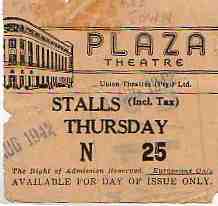
August 03, 1942 — Ticket for entry to the Plaza Cinema, Cape Town, South Africa. The cinema had a sliding roof, which opened completely in hot weather. The price was 1/3d that is 1 shilling and 3 pennies (now 6p). Note: the tickets were issued to Europeans Only.
This story was submitted to the People’s War site by Roger Marsh of the ‘Action Desk — Sheffield’ Team on behalf of Arthur Ward and has been added to the site with his permission. The author fully understands the site's terms and conditions.
Refer to Chapter 1-- A4345544 -for links to other chapters.
LIFE IN THE ARMY
by
ARTHUR WARD
Chapter 10 - The Second Part of My War
July 13, 1942
Now starts the second part of my war story when a great number of men from the 70th Field Regt. RA were posted abroad to join several units for the great push in the desert.
We paraded with all our kit, early in the morning of July 13, 1942. We marched to the railway station and eventually boarded a troop train which left at 06:30 hrs.
We travelled via Rotherham (where at Beighton and Woodhouse Mill I was only 2 miles from home), to Carlisle, Kilmarnock, Glasgow to Gourock which is near Greenock on the River Clyde.
The train lines were right up to the docks so that we did not have far to march.
We could see that in the middle of the river were anchored several "ocean going liners".
We were herded like cattle onto a small ferry boat called a lighter, and were packed so close together that we could not even sit down.
We were issued with a card each which said the name of the ship mess deck we would be on and whether on first or second sitting at meal times. We moved away from land and one soldier standing beside me said, "I do not know how they expect us to travel all the way to the middle or far east stood like this". What a surprise he had when the lighter drew up to a very large liner and a door opened about half way up the ship which looked massive when we were at the side of it and the men started filing off. It was a funny feeling crossing the ladders (or should I say the gangplank) and the water was about a hundred feet below us. The movement of the two ships did not make us feel any better so we were glad when we finally arrived on board.
We found out that the ship was called the "Duchess of Athol" it had been a pre-war cruise liner which took very rich holiday makers to the far east.
We hadn't realised how big it was and it took us quite some time to find our way round. The ship was divided into mess decks and in each compartment there must have been 100 men. There we had to sleep and spend most of our time. It was organised that at the top were 2 rows of hammocks, below them were long tables, then under them the floor. We had a rota where we all had turns in sleeping in the different beds in rotation.
The usual rumours were very rife among the men and the favourite was that we were bound for the far east to fight the Japs.
Another was that 17 July was a Friday and troop ships never sail on a Friday.
Of course at 8 pm on Friday 17 July, much excitement all round and we realised that we were on the move. We were only allowed on deck at certain times and as all the portholes were blocked off we could not see anything if we were down below. We also found out that whenever a ship reached port, as many men as possible crowded the decks and open spaces but we had to go where we were told as there was always a danger that the ship could keel over if everyone moved to the land side of the ship.
We sailed down the Clyde and into the Irish Channel.
Next morning we found out that there were several dining rooms and two sittings for each meal. I was on the second sitting. For breakfast we had kippers, which tasted very nice, one slice of pure white bread and a mug of tea. We were told that the bread was made on board so it was fresh, but we never had enough of it.
On board ship we had to wear running pumps all the time and life belts that we called "Water Wings". The pumps were in case of shipwreck when heavy army boots would have been dangerous.
So many of us were allowed on deck when it became daylight and the sea was very choppy, which caused the ship to roll a lot. This caused many men to be seasick, in fact after a few hours, the mess decks and staircases between decks were covered in kippers which had been brought back up. What a horrible sight!!! I was not actually sick but I did feel very ill.
The conditions on board ship were appalling, due to overcrowding and because the portholes had to be always shut in case of surprise attack, and at night for the black out. During the voyage we crossed the Equator twice and the heat was nearly unbearable, and when asleep, the sweat used to run off the men into the hammocks onto the tables and then on the floor. Most unhygienic and very uncomfortable.
During the voyage, which we did not know was to last 8 weeks, there was a roster, which allowed everyone to sleep in turn on the open deck. This was great out in the fresh air but the rotation worked out at 3 times each, but if there were submarines in the area during the night everyone had to go below, so your turn was lost.
We heard later that we had been attacked 14 times during the voyage, but The Navy had kept the subs away from the troop ships.
The only gambling game (officially) allowed was tombola, which later came to be known as Bingo. Of course many card games were taking place with men posted to keep a lookout for MP's or officers on the prowl.
We had boat drills several times a week, which caused more hardship having, to stand in the tropical sun for some time every time the siren sounded.
After a time we became used to the motion of the ship although all the time aboard we had constant headaches. Another problem were the latrines. These were constructed of long rows of wooden containers with holes in them (similar to the old fashioned earth closets). No privacy at all as there must have been twenty or thirty in each row, about 3 feet apart. Underneath was a large container which was emptied during the night so that submarines or enemy aircraft could not see the trail left behind the ship.
Washing facilities were poor due to shortage of fresh water, which was severely rationed.
The washbasins had warm fresh water for about 2 hours each morning during which time we all had to wash and shave.
Showers of cold water were available most of the day, but although they freshened us up and washed away the sweat, we felt sticky afterwards as it was seawater.
Another problem some of the men had when they took off their shirts for sunbathing, some did it to excess and paid for it later by being burnt almost raw. They did not get any sympathy, as it was an offence to be ill in the army with sunburn.
Another thing we did not like in the hot climate was the number of beetles and insects which climbed up and down the supporting pillars of the decks in their thousands.
One enjoyable thing on board was watching the fish in daytime, we saw many dolphins and flying fish that seemed to travel parallel to the ship. Also at night the stars reflecting in the water and the waves left behind the ship was a grand sight. I think they called this "Fluorescent". Each day we travelled an average of 280-420 miles and the ship's crew ran a sweepstake on the number of miles travelled every 24 hours. This made quite a large amount for the ship's funds but I did not manage to win anything. On the journey we saw the AZORES but not much else as we had to travel nearly to the USA then back to avoid German U Boats and to confuse the enemy as to where we were going.
The meals were not too bad but we were usually hungry as we did not get enough, especially the white bread which was the treat of the day.
Eventually we pulled into the bay of Free Town, which is almost on the equator. We stayed in the bay for 5 days whilst we waited for a convoy of American cargo boats.
I cannot describe how uncomfortable it was for this time in Free Town. There was no movement of the ship, so we did not have a freshening breeze, the air was still and red hot, the metal of the ship was really hot and almost too hot to touch. I would say that this was about the worst 5 days of my life.
It brought all the insects, beetles etc to life and of course extra sweat from hot bodies.
We set off again but the cargo ships slowed us down to about 260 miles a day.
Each morning we had to count how many of the cargo ships were still with us. Several submarines were said to have been sunk by our escort.
Our escort consisted of 3 destroyers and HM Cruiser 'Orion'.
The troopships in the convoy were The Empress of Japan, whose name changed to Canada when the Japs entered the war, The Duchess of York, The Windsor Castle, The Oronsay and ours was the Duchess of Athol. There were all either 2 or 3 funnel ships. I think our ship was a 20 or 30 thousand ton ship and carried 4,000 troops.
August 13, 1942
A great day - Land was in sigh;t it was Cape town in South Africa. We docked about 18:30 hrs. We were paid 10 shillings each and allowed off the ship for a few hours, so we went straight to a YMCA canteen for a good feed, then to the Plaza Cinema and saw Marsha Hunt and Robert Montgomery in "Highway to Freedom".
Everything in the shops was cheap to us and stayed open late (23:00 hrs.) where we bought plenty of fruit and chocolates.
We were excited to see all the streets lit up, no blackout and the troop ships were a marvellous sight on the dock all lit up with the port holes open. Each one looked like a little town on its own.
We had to be back on board before 23:45 hrs.
Friday, August 14, 1942
Route march at 10:00 hrs. for 8 miles. We were allowed to go ashore at 13:15 hours. Straight to a canteen where the food was all free, called the Union Jack Club. We had a walk round the shops where everything seemed very cheap to us. We went to the Alhambra Cinema and saw "You are the One" — a very poor film. We were amazed at this cinema as the roof was open to the sky but it had a sliding roof to shut in case of inclement weather. The newsreels were American. Afterwards, we visited the "Good Cheer Club" where again everything was free.
Then to a dance at the Lord Mayors Garden (free again), this also had a canteen so we were doing very well for food.
They had a system in Cape Town where girls volunteered to entertain the British troops, so at the dance we were introduced to Thelma, Phyllis and Joyce. They looked after a crowd of us by dancing and seeing that we had enough food, and organised transport back to the docks, so we were back on board at 23:45 hrs.
Saturday, August 15, 1942
Route march for 5 miles, allowed on shore at 13:00 hrs. To the Lord Mayor Canteen; had two eggs, bacon, 2 sausages, bread butter, cake and tea cost 7d, very good.
Harry Stead and I met Thelma and Freda at 14:30 hrs. We caught a bus to Camps Bay, one of the local beauty spots. We went to a cafe for tea, then we had a walk on the sands and rocks and climbed through the Glen to Kloof Nek. We rested at the Round House Cafe, which is part way up Table Mountain, where there was a marvellous view.
We rode back to town on a trackless (trolley bus) after a great afternoon. Then we went on a bus to Thelma's house and had dinner. It was a very modern house. They took us back to town in a Chrysler car, to a dance at the City Hall. We left the girls at 23:30 hrs. and made a date for 14:30 hrs. on Sunday afternoon, when we were to visit Rhodes Memorial, and then for dinner at Thelma's house. They asked what we would like for Sunday dinner and we decided on Lamb, so they said her mother would organise a "leg of mutton". We boarded ship at 23:45 hrs.
Sunday, August 16, 1942
To our dismay, there was much activity on ship and the dockside at 10:30 hrs. The ropes were pulled aboard and we set sail. So there goes our Sunday dinner!!!
During the morning, we saw Cape Town and Table mountain fading into the distance.
We decided that this was the most modern and gayest town we had visited. There was no blackout; no rationing and the people were very hospitable.
One thing we did not understand was the colour bar. We had never heard of the words "Apartheid" in those days and the white and coloured people were kept well apart. The coloured people lived in District 6. Everything was marked either coloured or white - the bus stops, toilets, buses, shops all had their own side marked out clearly.
The white people would not mix with the coloured people, except to employ them as servants.
Off the Cape we ran into some very heavy seas and we were only averaging 280 miles a day.
Eventually we stopped at Aden for 24 hours. We had realised that by now we were heading for the Middle East and not the Far East.
At Aden we were in a very large bay and we were surprised at the large numbers of coloured people who came out in all kinds of boats some just to beg for food or money and some who were selling all kinds of clothing, trinkets, blankets etc. It was all taken in good humour as was the banter between them and the troops.
The convoy then split up and we sailed up the Red Sea at intervals, and finally pulled in at Port Tupheg.
Pr-BR
© Copyright of content contributed to this Archive rests with the author. Find out how you can use this.


 Recommended story
 Story with photo