

- Contributed by
- TORRANCE Duncan Leitch
- People in story:
- Duncan Torrance
- Location of story:
- Perthshire
- Background to story:
- Army
- Article ID:
- A7420457
- Contributed on:
- 30 November 2005
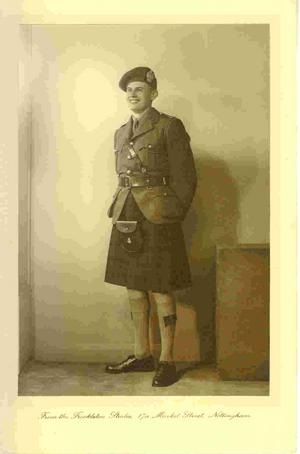
The First Real Acheivement of my Life. A shiney new 'pip'.And just nineteen.
CHAPTER VIII - ON FOOT IN THE HIGHLANDS
That the key to enjoying leisure is work and acheivement is well demonstrated by the pleasure I had from my leave. Further to this, it coincided with Christmas, which simply made time fly.
I was not sorry when I boarded the train for Perth.
I was now going to put to the test all I had learnt, and in a first class regiment, the Argyll and Sutherland Highlanders. And I would be stationed in the pleasant surroundings of Perth. That historic gateway to the Highlands.
I arrived by taxi at No 8 ITC (Infantry Training Centre), and was delivered to the door of the Officers Mess. In the Mess I found the C.O. 2 i/c and adjutant alone, so had little time to prepare myself for the introduction. The 'Old Man' seemed very decent and made me feel quite at home before handing me over to the orderly officer who saw I had a feed and a bed.
In the morning I had a more formal interview and was posted to a company on detachment. I found the new mess very pleasant. It was in an old house on a hill in the outskirts of the town close to the Academy. The other officers in the mess were very friendly and it was comfortable. One could regard it as a home. The barracks mess of the day before, was very regimental, so much so that one never felt at ease.
Our troops were billeted in the City Hall, a part of which was set aside as lecture rooms and offices. The Establishment entitled the company to seven officers, but there were nine doing a job which could be done efficiently by three good people.
Gradually officers got posted out. Just before I left, we were down to three. That last fortnight was very busy and very happy. The written reports on exercises were a chore. A ten page report on a scheme which each of us had to do was a bit of a waste of time.
The first forty-eight hour scheme began with a twelve mile march. It was January, and so cold we only had one halt all morning. In the afternoon the time was fully occupied erecting bivties and cooking the evening meal. We had been supposed to train in the afternoon, but owing to the early darkness, this was carried out on paper only.
In the evening we did a night patrol exercise. But, my sergeant being 'the old sweat type' sent the enemy back to the camp earlier than had been my intention. The night was very pleasant. I enjoyed stealthily shadowing the patrols in the cold crisp mponlight. On returning to camp, we sat round a large fire, drinking cocoa, discussed the nights work, then gradually all went off to bed.
I Was up at 5.30, stone cold. Going to the burn for a wash, I found it practically frozen. I knew it was cold, but it was not 'till I got back to the City Hall, that I found there had actually been
about twenty degrees of frost (Fahrenheit).
A look out had been kept all night to guard against any outside interference and incidentally to keep the fire going. All had found it very cold and slept very little, except one man, he had curled himself round the fire and slept like a log.
After breakfast it began to get a little warmer which only served to permit a blizzard. We were supposed to do some training in the morning and a map reading scheme in the afternoon. But my nature was too soft to set off training in the snow. So, after sheltering for a while, we packed up and marched off to the starting point of the map reading scheme.
We marched or stumbled into the blizzard for five miles 'till we reached an old empty barn, where we halted for half-an-hour. The blizzard degenerated into rain. We were all soaked to the skin anyway, but I could see no good reason for failing to do the map reading exercise. So off they went, in threes cross country, from
the barn.
A Corporal and myself follwed them round the course, as far as possible keeping them on the straight and narrow path. So, we were very surprised when one trio failed to meet us at the check point. I sent the remainder on, and started to hunt for the last section.
After doubling an hour in the rain, I found them. What had delayed them all this time? They had lost their way and sought refuge in a quarry canteen. Angry as I was, I was in an awkward position. I could ignore the incident, I could charge the party in which case they would have got two or three nights fatiques, or I could use my tongue and a little private punishment. I decided on this last course. I ticked them off for their escapade, and saw their training was hard for the next few days. It seemed to do the trick as this was the only trouble I had from any of the platoon at any time.
We marched into Perth looking a little bedraggled, muddy and wet. We sloped arms and held our heads up as we approached the billet. I could not help but feel a thrill of pride run through me despite the afternoon's incident. When I had first set my eyes on these twenty lads, they appeared a crowd of rather dirty unintelligent scruffy ruffians. On the scheme I had got to know them all personally and found my first impression completely wrong. They were all very much human beings, eaoh with their own ideas, likes and dislikes, abilities and shortcomings.
I was somewhat surprised to find the Company Sergeant Major telling my platoon to set about blancoing, polishing brasses and so on, in preparation for an inspection by the Colonel the following morning. I felt that, after what they had done it was unfair, especially when the others had had the afternoon free to prepare, and told the Compahy commander so. He insisted that they carryon. In the morning I was surprised to see how smart they were. Not one was checked.
Saturday was spent preparing for the next scheme, a 72 hour, due to start on Monday. Sunday was spent as orderly officer at the Barracks. I also had to write my report on the last scheme which I did in the remaining time working till two o'clock each night.
The platoon left at 8 o'clock but, as orderly officer,my duties did not finish 'til 9, which spared me from the rather dull first ten miles of the march. I slipped, very literally, in a 15 cwt truck, the roads were iced and the hills whiten,ed by a sprinkling of snow.
The first day consisted of the ten mile march, two demonstrations by the demo platoon, a further ten mile march, fllowed by two hours digging slit trenches and a night exercise. By the time I reached the platoon, the demonstrations were nearly over. So we had lunch and set out to march to an old croft we hoped to use for the night.
It was too cold to halt. So we just followed the custom of marching without halts. Perhaps this sounds somewhat morbid and gives no indication of the pleasure and exhilaration of treading over the crisp ground in a crystal clear atmosphere. There was not another soul to spoil the view across the snowclad hills.
On arrival at the croft, we found things hardly as we might have expected. A lance corporal had been there all day to prepare the place. He was sitting in front of the fire mid an untidy mass of kit and equipment. A little basic English soon informed him of our requirements.
The croft itself had two rooms and a large attic. It was dark and delapidated. In one room there was a small old-fashionned range which was automatically occupied by the N.C.O.s and myself. The room opposite was filled with seven, the remainder having to go upstairs. The attic floor was extremely weak, boards were being continually kicked out. Why the whole floor did not come down I do not know.
Darkness had descended by the time we had cooked and eaten our evening meal, so we had to do our digging as a night exercise. After two hours digging slit trenches we had a short break and then did a patrol exercise. The patrol I took did not do very well, but was so improved the following night that I had to behave very carefully myself to avoid making more noise than they did.
I have always enjoyed night work. Especially those of short duration on a beautiful night, when there is a drink and a fire at the other end. This night was no exception.
I was up at 6.30 in the morning, ready for 'dawn' at 7.00. I had warned them to expect: a stand to in the morning. I made reveille of a rather novel but effective nature by letting a thunderflash off inside the cottage, and a second on the roof. At first I feared some damage as I saw a cloud of plaster and dust fly about inside the cottage. In fact, the stimulous proved effective without being dangerous.
The time taken was seven minutes for all the men to be armed, dressed, and out of the building. This was vary quick considering they were getting dressed in the dark.
After breakfast, the men deepened the slit trenches they had started the night before. This filled in the time until the Company Commander came to inspect the camp.
One fellow had reported sick that morning with a sceptic hand. We should have sent him back sick but he would probably have been put back a squad for missing the exercise. After my experience, I felt competent to treat him. He agreed. The decision taken, I got down to the job. No antibiotics in those days; poultices and bathing in hot salty water to draw the puss. Delighted he soon recovered.
So, now I was still waiting for the Company Commander. The mornings training was supposed to be a field firing schemerun by the Company Commander so was of little concern to us. In fact I had no idea how the scheme was run, or anything else about it. I later discovered that it was an opportunity for the Company Commander to assess the standard of training of the platoon. It was supposed to be run on the following lines as I afterward heard.
The company commander sent out three members of the demonstration platoon to pre-arranged positions, which were attacked by the men in sections. The three enemy were armed with live ammunition which they fired over the heads of the sections which were only armed with blanks.
It was 9.30 when, not the company commader but the second in command arrived with two enemy. Fortunately they knew where to go but had no live ammunition. He and I then got the platoon together. As we walked up, it became apparent, he intended me to be much more than a spectator.
I started off with the first section, uncertain as to the enemy's positions, but somehow blundered through the scheme. I found the section slow in advancing. But, on looking round for the second in command, found he was even slower, so I was landed with giving the criticism as well.
The afternoon was used internally and spent in getting wood, water and all the many other jobs which go to making a camp comfortable. In the earler part of the evening we did a short patrol scheme and in the latter half, prepared for the big events of the 'morrow, Owing to this, it was it was 11.30 before I went to bed. But, unable to sleep, I admired the windows, white from a blizzard which was raging outside.
Our instructions for the morning were as follows.
1. Reveille at 0300. No rations to be issued.
2. Leave 'Croft' at 0400 hrs.
3. Perform routine training.
4. Do a march across ground memorised from maps and return to bi11ets.
The blizzard had already caused me to err from orders. We were to have reveille at 0400 hrs followed by cheese and bread.
I was up at 2.30, unable to sleep and saw the snow getting deeper and deeper.
The blizzard was still in full swing at 05:15 when we evebtually plucked up sufficient courage to leave. We marched, or to be truthful plodded on in single file. The leader was changed every fifteen to twenty minutes.
The snow was nearly a foot deep all over, with frequent drifts so deep that I could not find the road with my walkingstick.
This stick was not without its history. It was an Irish Blackthorn my Father had carried in the First World War. That stick is now in the Royal Armrmy Veterinary Corps Museum at Aldershot with other items of Father?s.
Although tiring physically it was grand to watch the dawn light up the sombre clouds. As if by magic, shortly after dawn, our blizzard ceased.
I left the platoon for a short time to try and obtain authority to march strait back to barracks and stop a ration truck that was coming to us. But I failed to get through.
We got to the farm at about eight o'clock and began to think about our breakfast. We tried to make fires with no success. But for the decRncy of the farmer's wife would not even have got any hot tea. It is amazing how good tea and cold beans can be under these conditions.
Needless to say we did no training, but as the map-reading route was cross-country and took us back towards Perth on a direct route, I decided to do it.
As we went along, a thaw began, and by the time I reached the road, vehicles had worn a way right down to the road metal. We were sitting down by the roadside, waiting for the last trio to finish their map-reading, when what should hove in sight but our ration truck, returning after a fruitless search. It was twelve o'clock, but despite our late breakfast, we soon got stuck into our fresh rations.
Back at Perth, I felt contented. I had done my last scheme as I thought. The platoon still had a further 72 hour one to do. One of the clerks in the C.O.'s orderly room had given me the tip that I was to proceed on embarkation leave.
I was very surprised when I Was called upon to take the last scheme. But, there being no other option, I buckled down to it.
Two days before before it was due to start my salvation came. I was sent on fourteen days embarkation leave.
I was sorry at heart to go. I had developed a great liking and respect for those twenty men I called mine. They had grown on me 'till I became quite horrified at the thought of having no mmre fun with them. We had lived like a family for weeks, but now our lives must follow different paths.
© Copyright of content contributed to this Archive rests with the author. Find out how you can use this.


 Recommended story
 Story with photo