

- Contributed by
- actiondesksheffield
- People in story:
- ARTHUR WARD, Vic Brownhill, Sgt. Finch, Major K Boulton, Chrys Harrison, Jack Potter
- Location of story:
- El Almazah, Khatatba, Helopolis, El Alamein
- Background to story:
- Army
- Article ID:
- A4454156
- Contributed on:
- 14 July 2005
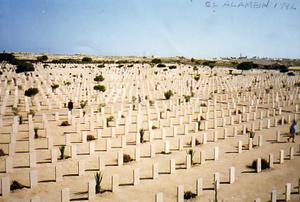
October 1992 — This photograph was taken, on the occasion of the 50th anniversary service, of the Military Cemetery at Al Alamein, Egypt.
This story was submitted to the People’s War site by Roger Marsh of the ‘Action Desk — Sheffield’ Team on behalf of Arthur Ward and has been added to the site with his permission. The author fully understands the site's terms and conditions.
Refer to Chapter 1-- A4345544 -for links to other chapters.
LIFE IN THE ARMY
by
ARTHUR WARD
Chapter 11 — A Practically Unknown Train Stop Called El Alamein
September 03, 1942
We had been on board for 48 days, most of them very uncomfortable, hot, and sticky with a constant headache, so we were pleased to get back on dry land.
We boarded a small ferry, which took us to the docks where a train was waiting for us.
More discomfort as the carriages were just like cattle trucks. We set off about 23:00 hours and travelled all night until 04:00 hours the next day.
September 04, 1942
We disembarked at El Almazah where we marched 3 miles to the Base Depot Royal Artillery Camp.
There I saw Vic Brownhill who came from Sheffield and was an ex member of 70th Field Regt. We stayed there for 3 hours, giving all details etc. then I was posted with all my mates to an RHA Regt.
We boarded a truck and travelled right through Cairo on the main Alexandria Road. We passed within about 1/4 mile from 3 Pyramids and then arrived at a camp at Khatatba.
There we had to report to our new Regt. and told that my address was:
Gnr A Ward 954330 RFHFY
c/o APO 1915.
But soon the address was changed to:
Gnr A Ward
'C' Troop
'A' Battery
11th (HAC) Regt. RHA MEF.
We had never heard of this Regt which we were told had a great tradition and HAC meant Honourable Artillery Company, and was said to be the oldest unit in the British Army. It had been a territorial unit before the war. It was a London Regt so most of the original members came from London, but they had lost a lot of men; killed, wounded or taken prisoner in earlier battles in the desert, so we were there to make up the numbers. RHA meant Royal Horse Artillery and most RHA units were in armoured divisions.
We learnt that we were in the 1st Armoured Division and our Battery ‘A’ supported the tanks of the Queen’s Bays, ‘B’ supported X Hussars and ‘E’ Battery the IX Lancers. We started off by having gun drill on 25 pounders and lectures on desert knowledge.
September 14, 1942
Rumours were rife that we were to have a new self propelled gun called a "Priest" and after a few days a batch of men were picked out to go to Helopolis, which was in the Cairo area, to an American base, to learn how to use the new equipment.
I was very disappointed not to be picked to go as a gun layer, but Sgt. Finch, who had travelled abroad with us, had taken a dislike to me at Nottingham (I regarded myself as a better gun layer than him) and he would not put me on the list.
In a report at the time Major K Boulton wrote for the History of 11th (HAC) RHA in World War II:
" In September 1942 the Regt. received approximately 350 reinforcements who had just arrived from the UK. They had had a most unpleasant voyage and journey through Egypt and looked very sorry for themselves. None had shorts to fit and all wore topees (pith helmets), which the Regt. had never worn since arriving in Egypt, and their white knees, white faces and bewildered appearance created an astonishing spectacle. The old hands made them welcome and after a cup of tea and a hot meal by lights out on the first day, they were all very impressed by the new Regt. Nineteen new officers also arrived to replace the killed, wounded and prisoners of war suffered in the last battles".
After a few days we were all the best of mates. We all knew that a big battle was imminent.
The new self propelled guns arrived. It turned out to be an American 105 mm Howitzer, mounted on a Grant tank chassis of which the top half had been cut off to give more room, and at the front was a circular turret where a 0.5" Bore Browning machine gun was fitted. This looked like a pulpit in a church so the whole thing was called a "Priest". The Regt received a full Quota of 24 Priests, but we learnt later that the Americans had sent 72 in all, but all the others had been on a ship, which was sunk on the way across.
It thus turned out that we were to be the first British troops to use a self-propelled gun in action.
The shells weighed 35 pounds each so it was hard work for the ammunition numbers who had to lug them about. The dial sights were in metric, so all gun layers had to learn how to lay the guns on line again. Also the infantry of the armoured division were now issued with the brand new Sherman tanks, that had a 75 mm gun, which was far superior to previous ones used in battles. I was given the job of Ack Ack gunner in the sub section so I was responsible for firing the Browning at enemy planes, also at enemy infantry if they came close enough.
September 20, 1942
The Regt was split up into two groups, one group were all tracked vehicles and the other all wheels (truck etc). A large number of tracked vehicles massed in one area and during the day when "Shufty' (Arabic for look and see) planes came over, we fired at them so that the enemy knew we were there (behind the Ruw-eisat Ridge). Then at night the engineers built dummy tanks over the top, made of timber and canvas and we all moved. We spent all night with brushes brushing out all the tracks, so for the next few days the enemy thought that we were still there, but we had moved to another sector. Then native troops were allowed to move about in daytime, making fires etc. also making it appear to the enemy that that we were still there.
OCTOBER
Another new method was tried at El Alamein, which was Montgomery's idea. All the top ranking officers were called together on the afternoon of 23 October 1942 and the whole plans were outlined to them, and they returned to their units and passed on all information required so that everyone from the lowest rank to the top, knew what everyone else was doing. Prior to this we only knew what was happening in our own immediate area. This new method proved highly successful, so it was used for all future battles.
The Army name for information was "Griff".
I forgot to mention that in the early days of October we had an intensive training period on the new guns, and I took well to the new metric dial sight. Also in each Priest was a No. 19 wireless set and the gunners were trained how to use this.
Open-air picture places were set up by an Arab called Shafto, and we attended as many as we could, although most of the films were very ancient.
I saw Chrys Harrison and Jack Potter who were in 2nd RHA (Ex 70th).
We then moved up further into the desert, near to the front line, which at this time was static. We called this op. the "Bluey", so called because of the cloudless blue skies in the desert.
We camped at a place called "Half Way House" possibly because there was only one house there with a well for water. There was only one road in this part of Africa and it ran parallel with the coast for many miles, approximately from Cairo to Tripoli which was to be the objective of the Eighth army.
Every day without fail, we had terrible sandstorms, which blew up about 16:00 hours and lasted for half an hour. During this time it was impossible to move so we had to just sit in our bivvies with the flaps tightly closed, and when it was all over, clamber out and move the sand, which had built up into large drifts against everything solid. It was just like being at home and having to move snowdrifts, but much worse than that, as the sand got into everything, clothes, hair, food, so we were glad when we moved from this area.
One day we had a very bad thunderstorm, which was much worse than anything we had ever experienced. Another frightening thing was electric storms, particularly at night when we had vivid lightening but no rain or thunder.
By now we were finding out that it was not advisable to be out in the sun without clothing, as some of the men straight out from England, had laid in the sun on the troopship, but had suffered for it with sun blisters for which they received no sympathy. As I was used to working out doors I was lucky and I became very brown by doing it gradually, and now just wore shorts when not on parade, although in the desert at night it could be very cold so we had to wear Khaki drill slacks, a shirt and pullover.
One day we loaded the Priests on to transporters, which were very big trucks with a low platform where tanks could be strapped on and then moved without using their own power.
We stopped at an area of desert with no name, just off the coast road, and were told that we were 15 miles from a stop of the railway line (which ran very near to the coast road) which had a practically unknown name called El Alamein, and it was there where the two armies were to face each other in static positions.
We were now in 2nd Armoured Brigade in the 1st Armoured Division. The Divisional sign on trucks and shoulder flashes was a white rhino on a black background.
EL ALAMEIN
October 23, 1942
FRIDAY
On the morning of 23 October 1942 we had to all parade and Lt. Symonds told us that the big push was to be made that night, so we would be in action early next morning. I did not shave that morning, as I thought I would leave it until the last minute before moving off so that I would not be so bad the next day, in case we were not able to shave in action. Lt. Symonds reprimanded me and said that we must shave every day, whether in action or not. Little did he know that it would be 5 days before any of us had a chance to shave!!!
Our sub section at the time was:
Sgt. J Rodbard,
Bdr. Bob Pace,
Gunners:
A Ward,
"Chalky" White
Bob Kearney
"Wally" Walton
Don Stewart
Driver Morton.
At 21:15 hours under a full moon and a cloudless sky we moved forward to our starting position.
Until the engines started up, there wasn't a sound to be heard. It was very eerie, and then we heard the drone of a German plane; it dropped one bomb which we heard later had landed near 2nd Armoured Brigade HQ, but had done no damage. I think it helped to put us all on full alert. Were the enemy waiting for us or would the attack be a surprise?
Then at 22:00 hours the flashes of 800 guns firing a barrage, which so far was the biggest ever, fired, lighting up the whole area. It was said that a million troops were involved in the attack.
At this time, I am afraid that, the same as many more men, I had an attack of the runs which meant a walk with a shovel, and more than once.
Note: A walk with a shovel meant walking away from the camp area and digging a hole for a toilet and them filling in the hole.
The noise was tremendous and the air was filled with smoke, the smell of cordite and the dust stirred up by hundreds of vehicles all going one way. This is westwards towards the enemy lines.
We had no time to think of our own problems, as we trundled forward to the minefields, which were waiting for us.
We knew that the 51st Highland Division with their Scottish Infantry men, complete with Bagpipes, were in front of us.
The plan was that 3 tracks had to be made through 2 minefields before daylight. Then the new Sherman tanks would pass the infantry with us following up in support.
The lanes through the minefields were marked with white tape, and military police were there to direct us through.
After a time, dishevelled and dirty German and Italian prisoners passed us going to the safety of the area behind us, then the wounded of all nationalities passed us with blood showing through their temporary bandages.
We were beginning to wonder what was in store for us and we hoped that we would get through it all OK.
I was manning the 0.5 Browning gun in case the enemy infantry got through to us, and I remember a wounded Scottish infantry man on his way back shouting to me, "Give them hell mate just for us". We did not know at the time that we had been given wrong information and that the Browning would not fire, because the ammunition had been loaded wrongly.
October 24, 1942
Disaster. Daylight came and we should have been clear of the minefields, but at 06:45 hours we were still in the second minefield and the infantry were 500 yards short of their objective, so the tanks could not break through. By now bullets were whizzing all round us, so we were thankful for the protection of the armour plating round our tank. 88 mm shells were landing all round and some of our lads were injured. The observation posts called for fire from our guns, so we had to take a big risk and move off the safety track into the minefield and go into action. Fortunately the mines could not have been so thick there and not one Priest or vehicle hit one.
We were all firing continuously all morning. The ammunition numbers had to work until nearly exhausted. The whole desert was covered in smoke just like fog, and it was a miracle how anyone could survive the inferno.
We were pleased to see formations of "Boston" twin engined bombers flying over and dropping their bombs a couple of miles in front of us. They came over 18 at a time at regular intervals, so we called them the "RAF Bus Service". The enemy must have been suffering but they were still sending plenty of shells and bullets our way.
At midday the Highlanders attacked again and were able to take their objectives.
It was found that 3 more minefields had to be negotiated, and the last 2, were not expected to be there. Quite a few vehicles and tanks were put out of action.
The first day in action we fired 200 rounds. Before dark we were mixed up in a tank battle and the battery had some men wounded.
Nighttime did not provide much relief as we had several visits from the Luftewaffe (German Air Force), but except for us losing sleep, not much damage was done.
October 25, 1942
We were busy firing all day and we were shelled and bombed by the enemy at frequent intervals.
German Stukas tried to dive bomb us several times. Those planes have a siren fitted, so when diving down, they made an awful shrieking sound, enough to frighten anyone to death. During the day one Stuka dived down about 100 yards from us and we saw a bomb drop and land straight onto a jeep. When the dust and smoke cleared there was only a heap of scrap metal left. We did not find out if there had been anyone on board.
October 26 & 27, 1942
Two very similar days but the 8th army was slowly gaining ground and the 1st Armoured Division had made a bulge in the enemy defences.
Pr-BR
© Copyright of content contributed to this Archive rests with the author. Find out how you can use this.



 Recommended story
 Story with photo