

- Contributed by
- Julie Howarth
- People in story:
- Philip Howarth
- Location of story:
- Italy
- Background to story:
- Army
- Article ID:
- A8944653
- Contributed on:
- 29 January 2006
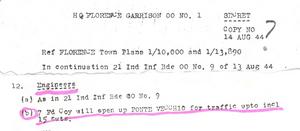
The orders received by Capt P H Howarth August 1944
This is the fourth and final section of an account written by my father Philip Hamer Howarth. It follows on from his experiences with the 2nd Bn King’s Own Royal Regiment in the Middle East and Tobruk (A8943681)to his time in Italy with the King George V's Own Bengal Sappers and Miners (A8944086, A8944356). He wrote it several years before he died in March 2005.
After Monte Cassino the Brigade handed over and was withdrawn, to rest and reform. But not for long. Soon the pressure all along the front pushed the enemy into retreat and the long summer chase up Italy began. We found ourselves on Route 6 trucking through the ruins of Cassino and then into the Liri valley and soon bridging across the Liri river. It was a long chase with a major engineer role to keep the Division rolling forward. Mine clearance, bridges of all types, large and small, demolitions, and for long periods often working 24 hour days. Bridging lorries were often the first to cross a new bridge as the last bolts went in. Frosinome, Alatri, Subiaco, Arsoli, Terni and into Umbria, Foligno, Perugia so the chase went on. We had difficult and black times suffering many casualties but there was also moments of light relief like the occasion when a water-truck driver returned after some delay without finding a suitable source of water but with his tank loaded up with country vermouth, which he happily pronounced to be 'bilkul tikh "vino", Sahib'.
Opposition stiffened in the hills around Perugia and the advance towards the Arno slowed as we approached Tuscany. From Foligno and Assissi we were switched west through Sienna until we were flanking the Americans and we reached the River Arno west of Florence in August.
The engineering problems opening up our routes and dealing with the demolitions left by the enemy were many, very varied and interesting, and perhaps a few are worth special mention. While clearing demolition and disposing of a 500 lb unexploded bomb, one of our own, on lateral routes just south of Florence I was summoned to 21 Brigade HQ in the city to deal with a number of mines in the area they were holding on the South bank. While there I was asked to take at look at the Ponte Vecchio the only surviving bridge across the Arno.
On the 30th July, German soldiers had come from Northern Italy and were ordered on the 31st July to prepare “Feuerzauber” meaning “spell of fire” by mining bridges and the area along the River Arno in order to blow them up and halt the allied advance. During the first few days of August the Allies continued to beat back the German defensive line. On August 4th a series of explosions destroyed five out of the six bridges of Florence and a large area of the historic buildings at either end of the Ponte Vecchio. It was said the city shook as if in an earthquake. The Ponte Vecchio was spared as a result of a telegram order sent by German Supreme Command not to blow up the bridge.
By the time I arrived on the scene about 10 days later, Florence was a fairly "open" city. However food supplies for the population in the Northern half were short and UNRRA wanted the Ponte Vecchio opened to truck in food. I got the job (as the orders for 21 Inf Bde dated 14AUG 44 show).
The bridge itself was undamaged but loaded with demolition charges. However the buildings on the approaches at either end had been demolished in depth and then liberally sown with mines. The Southern approach had suffered very badly. I estimated the depth of debris in the roads leading onto the bridge to be 18 feet and at stages we found ourselves level with and on top of the roof of the ancient bridge. The only way to gain access was to carve ourselves a route over the debris. My sappers went to work clearing S mines and anti-tank Tellermines and constructing a track over the deepest of the debris and onto the bridge. We lifted the demolition charges dug into the roadway across the bridge and on the North side cleared a sufficient area to allow jeeps with trailers to turn right off the bridge and proceed with three inches spare clearance along the colonnaded side walk of the Corridor Vasariano towards the Uffizi Gallery, bounce down a flight of steps and into the city. It was a day's work and I drove my jeep on the inaugural crossing to test it out. The bridge was open again albeit with limited capacity. The Indian Army's contribution to the architectural history of Florence! Unfortunately not without cost; two Italians who volunteered to help died when they triggered off a group of electrically connected S mines and one of my chaps was wounded. [Minutes of the Conference held at HQ 71 Garrison on 15AUG 44 (held in the National Archives at Kew) record these deaths as occurring at another bridge but my Dad’s memory was clear that they died on the Ponte Vecchio].
Months later at the end of the year we were bridging our way along the Senio valley route on the Northern side of the Appenines. The river ravine was deep and the many bridges required were all big ones. 'SAUL' bridge created a record because it involved building a 70 ft double truss Bailey pier as well as a 30 ft pier on top of a buttress on the far bank. We were involved in a lot of work clearing existing masonry to make good bases for the piers and on the far bank the buttress was chambered and we had to cut it away until the arches above the chambers and the Bailey 10 ft module were compatible. In the depths of the winter there was snow on the bridge when we launched it, and the site was under distant observation by the enemy. To get to the far bank meant following a path to the bottom, some 100 ft below, fording the river and climbing out again. There were several days working and each morning we discovered the path to be freshly mined again despite overnight bridge guards. It was completed and opened on Christmas Day 1944, and the next day we moved back across the mountains and over to the Serchio valley North of Lucca in the American sector on the West.
The Serchio had roads running forward on either side and again there was more bridging to be done. 7 Company's most interesting job there was TIRCHIA bridge crossing the Serchio to connect the two roads. The gap was 170 ft requiring 210 ft of bridge and one side was 12 ft higher than the other. There was virtually no launching and building space and we could not shut down the two forward roads. We had to resort to counterweighting the bridge as we built and for this purpose used a heavily loaded Matador truck with a high located transom and reversed roller bearing on the top Bailey chords. Watching carefully I saw the Matador gently lift a couple of inches and swing just as we touched down on the 130 ft distant pier!
I had been abroad for four and a half years and qualified for repatriation. I took an opportunity to speak to the Commandant of the Bengal Sappers when I was asked to escort him to a cinema show in Maradi during his tour of all the Bengal units in Italy. I was at pains to point out that I didn’t want automatic repatriation to England as I had a fiancée in India. He must have recorded this, as to my later surprise I got a posting back to India and arrived in Roorkee in March 1945. Wilma and I were married in Bangalore on 14th April and finally made it to England in September 1945, just over 5 years since I had left home.
Post war, Dad returned to Italy on a number of occasions and took us to the places they had built bridges. The Ponte Vecchio was always a special place to him and he was proud to have helped save it from destruction.
© Copyright of content contributed to this Archive rests with the author. Find out how you can use this.


 Recommended story
 Story with photo