

- Contributed by
- donaldbramwell
- People in story:
- Rosamund Mary Berry (nee Gregory)
- Location of story:
- Africa
- Background to story:
- Civilian
- Article ID:
- A4650653
- Contributed on:
- 01 August 2005
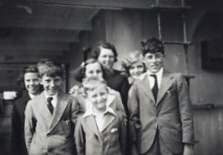
Some of the children on the Llangibby Castle
Wartime Voyages to and from Africa
It was 1939. I was a domestic science teacher, 25 years old and about to go out to the Church of Scotland Mission in Nyasaland, preceded by a course at the Women’s Missionary College in Edinburgh. When war broke out the college was closed and there would be no sea passages for civilians.
The Women’s Voluntary Service lost no time and I was asked to open a hostel for Kings College medical students. A quick shop in the town (Horsham, West Sussex) procured the essentials and the students fixed up the blackout curtains. I was there for several weeks feeding the students with the help of kitchen maids.
After a while the college in Edinburgh re-opened and the Colonial Office made passages available. It was realized that missions in Africa could look after women and girls while their men were away with the King’s African Rifles and so our work would be considered a reserved occupation.
I was travelling with a couple and their son returning to Nyasaland after home leave and another missionary going to Kenya. It was August 1940 and we had only a few days’ notice of sailing. From London we travelled on the boat train, not knowing from which port we would sail, until we arrived at Liverpool. There we boarded the Union Castle line Llangibby Castle and learnt that we would be one of the last unconvoyed ships to leave Britain. We took six weeks to arrive at Cape Town, zigzagging and calling at one port which we assumed was off the coast of West Africa.
There were a hundred unaccompanied children on board, travelling out to their parents in Uganda and Kenya. We single women were invited to entertain them in any way we could. I offered to take them for musical exercises and dietetics! The exercises took place on the boat deck accompanied by the ship’s accordion player. The dietetics lessons (healthy-eating in modern jargon) were conducted entirely by questioning and I had the pleasure of a very intelligent group, enjoying the subject.
We were each also asked to look after a group of children for boat drill. There were twelve in my group. I have photos of some of them. It would be good to meet them again. We later received letters of thanks from the Crown Agents for the Colonies.
On arrival at Cape Town we were told that our ship was to be taken over for troops and that we must disembark at Durban, with the possibility of boarding the next ship to arrive. We booked into a hotel and after five days’ wait the ship came in and was full. So we had to make our way overland. We travelled by train from Durban to Salisbury, passing through beautiful scenery. On arrival at Salisbury we took advantage of the regular transport which ran between Salisbury and Blantyre by car and lorry spending a night at Tete, crossed the Zambesi on a pontoon and so on to Blantyre, travelling on a dirt road all the way.
That was my experience. It was a testing time for all the passengers. The town of Durban suddenly had to receive a whole ship-load of people who would have to wait for an unknown length of time for some means of travel to take them to their various destinations.
The Durban people responded wonderfully concerning the children. A long line of cars, trucks and Landrovers drew up alongside the ship to collect the children as they disembarked, two,three or four children to a car, taking them to their homes till means of travel to Uganda or Kenya was available.
Adults also were helped in finding accommodation. My fellow-traveller, who was a nurse,felt very blessed in that she obtained a post as night staff in a hospital, thereby providing her with accommodation and food for the next two-and-a-half months when she was given a passage on a Dutch trading ship going up the east coast to Mombasa.
It would be good to know that the people at Durban were duly thanked for their help and kindness.
I began what was to be five years in Nyasaland, at first moving from station to station because of unsettling war events.
The War affected us in relatively minor ways. There was a shortage of staff, some having gone north with the K.A.R., others unable to return from home leave. Some staff served long periods over their normal four years. Home mail was very irregular, often none for six weeks or more, so we had the anxiety of not knowing if our families at home had escaped the bombing, but we did not suffer the day to day traumas of the war. Education materials were very scarce. There were of course no imported foods; a tin of corned beef was a rare luxury.
On September 6th 1945, with five days’ notice, I was given one of the first available passages home, sailing from Cape Town on the old Mauritania which had been converted to a troop ship. There were 8,000 troops on board. The captain did not want civilians and it was made clear we travelled at our own risk. We women enjoyed officer status, whereas the men slept in hammocks and queued up with tin plates. There were eleven in my cabin, including Baden-Powell’s daughter and her children. Unfortunately there was a lot of pilfering on board.
We reached Britain in thirteen days, having the thrill of seeing the White Cliffs of Dover. But it was very stormy. The ship, being too big to dock at Southampton in the bad weather, we sailed round Ireland for two days till the storm calmed. And so I disembarked at Southampton to war-torn England, just five years since leaving.
Rosamund Mary Gregory (maiden name)
August 2005
© Copyright of content contributed to this Archive rests with the author. Find out how you can use this.


 Recommended story
 Story with photo