

- Contributed by
- actiondesksheffield
- People in story:
- Reg Stone
- Location of story:
- Huddersfield area of West Yorkshire
- Background to story:
- Civilian
- Article ID:
- A4017953
- Contributed on:
- 06 May 2005
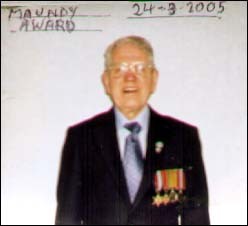
Reg Stone all dressed up to meet Queen Elizabeth II to receive his Maundy Money at Wakefield Cathedral March 24, 2005.
The trials on the home front in WWII
By
Reg Stone
In 1939 just prior to the start of WWII, I was a young man starting cycle touring, and had joined the local cyclist-touring club. At the outbreak of war, all signposts were taken down, and not being able to take maps with you for security reasons.
You can realise how difficult it was to find your way. Also, army posts were set up in the countryside, you were challenged for your identity, and had to produce your identity card; also after dark, all lights had to have a mask over the front of your lamp showing only a slight downward beam.
I worked as a textile worker at the outbreak of WWII; most mills were already processing army, navy and R.A.F. uniform cloths. As from 1938 when Prime Minister Chamberlain went to see Adolf Hitler, and came back, the powers to be realised war was inevitable.
My job was to see that black out covers were put under the skylight windows, air raid wardens would soon let you know if any light was showing, in case of an air raid. Also fire buckets had to be filled and stirrup pumps in place, for this you qualified for the defence medal.
At the outbreak of WWII The War Office ordered that all metal railings around your house had to be taken away as scrap metal for making arms etc.
As London was a target for the German bombers, most of the young children were sent north as evacuees, until better days came along. All were carrying their gas masks in small boxes, and a label on their coat, they also had their ration books of coupons, which had to be produced to get food from the shop. A small allowance was provided for their keep.
As a recent widow, my mother had three teenage sons, a daughter, and a four year old son. We all had to live on ten shillings (50p) a week widow’s pension, so the three boys handed over their wage packets to her, because that was the practice up to being 21 years of age.
Early in the war, all three teenage boys were called up into the forces, one in each service. On losing the pay packets of the sons, we had to give half our service pay to our mother. My particular pay was two shillings a day, so this left me with one shilling per day or seven shillings a week (This is equivalent to 35 pence per week today).
Pr-BR
© Copyright of content contributed to this Archive rests with the author. Find out how you can use this.



 Recommended story
 Story with photo