

- Contributed by
- sallyspecial
- People in story:
- Irene Griffiths, Sir Augustus Walker
- Location of story:
- London
- Background to story:
- Royal Air Force
- Article ID:
- A6080852
- Contributed on:
- 10 October 2005
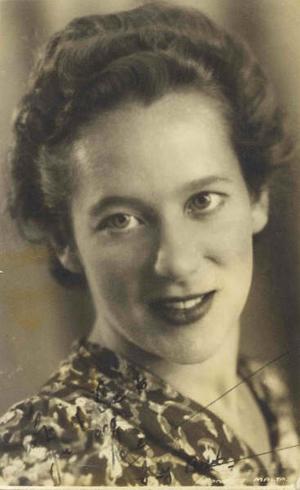
Rene Bussey July 1946
This is my aunt Rene’s wartime recollection:
A YOUNG TYPIST AT THE AIR MINISTRY
The day war broke out
Sunday 3rd September 1939 dawned bright and sunny in suburban north London; after a breakfast of eggs and bacon, I got out the deckchairs and sat in the garden soaking up the unexpected warmth. My two sisters must have been there too, although I can’t recall them being with me in the garden. I remember bumblebees were busy among the honeysuckle on the rustic arch, raspberries and blackberries ripened along the fence, and everywhere dahlias, gladioli and michaelmas daisies were in full bloom. It was an idyllic late summer day. Then, as 11.15 a.m. approached we all reluctantly moved into the drawing room to join Mum and Dad, the battery-powered wireless set was adjusted by Dad and we settled down to listen to the Prime Minister’s scheduled broadcast. There was little doubt as to what he would tell us.
From 30th September the previous year, when Neville Chamberlain had landed back from Berlin, waving his piece of paper and declaring ‘peace for our time’, preparations had been under way for the inevitable war with Germany, using the breathing space gained to become as ready as possible.
The year before
In that September of 1938 I’d turned 20 years old. I was a shorthand typist, working in my first job, which was in York House in Kingsway, in the typing pool of the Air Ministry. In the year leading up to war I saw trenches dug in the London parks, and sandbags being filled. We typists were instructed to practise typing while wearing civilian gas masks. We found this virtually impossible, and fortunately the idea was abandoned.
In the offices at work young men appeared wearing Air Force uniforms, and we young typists found them wildly romantic. The men said they hated being stuck behind a desk and couldn’t wait to get back to their squadrons. I remember one attractive young officer who used to say gleefully ‘I think the balloon’s about to go up’. He was Flight Lieutenant Gus Walker, an international rugby player. He went on to a distinguished flying career, losing his right arm in 1942, and eventually becoming Air Chief Marshal. We all clamoured to be chosen to take his dictation.
We typists were equally impatient for things to happen, to the horror of our elderly messenger, a veteran of the Great War. ‘You young things don’t know what you’re talking about,’ he grumbled. It didn’t take long for his words to come back to haunt us but at that time my main feeling was excitement; we couldn’t wait for the outbreak of hostilities.
One day at work volunteers were sought to work overnight. After a quick meal, three of us crossed Kingsway to Adastral House, where we were set to typing mobilisation orders. Some time after midnight all the orders had been neatly stacked, and we were about to start a game of Monopoly. Then we were told we could stand down: Parliament had risen, and there would be no war. We must have slept in the office that night, as I remember being woken by the cleaner at five a.m.
The war starts
Now, several months on, time had run out. Hitler’s annexation of Poland was proving the last straw and Britain had belatedly issued a two-day ultimatum. ‘I have to tell you now’ the Prime Minister told us, ‘that no such understanding has been received and that consequently this country is at war with Germany’. Even as he finished speaking an air raid warning sounded across the country. It proved to be a false alarm. We had entered what became known as the Phoney War. I remember those as halcyon days; nothing seemed to be happening, as both sides geared themselves up for the approaching struggle.
Then, in the early days of 1940 I was given quite the strangest job I’ve ever had. Alone on night duty, I was in an office equipped with nothing but a couple of different-coloured telephones. It was my duty to receive messages on one telephone and pass them on by the other telephone: the names of village after village, town after town, as one by one the European countries surrendered to the invading armies — Denmark, Norway, France, Luxembourg, Holland, and then, on the 28th May, Belgium. I did my job carefully; looking back it seems a big responsibility for a 21-year-old typist.
The terror of the pilotless planes
Another strong memory of the war is the dreadful arrival in 1944 of the pilotless planes, Hitler’s last desperate bid to defeat us. I had become used to the stomach-churning two-tone wailings of sirens heralding the approach of enemy bombers, but the sheer terror when the engine of the pilotless planes cut out and it was anyone’s guess where they would land and explode never quite left me. These ‘V1s’ were dubbed Doodlebugs. Later that year came the ‘V2s’, which gave no warning at all. Yet we did learn to live with the pilotless planes. This was summed up in a popular jingle of the day, which went something like this:
‘If the word supersonic comes wafting your way
Be neither astonished, nor fear it
It’s simply that someone is trying to say
It hits you before you can hear it.’
Irene Griffiths (nee Bussey), born September 1918
© Copyright of content contributed to this Archive rests with the author. Find out how you can use this.


 Recommended story
 Story with photo