

- Contributed by
- TORRANCE Duncan Leitch
- People in story:
- Duncan Torrance
- Location of story:
- Lybian Desert.
- Background to story:
- Army
- Article ID:
- A7465151
- Contributed on:
- 02 December 2005
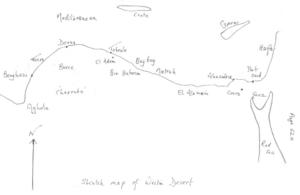
Sketch Map of Western Desert.
CHAPTER X - Part One -BURY ME OUT IN THE DESERT IN THE HEAT OF THE LYBIAN SUN'
My Green Howards Sergeant.
It was on that famous single track railway that I travelled to Tobruk. My posting came through eventually one Sunday for 25 Graves Concentration Unit. I was kept waiting a week before startting this great journey on a weekly train that ran on Sundays only.
I was glad to see the last of the Delta, with all its filth and dirt, both mental and physical. The desert was not quite what I had expected. There was sand, but only a thin covering which sat in the crevices of rock. Sand did exist in places, but was more like sandstone than sand, in others harsh granite stood bare.
The ravages of war were apparent euerywhere. The desert was strewn with derelict vehicles of every type and make, both of our own and the enemy.Shell cases, ammunition, and even a few guns, and, of course, an endless countless number of old petrol tins of all sizes and shapes from 2 to 44 gallons.
The night was cold, but this time I was better prepared with three pullovers and a greatcoat. Even with all this warm clothing, I didn't sleep much after three. At seven o'clock I got a grand hot cup of tea from the NAAFI car on the train. At ten we pulled into Tobruk, just 24 hours after leaving Cairo.
A truck was on the sand ready to meet me and take me through that war shattered heap of rubble to my unit. I was introduced to my new C.O. who told me that the unit was preparing to move to Fort Capuzzo in three weeks. They were doing no desert work and I would in all probability be posted before the move. A cheering start.
We had a very comfortable mess with five members. Our batmen and mess staff were all German PW?s (P's W for the pedantic) and did their job exceedingly well. The cook in particular excelled himself providing food the like of which I had never tasted. As I went round Tobruk, I saw an enormous number of PW's performing every conceivable job, drivers, traffic control, clerks, builders. They even had their own Regimental Police. They far outnumbered the British Troops. A standing joke was that, after all the fighting and eventual Victory, it was the Germans who occupied Tobruk.
I had done no real work now, apart from a few odd days, since I was commissioned and found further weeks inactivity extremely irksome. We had heard a great deal of the shortage of officers. How were they using the ones they had got? There was little room in any of the infantry batallions. The First A and SH were at Te Aviv, with six officers surplus to establishment. Others appeared to be the same as only about ten per cent of the infantry subalterns that came out with me ever reached batallions. Most of us were employed extra regimentally at PW camps, transit camps, leave camps and the like.
In a few days a posting came through for me to proceed with another officer to Benghazi. We travelled up in a 15cwt Dodge, making Derna in the first day, a matter of 120 miles. It seems nothing to someone who has not travelled up the Desert Road. But, to those who know its width, twists and turns, but above all, its terrible surface, it becomes at any rate a respectable day's work.
Soon after we left Tobruk, the desert became less barren. The sand was a remarkable red colour and sufficiently rich to produce good crop of gorse bushes.
Derna lies at the bottom of a steep pass. It is grand to look down and see it nestling there, a collection of quaint buildings set in a deep blue Mediteranean. The pass itself is a steep,winding road including six or seven hair-pin bends. A rather sarcastic notice at
The top forbids overtaking and enforces low gear.
I pictured two streams of traffic on this road at night, without lights. The one rushing madly Westwards with petrol, ammunition, water, and rations. The other tearing back for more supplies. One or two derelict vehicles littered the pass as a constant reminder.
In the morning we started on our journey to Benghazi. A 186 mile journey which was to become very familiar. Ten miles outside Derna, we left the coastal plain and climbed up another pass every bit as bad as the one we had just come down. It would be wrong to assume the desert road was either strait or level. From Derna to Benghazi, it winds in and out of wadi's (dry valleys), and is by no means flat.
Eighty miles beyond Derna we descended Wadi El Kuff. Equally the most beautiful and the most dangerous pass on the road. A ring road had to be made for all vehicles over three tons. The Italian road was very good and very safe for ten-tonners. But the road we used was improvised as the orginal one had been blown up by us during the second retreat.
We crossed the semi-fertile plain of Barce, and then began winding in and out again. Some fifty miles before Benghazi, we descended Tocra, the last big pass, onto the coastal plain and roared up a level straight dull road.
The position in Benghazi was typical of Army organisation. There were in the first place two Graves Registration units working as a Concentration Unit. A Registration unit was equiped simply to register graves. A concentration unit was equiped to exhume and concentrate casualties into military cemeteries. There was only transport for one Registration Unit. The office was far too small, two tiny rooms in District H.Q. The men's billet was two miles away in one direction. The officer's mess was a mile-and-a-half away in the opposite direction. Our stores were housed in yet a third small room lent by The Army Education Corps.
Here I had hoped for work, but once again found none, unless being of the H.Q. office boys be considered work. We had a surplus of officers in comparison to labour, drivers and vehicles. So, as might be expected,I became no better than a clerk. Thats where I typed up a lot this account from the hand written draft.
The first'trip I did was to Derna and Mechili where we camped for five days. The party consisted of three officers four drivers and twelve German POW's. Our first day was spent travelling up that familiar road to Derna where we spent the night. As well as our own two 15 cwts, we had borrowed two three tonners from a transport company. We had quite a thrill when one of the three tanner drivers missed his gears and started to run back as he struggled up Wadi El Kuff.
In the morning we set off to Mechili, forty miles South in the desert proper. On the way we noticed a horse by the track obviously only a few hours dead. But, on our return five days later, the kite-hawks had shifted every bit of flesh leaving only dry bone, hoof and mane.
On arrival there, I was made orderly corporal. My duties were to attend to the minor details of the camp, preparing the bill of fare, latrines etc. I had two German labourers, one to cook, the other as a fatigue and batman, and two German drivers. None of the four men had a word of English.
We were fortunate as far as wood was concerned. Near the camp was an old Turkish Fort, with the remains of a hut. We burnt some of it for cooking and afterwards discovered sappers from Derna were in the habit of sending trucks there for it. The fort naturally meant water. Although not good, it served for washing, making life tolerably civilised. My duties may have seemed simple buy were extremely boring. The days seemed long with only four Germans as companyand little work to do. The OC of the expedition knew some German, and did not appreciate my difficulty in getting the POW's to understand what was wanted.
A word here about the state of the bodies themselves may prove of interest. Those buried in the desert were as a rule just bones. At Mechili however, we came across a lot that were completely mummified, I suppose by the interaction of sun and salt. Later we came upon cases, especially in Benghazi, where Italians were fond of using coffins. Some of these were very messy and solid with maggots. In two cases, they had used sealed zinc coffins. They were terrible. We had to puncture them to allow the fluid to run away. The finger tips on the bodies were still pink.
Back in Derna we were faced with a problem. There were no graves prepared, and already our load had become a little offensive. At 10.30, it was decided that I should take a three tonner and a 15 cwt truck back to Benghazi where graves were open ready to receive our 75 guests. By 11.30, we were off.
It was somewhat disconcerting when, at about 1.30, a cloud of dust rose from the rear af the three tonner. She gained a heavy list to starboard, and stopped with a burst tyre. We fitted the only spare, and checked the other three. In two hours, the opposite rear one had built up from 70 to over 100lbs pressure.
We travelled on to within eight miles of our goal, then the three tonner's other tyre went. We had no spare. This time it wasn't quite such an amusing incident. Eventually, we put the 15 cwts spare wheel on, and finishing the journey by crawling into Benghasi at about ten miles an hour, as the night closed in on us. I had such a load that it took us two days to bury them.
The three tonner was sent back to the transport company and we returned to Derna in the 15 cwt. In Derna, I was presented with a cemetery of seven hundred enemy, an old and extremely innaccurate Italian register, and told to get on with it. Some of the locals are notorious for their thieving, and used to make our jobs much harder by stealing the crosses for firewood. In some cases, the crosses were the only means of identification. On occaisions they used to dig up bodies we'd buried, and take the old blankets we'd used to wrap round the bodies. The worst case of all was when they raided a loaded 15cwt truck. They undid the bundles, took the blankets, and left the remains loose in the truck.
Derna cemetery was different. It took me two days to decide on the identity of everyone in the cemetery. Some I took from the crosses. For others, I resorted to the register. It wasn't always helpful. There were even names like 'Crocce Ferro'. A further two days were occupied in making a fair copy of my new register, and drawing a plan of the cemetery. It gave me quite a thrill when I found it took our two clerks five days to type the register.
All the casualities in Derna Civil Cemetery were enemy, mainly Italian. It was tedious working with unfamiliar names and unfamiliar writing. The policy was always to try and identify enemy dead. But they were only moved to military cemeteries when their present grave was unlikely to survive in perpetuity:
In Derna, I discovered a very pleasant walk, up a wadi, little more than two miles from the Transit Officers Mess. This was a spot where the rocky hills were almost sheer on either side for 6-700 feet. It was great to sit there on a boulder at night, watching the moon and stars hemmed in by the towering, jagged cliffs on either side. In this wadi was running water, a thing I?d only seen in one other place on the coast. One heard the water rickling town the hill, rivalled only by a thousand crickets and the odd dog barking.
On Easter Monday we visited another place, rightly famed as the beauty spot of the coast. Forty miles West of Derna, a road runs down to the coast, through a Precipitous wooded pass, Lamluda, containing a trickle of water. The view from the top is wonderful. One may stand there in the shelter of green trees and see a thousand feet below, sparkling in the sun, the little Arab village of Ras IL Hilar. When viewed without the smell, its very attractive.
The village itself is in a bay, a deep blue bay of the rich colouring only the Mediteranean possesses. If one can picture the scene, and realise the heat, it will be understood how we were uncontrollably siezed with the idea of a bathe. We tore down the pass in the 15 cwt, and then rushed into the water. On getting out, we suddenly saw a sight which brought us back to the realities of life. A big black sea mine lay not fifty yards from us.
© Copyright of content contributed to this Archive rests with the author. Find out how you can use this.


 Recommended story
 Story with photo