

- Contributed by
- Frank Yates
- People in story:
- Frank Yates, General Ross, Ken Kenway
- Location of story:
- Hilden Barracks, s' Hertogenbosch
- Background to story:
- Army
- Article ID:
- A7406750
- Contributed on:
- 29 November 2005
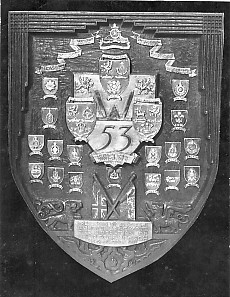
The s' Hertogenbosch Shield showing the badges of the units involved in the liberation.
Memories of Frank Yates CHAPTER 45
The anniversary of the ‘s Hertogenbosch Battle was approaching, in October 1945, and the Dutch wanted to make a big thing of it, They were to present Gen. Ross with the Freedom of the City and they wanted to entertain a large number of men for a couple of days. There would be ceremonies and celebrations as well as a football match. The General arranged to have an artist, in Dusseldorf, make the ‘s Hertogenbosch Shield. The shield, made of black bog oak, is carved, in relief, with the badges of all the units in the Division, picked out in colour. This impressive piece of art has been on display in the Welsh Room of the old town hall for the last sixty years. During October 1945, it was my duty to take it round the division so that every soldier could have a look at it. A large plywood case had been made, to protect it, and I took it to two of the brigades, leaving it with them for four or five days each, so that they could show it to their infantry battalions and the attached R.A. and R.E., troops, then to the Recce Regt. and the other independent units, represented on the shield.
158 Brigade was in Ghent, now detached from us, but of course, their representatives were required for the big shindig in Holland. Detailed orders were prepared for them and muggins got the job of delivering them by aeroplane! to Ghent. I duly arrived at the Air O.P. field, just up the road from Div HQ. The captain pilot strapped me in the, side by side, cockpit of the Auster and apologetically explained that the airstrip, made with a temporary steel mesh strip, was to be upgraded, the hardcore being stacked in heaps each side of the narrow airstrip. He also comforted me by remarking that, before the tail lifted, at take off speed, he wouldn’t be able to see in front for the b****y engine!
In fact, there were no problems in taking off, and we were soon over the Rhine at Dusseldorf, where we ran into fog. My cheerful friend informed me that he was lost but would fly a compass course until things could be seen again! This was my first trip in an aeroplane, and to make me feel more apprehensive he told me of his brother in law whom he met in Normandy, an officer in the R.A. They were using 3.7 AA guns in a field artillery role and the brother in law begged a trip with him to observe the fall of shot. He did more than observe the fall of shot, a 3.7 shell went through the cabin, with a terrific crash, at an angle, taking off his head and passing behind the pilot and out at the other side, leaving two broken windows and a cockpit dripping in blood. My pilot told me that he only just managed to put down, before he fainted!!
After getting over this macabre tale, I noticed that we were now over a sunlit Belgium, following the railway towards Bourg Leopold. At this time, I made the unfortunate and uncomfortable discovery that I wanted to pee! I confided the news to my friend who simply landed the thing in a field, where I climbed out and thankfully relieved myself. I now had another new experience; to “Swing the prop.” I was shown that the switches for the two magnetos were off and was told that I must swing the propeller to prime the cylinders, then when he shouted “Contact”, he would close both switches and I would swing the propeller, keeping my thumbs and all fingers on top of the blade, smartly getting away whether the engine fired or not. A yell of “Switches off” prompted me to pull over the heavy propeller. Then came the yell of “Contact” Apprehensively I heaved down on the blade and an ear splitting roar greeted me as I backed away. When we resumed our flight after a bumpy take off, Tom, (I can’t remember his surname), explained why he had landed so quickly “Took a major to Brussels last week, silly b****r felt sick and didn’t tell me. He slid the b****y window open and spewed. The slipstream blew it back as a fine spray” I said” I could hardly have peed through the window”. “No, but you would have ruined my passenger seat!”
We landed at Ghent airstrip and I was met by a car from 158 Brigade, which took me and my briefcase to their HQ. Tom stayed with his plane and his AOP pals at the airfield and asked me to be as quick as possible, in order to be back in Dusseldorf before nightfall as there were no night flying facilities at these primitive airstrips. I handed over the orders to the Brigade major, enjoyed a quick snack with them and returned to the plane,
The return journey was uneventful, (Thank goodness), but as we crossed the Rhine, Tom said that he was not landing at Hilden with those piles of building material by the strip and our destination would be Dusseldorf, with its pre-war airport, complete with its tarmac runway, One last surprise to me, (The fledgling flier,) was suddenly leaning over, at a near vertical angle, staring down at the ground from my window as we banked steeply to line up with the runway. Safely down, Tom telephoned his mates at Hilden, who sent a jeep for us. The Hilden AOP unit transferred to Dusseldorf for a month during the laying of the new runway, so I was the last passenger to leave the Hilden grass airstrip. I might mention that the next time that I flew in an aircraft, 32 years later; it was a Boeing 747, 300 seater with in flight films!
You would think that, as I had been so concerned with the Den Bosch preparations, that I would be going to the celebration, but I was not invited! Don Phelps, who had just been awarded the MBE for his services as GSO (Intelligence), was going with the football team. The ceremony was a terrific success and has been remembered, on the Anniversary, every year, for the last 59 years by an influx of Welsh Div, veterans to hold a ceremony at the Welsh div monument, erected in the Town. It has been my ambition to, one day, visit the Town Hall in Den Bosch and look at the shield which was in my charge in those long ago days, but, as I am 83 years old, as I pen these notes, I would not easily get insurance for the trip.
Down the road towards Hilden, in a large house, was a Russian Military Mission. There was a huge camp, located on the road to Wuppertal, and the Russian presence was concerned with their welfare and eventual repatriation. The unit was commanded by a major, a frequent guest at our mess.
A German girl was murdered in Hilden and the police knew that a Russian soldier had committed the act. They attempted to arrest the Russian, but were rebuffed by our friend, who refused to release the murderer, and denied access to the German police. I can understand the Russian way of thinking that the matter was trivial, and a defeated enemy had no rights anyway. In Western Military Law, however, a soldier who commits a civilian offence in a foreign country is subject to the Civilian Law of that country.
The Police approached our General, in whose area the Russian HQ was situated, and he ordered the Major to hand over the soldier, with no effect. The matter was referred to Army who contacted the Russian HQ, in Berlin. The Russians, probably not relishing the possible adverse publicity, ordered our friend the major to release the murderer and to report to Berlin for interview. A week later a new major arrived and we asked him what had happened to our friend. He said that, unfortunately, he had been killed in a motor accident, on his way to Berlin!
It was not long before the new Russian CO. arranged a film show at the local cinema in Hilden, for the benefit of the internees at the camp. Our general and the GSO 1 were invited to the Saturday afternoon matinee. There was not the slightest chance of them going, but to avoid a direct refusal, Ken and I were told to attend in their places, representing the general. I don’t know the thoughts of the major, who got two lieutenants instead of a general and a colonel, but we thought he was lucky to get us!
On the Saturday afternoon, a Russian driver arrived outside “Fircombe Hall”, got out of his wonderful Mercedes open tourer, no doubt looted from some high ranking German, and then produced a large throwing knife which he put in his mouth, horizontally, and BLEW it out, to stick, quivering in a tree. We watched from my bedroom window, as this circus act was repeated several times. When we went out, he, obviously briefed, sprang to attention and opened the car door with a flourish. On the way down the road to Hilden, Ken and I cringed as the driver changed gear several times without using the clutch. The noise generated in the protesting, non-synchromesh, gearbox was heartrending. A small child was sitting on the pavement edge and if Ken had not reached over and tweaked the steering wheel, we would, sure as anything, have run over the little girl’s legs! We were glad to see the cinema, with the major standing outside to welcome us. We climbed the stairs to the front row of the balcony, where we were astonished to find hundred Russians, down below, who turned to face us and applauded. We were glad when the lights dimmed to hide our embarrassment
The film was monumentally boring, about a Russian tank factory, and the winning of weekly awards for the best production record among all the tank factories. We were all very glad when it was over. Ken and I were ushered back to the Mercedes, driven this time by the Major, with the Neanderthal knife blower sitting next to him in the front seats. We hoped that he noticed that the major declutched when changing gear!
We were driven to the camp, where we were entertained by the camp leaders. They produced large bottles of Vodka, or Schnapps or whatever firewater it was, and explained that we must drink the glassful in one swallow, this being a sign of respect for the hosts!
I drank my glassful at one gulp and then stood, fighting for breath and expecting death to strike at any moment. When I had recovered my composure, and wiped my eyes, I made the second glass last an hour, taking very small sips. The major did not stay for the session, but the car arrived back with the gorilla driving, to return us to our HQ. Apparently, he was a slow learner, because, again, he changed gear without benefit of the clutch pedal. He also shocked us, by pulling up outside “Fircombe Hall” by putting the brakes hard on and letting the engine stall!, all this in a car of extreme comfort and mechanical excellence.
© Copyright of content contributed to this Archive rests with the author. Find out how you can use this.


 Recommended story
 Story with photo