

- Contributed by
- buxeycooper
- People in story:
- Buxey Cooper
- Location of story:
- Brighton and Hove
- Background to story:
- Royal Navy
- Article ID:
- A4450150
- Contributed on:
- 13 July 2005
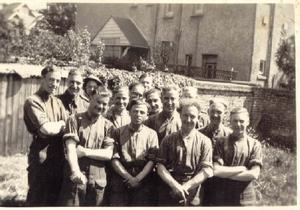
A group of the Bows and Bells lads. Johnny (front row, second from right), Harry (second row, third from right)
NAVY RUM AND BROWN SAUCE
A Hove Wren’s Eye View of Life 1939 - 1945
By
Leading Wren Buxey Cooper
*****************
CONTENTS
Introduction
The Beginning — 1939 — August
SomeWar some Hove some Various
Fun, Games and Living
Promotion
The End — 1945 — August
Epilogue
Appendices —
Other People’s Memories
Strange Encounters
Afterthoughts
Dedicated to the Wrens of the Second World War but especially to those who served on
H.M.S. Vernon(R) H.M.S. King Alfred and H.M.S. Lizard.
I am grateful to many friends for help and advice and to my husband and family for their unfailing support.
I am indebted to the Headmistress of Roedean School for permission to reproduce the painting by Morgan Rendle and to the Venerable Lionel Whatley for the pictures of Buncton Church.
Copyright © Buxey Cooper 2004
A Wren’s song — sometimes!
Rolling home, rolling home, rolling home, rolling home
By the light of the silvery moon.
Happy is the day,
When the Jenny Wren gets her pay,
Rolling rolling rolling rolling home.
INTRODUCTION
Roedean is a prestigious school for girls situated on Downland to the east of Brighton in Sussex. I was, therefore, very intrigued when I heard about an Association called Roedean Old Boys.
In due course I contacted their Hon. Secretary who told me that the Roedean Old Boys Association is made up of some of the 31,000 men who attended courses at H.M.S. Vernon, the Royal Navy's Mining and Torpedo School which was based at Roedean during the Second World War.
I was a wren at H.M.S. Vernon (Roedean) from 1941 - 1944 and I am proud to have been invited to become a member of this illustrious - albeit transient - group.
Perhaps this is as good a reason as any for me to write about the time some of my friends and I spent in the W.R.N.S.
THE BEGINNING — 1939 — AUGUST
It had been a hot August day. I was glad of the cool evening breeze as I waited at the bus stop near the Star Inn at Steyning.
From the field up Mouse Lane where I had helped my father pitch the tents I could hear the scouts singing round a campfire.
I recognised the tune and knew that the song contained the following words “Fare thee well for I must leave thee …
Although there was much talk of war I don't suppose that many of us realised how true those words were to become. Nor how soon the lovely August days of 1939 would signal the end of our way of life.
On Sunday 3rd. September 1939 war was declared. Rationing of foods, clothing and petrol came into force. Blackout precautions were put into place — wardens patrolled the streets to ensure that no chink of light could be seen from any windows and strips of brown adhesive paper were applied to windows to guard against flying glass. In the roads the tree trunks were painted with white bands to help people see in the dark, as lighting was very limited. We looked forward to moonlit nights, we could see so clearly. Being used to street lighting we had not realised how well moonlight illuminated everything. Before the war the street lights were gas lamps and each evening a man came round on a bicycle and turned them on, returning in the morning to switch them off. A sentimental song at the time was called "The Old Lamplighter".
A few days later my parents accepted an evacuee from London, a young mother with a small baby. There was great fear about the coming bombing raids, especially on the Capital, however, unbeknown to all of us we were about to experience a "phoney war". In the event this proved a Godsend. The young mother decided to return home, much to our relief, as she was as incontinent as her baby.
My brother was just 10 and I was 18 when our father died on 31st. December, leaving our mother, who was French by birth to care for us and complete the upbringing of a young son.
The winter of 1939/40 was a particularly cold one. During the "phoney war" we could walk on the seafront and watch as the wash left by the sea froze on the beaches. It was so cold one Sunday that by mid-day the rain which had fallen earlier froze. The trees were covered in ice and the branches tinkled in the wind. New Church Road was like an ice rink - very pretty and very hazardous.
For some of us life went on much as usual during this strange period of “calm before the storm” until in early April we heard the news of the German invasion of Norway. Until then we had thought little about the onslaught that was to come and, along with much of the population, had been lulled into a sense of false security with, for instance, songs like that which invited mother to hang out her washing on the Siegfried Line (the German fortifications). There were parties and dances — the Winter Gardens at the (then) Metropole Hotel in Brighton was a popular venue, and we enjoyed what was to be one of the last dances held there in mid-April before the hotel was closed. It was glamorous and romantic — the girls in evening dress and the young men in blues (dress uniform) — and the new dance was “In the Mood” by Glen Miller. Although this was not, perhaps, a pre “Battle of Waterloo” ball, it was, nevertheless, an occasion and time that we were not to see again.
1940 was the portent of things to come. The “phoney war” had ended and in the midst of all the great events taking place — the tragedy and miracle of Dunkirk — the daylight bombing raids — the Battle of Britain — security in Hove was tightened up. An invasion was expected and in June/July the beaches were mined and barbed wire placed along the south side of Kingsway. Roads south of New Church Road were put under curfew and those living within the area had to be in by 10.00p.m. The Special Constable who patrolled along New Church Road was Mr Westerman. In "civvy" life he owned and managed the Wine and Spirits shop in Richardson Road. He took his police duties seriously and it was not for the want of trying that he did not catch us when we were late coming home from an evening out! Local residents were helping the war effort in different ways, and some became Fire Wardens. They were given stirrup pumps and buckets for water to fight incendiary bombs and wore arm bands with Fire Guard printed on them.
Early one morning a German plane came over Hove. A postman walking along New Church Road was killed and the marks on the pavement made by the plane’s machine gun bullets can still be seen at the top of Westbourne Villas. Later that day, when I arrived at the house in Pembroke Crescent where I was to spend the night, I found that a few inches above the bed in which I was to sleep, the wall was damaged by machine gun bullets fired from the same plane which had earlier killed the postman. Perhaps this was an indication that I would be fortunate and survive the war, especially as the original arrangements had been for me to sleep there the previous night, and were changed only at the last minute.
One day in July a soldier called unexpectedly at our house. He had been amongst those evacuated at Dunkirk and he brought with him a gold fountain pen that he said belonged to his friend.
Awkwardly, he explained that he and his colleague - both fearing that they might not survive the coming battle - had each given the other a personal item to take home. If both returned, so much the better, but if only one survived he would discharge the duty as promised and return the pen to the other's family.
They had been in action together and the worst had happened. His friend was " missing, presumed killed in action". Then he gave me the pen and said that his friend had told him to say that it came with his love.
The soldier's name was Corporal Dunk of the 7th Battalion The Royal Sussex Regiment.
His friend was my first love.
The first uniformed troops to arrive in our road were from a London Regiment and they wore a Bows and Bells insignia on their uniform. They were a good crowd with many colourful characters amongst them. Johnny from the East End who did sentry duty at the top of our road sitting on a deck chair (which we had lent him!) wearing a rose in his tin helmet and his pal, Harry, who had been a greengrocer and who played the mouthorgan like a professional.
The new uniform - 1941
While the Commissioned Officers were billeted in a house opposite, Johnny and Harry and their colleagues were next door to us which made it easy for them to jump over the wall from our back garden to theirs whenever the Sergeant or Officer turned up.
When they finally left in August they marched down the road to their transport singing "We'll Meet Again" - it was sad and nostalgic. Untrue to form we did meet some of them again, just once and only for a few minutes when they returned two weeks later to collect supplies from a local depot. That was the very last we saw or heard of them. It seemed that when they left they took away the last vestige of light heartedness. Other troops came and went, some friendly and some not, but none like the newly conscripted Bows and Bells lads - for they were fun. As yet untouched by battle and still lacking the tough hardness which we were all to become subject to in the coming years. As the Summer turned to Autumn the war gathered momentum. We prepared for winter and the expected night bombing with foreboding. We did not know what was in store for us but the uneasy feeling that it was going to be difficult was increasing hourly.
Most of my friends had joined up and I applied to join the W.R.N.S. and was taken on in early 1941.
Life was certainly changing.
(to be continued)
© Copyright of content contributed to this Archive rests with the author. Find out how you can use this.


 Recommended story
 Story with photo