

- Contributed by
- Frank Yates
- People in story:
- Frank Yates, Tony Rutherford, Dad De Koenig
- Location of story:
- Hamburg
- Background to story:
- Army
- Article ID:
- A7405049
- Contributed on:
- 29 November 2005
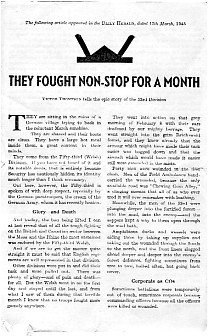
German version of the Victory Herald reproduced with the permission of Frank Yates the author.
Memories of Frank Yates CHAPTER 41
Now to continue with “Victory Herald”, I had to recruit some people who could translate into their own language from English or German and were able to type. I needed someone who could take dictation from the BBC News and translate, with the correct nuances, into English and German. I placed an ad in the local Hamburger “Anzelger” for the latter requirement, a girl turned up who was born of a German father in Guatemala. She fulfilled all the requirements perfectly and had the advantage that she was the most beautiful girl I had ever seen. In fact she was the best looking girl that any of us had seen, even in films! There was a constant stream of licentious soldiery coming to see how my newspaper was getting on! Tony Rutherford, the Div Army Photo Interpretation Officer came bearing a half plate reflex camera to take her picture!
Then it was a case of visiting national camps to find the rest of the team, taking “Dad” de Koenig with me as he, like both our Dutch liaison officers, spoke, or understood most European languages. We found an Italian professor of political history, a young Dutch schoolteacher, a Parisian seamstress and a Polish medical student. Finally we visited a vast camp containing Three thousand Russians, where, with difficulty, we found a 16 year old girl, who could read German. You will understand that, apart from the German girl, we offered board and lodging only and you can imagine that they were delighted to be fed to our standards and sleep in a 5 star hotel bed!
We had the use of a function room and began our opus, a job which could hardly be called onerous. Our German beauty took down the BBC news, in shorthand (There were no tape recorders), and typed it in German and English. The others translated into their own lingoes and arranged the items, neatly, to fit the single sheet. Then I took the sheets to the Nord west Radio Rundfunk, where a Col. Leven was installed. He, a Canadian, not behind the door when brains were dished out, was the Director of Psychological Warfare. He insisted on seeing all the copy, before printing. I understand that he spoke seven languages and very quickly scanned through the sheets, each getting a grunt of approval, until he read the Russian copy and stopped dead. “What three year old wrote this rubbish? The spelling is awful and the grammar is even worse. You’ll have to get someone else”.
With the remaining copies, I went to the Hamburger Anzelger newspaper office, contracted (By order) to print the sheets in specified numbers, They were in a bit of a turmoil, because the first horrific photographs from the concentration camps such as Belsen and Dachau, with the accompanying stories, against the opposition of the Editor of the erstwhile Nazi journal, were to be published, and the newspapers circulated free, to the general public. All over our occupation zone, similar orders were imposed on newspapers and newsreels. All the German locals protested that they had no idea that such horrors had been going on! In some cases this may well be true, but unlikely, as the camps had been in existence for seven years or so. At the time of writing, a novel called “Fatherland”, by Robert Harris, deals interestingly with this issue, where in the future, when Germany had won the war, and was the Master of Europe and Asia, the existence of the camps was unknown to its citizens.
I am digressing; My “Victory Heralds”, nicely printed were delivered to a sergeant, who sent the copies round to the various ethnic groups. They were well received, and the news of the enterprise quickly reached England with results which I will recall in the next paragraphs.
First things first, next morning, we took our little Russian girl back to her camp, for two days she had lived better than in all her life and I felt a bit sorry for her. We confirmed that there was no one who could write and knew another language. On returning to the office, our beautiful fraulein announced that she knew a neighbour who had taught Russian in a school before retirement. I told her to get him in and he turned out Russian copy which got a purr of approval from the DOPW. Our little production line worked smoothly for weeks, my interference restricted to matters of comfort for my small staff, who, truth to tell, looked after themselves very well.
Out of the blue arrived a photographer, from the London “Daily Sketch” a paper which has been defunct for years, but back in 1945, was big time. He took pictures of me, holding a “fan” of “Victory Heralds” and one of the papers being delivered to some of the readers, all with outstretched hands to collect their copy. All stage managed by the newspaper man! He enlisted my help in doing a “Fraternisation” story. It was forbidden to fraternize, socially, with the Boche, but this was a fairly difficult thing to enforce. We went to Blankinese, a riverside resort, on the Elbe where there was much fraternisation going on between frauleins and soldiers, sitting in pairs on the sea wall. My manipulative companion told the soldiers to turn round so that their legs were on the outside of the wall, He hinted that, if wives or girlfriends should see the “Sketch”, they would see back views only, and there would be no chance of recognition! He was also careful to include, in his shots, the girls with the best looking legs!
When we saw the paper, a few days later, the picture was printed with a caption saying that the “No fraternization policy” was working well in Hamburg, despite the presence of pretty German girls. Since then I have read any newspaper story with suspicion!
My mum, in Sheffield, had a visit from a Sheffield newspapers reporter, who had picked up the story. My picture, from the “Sketch” was reproduced in the “Star” with a heavy bi-line which shouted “They read the truth”, (Which is more than the “Sketch” readers did!!)
Then the newsreels moved in. I received a letter from a chap called Ian Struthers, written on “Paramount News” notepaper, to inform me that he would like to come and film a story about my efforts. He actually arrived at the same time as the letter, having begged a lift, in an RAF jeep, from the airfield. Media people, it seems, were able to get passages in Dakotas without much trouble.
Ian was a charming bloke and I went to the soldier, who acted as receptionist, for the allocation of a vacant room. I led Ian up, in the lift, to the room, unlocked and opened the door. We stared, open mouthed, at the spectacle of a chambermaid and a soldier, heavily engaged in “a bit of the other” on the bed. We waited as they adjusted their clothing and, shame facedly, slunk away. Ian, recovering, complained that his camera was still in his luggage!
I found out from sister Gladys that she had met someone who told her that I was on the news at the cinema. Apparently they had a family trip to see me at the “Rex”, at Intake. I also had a nice letter from Ian Struthers, who thanked me for my hospitality and wished that he could always have such gratuitous entertainment on his trips!
To finish the “Victory Herald” saga, a request came from the Imperial War Museum for a copy of every issue, in every language, and I sent them off to London. Should any reader of my story wish to look at them it is necessary to write to the Museum, in advance, so that they can be got out of the archives. When we left Hamburg, another unit took over, but I insisted, that, although they could use the title, they could not use our Div sign.
© Copyright of content contributed to this Archive rests with the author. Find out how you can use this.


 Recommended story
 Story with photo