

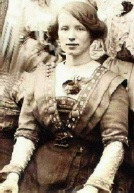
Annorah Driscoll 1890-1977
- Contributed by
- annorah
- Article ID:
- A7664547
- Contributed on:
- 10 December 2005
My name is Albert Smith. I was born on the 17 of May 1932, so I do remember the day war broke out, but not very clearly. I was only seven after all.
We lived in Old Canning Town, which was almost an island site situated between the LMS railway line and the River Lea on the east side of London.
A few days after the war was declared, my Mother, born Annorah Driscoll and known to everyone as Norah, my two older sisters,
Norah and Catherine, and I, went down to Kent for the hop-picking season. From there, at the end of the season, we were evacuated to Dudley in the Midlands to escape the anticipated German bombing.
My third sister, Anne, was married to Bill Goodey, who was in the Air Force, and so she was evacuated separately to the West Country.
Initially we stayed with a nice middle class family who were kind enough to squeeze us into their semi-detached house. But my Mother felt ill at ease there and she soon found us a little house of our own to live in. And I do mean little. As modest as our house in the East End of London was, it was a ranch compared to this. One up and one down and a shared toilet in a yard at the back. But we had our own front door and so we were all quite happy there. In the yard at the back there were two more equally small houses inhabited by lovely Black Country people with whom we quickly became the best of friends. We stayed in Dudley for a year and then returned to Kent to go hop-picking again.
I believe they called the first few months of the war the phoney war because nothing much happened. Well something happened, because our house was destroyed by enemy bombing, that's what happened. Our house was near the River Lea. On the banks of the river was situated Howard's woodyard. It seems that the woodyard, a major concern, was struck by incendiary bombs and was burnt to the ground, taking most of our road, Chard Street, with it.
My two older brothers served the six years of the war in the armed forces, Danny in the Royal Navy and Johnny in the Army. Danny spent almost all of the six years wandering the planet, spending time in Australia, India, and the USA. Well he was in the Royal Navy. When he eventually left the Navy at the end of the war, he never spent a night away from home again for the rest of his life. It rather puzzled him why people should want to go away on holiday.
Johnny, unfortunately, ended the war as a prisoner of the Germans. I well remember the day he departed for active service, though I'm unsure of the date, perhaps '40 or '41. He was home for a few days embarcation leave. My Mother was distraught at seeing her eldest son in army uniform leaving for we knew not where.
After some time news reached us that he was missing in action in North Africa and we feared the worst. Following another agonising wait we were informed that he had been taken prisoner. Perhaps not great news, but he was alive and it was a wonderful day for us all.
Like most ex-servicemen, I believe, he rarely spoke of his experiences, but he did let slip once or twice that, for much of his time as prisoner, he and his mates were close to starvation. Yet strangely enough he never complained of his treatment at the hands of the Germans, and after the war he never seemed the least bit anti German. I suspect that his captors were almost as bad off as their prisoners.
My father Jack was too old for military service. He was born in 1889, the same year as Adolf Hitler. They had nothing else in common. The Old Man couldn't even speak German, and I know that he had no plans to invade Poland. But he served four years in the Royal Navy in the first World War, so he certainly did his bit. Dad I mean not Adolf.
Whilst hop-picking in the fields of Kent in September of '40 we had a worm's eye view of The Battle of Britain rageing in the skies above.
We never felt in any great danger. We reasoned that the Luftwaffe wouldn't want to drop their bombs on a few hop-pickers.
At the end of the hop harvest Mother had to decide whether to return to Dudley or back to our East End base. Easy. We were going home. Adolf didn't frighten my old girl. But there was a small problem, we didn't have a house did we? It was a problem easily resolved. With so many famlies evacuated, there were empty houses everywhere. I remember walking around the streets of Canning Town with Mother deciding which one to rent. Investing in a bit of property didn't seem a very good idea at the time. She finally chose one quite close to the Royal Docks,a prime taget for the Luftwaffe. I did say that the old girl didn't frighten easily.
One of our first tasks when we moved in was to dig a hole in the yard for the Anderson shelter.
Soon the German blitz started in ernest. At first we used to evacuate to the shelter when the warning siren sounded in the night, but eventually, some of us at least, decided to make our beds in the shelter and pass the nights there. When the siren went Dad would join us. He liked to monitor the progress of the raid with one foot in, and one foot out of the shelter. Regrettably he tended to be of a pessimistic turn of mind. Judging by the sound of the bombers, he felt they always seemed to be heading in our direction. "I think they're coming this way Norah". Mother would decry this as negative thinking, and I can't deny that this , at times, provoked some lively discussion between them.
For a period Mother decided it would be a better idea to pass our nights sleeping in Stratford Underground station. A stretch of line no longer in use was fitted out with wooden bunks for those who fancied taking shelter there. I found it great fun playing with other kids in the station until it was time to go bed. But going there meant a bus ride both ways and Mother got fed up with it, and so we returned to our Anderson shelter.
My memories of the war years are very mixed. At the time there was hardly a day passed when I didn't long for it to be over, but, looking back, I also have many good recollections of the very real camaraderie that existed, and, from a strictly personal point of view, the family that surrounded me that no longer survives. Although my two brothers were away, I had many relatives living nearby. Notably my favorite aunt, my Mother's sister Mary, her husband George Herold, and their eight children, Mary, Georgie, Florrie, Kathy, Eileen, my favorite cousin Patricia, plus Albert, and the youngest, Doreen.
We were all certainly very poor, but we always had a roof over our heads and enough to eat, and do you really need much more?.
Albert Smith
© Copyright of content contributed to this Archive rests with the author. Find out how you can use this.


 Recommended story
 Story with photo