

- Contributed by
- buxeycooper
- Location of story:
- Brighton and Hove
- Background to story:
- Royal Navy
- Article ID:
- A7378446
- Contributed on:
- 28 November 2005
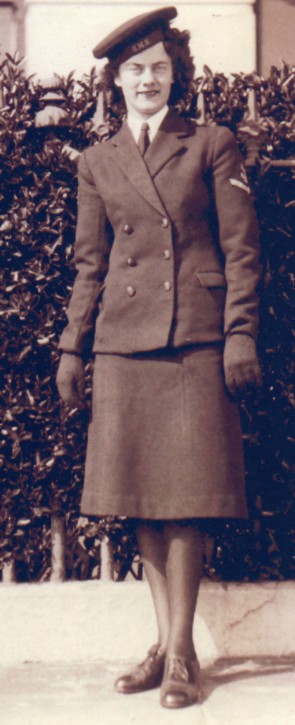
Leading Wren Vi Sladen
During the war years many thousands came to Vernon for training and instruction - one group consisting of Russian Naval Officers. The Ward room - the officers' "home" - at Vernon was a separate building some way from the main school and had previously been the Junior School of Roedean. Accommodation for the officers and ratings was found in various places including some private houses in Brighton. Some officers were lodged in flats in Marine Gate, a large modern block near Whitehawk - sometimes as many as 15 to a flat - and some in St. Dunstan's in Ovingdean and others in the school itself, and the wrens in the John Howard Home in Whitehawk. In the Ward Room the officers had their own dining room, sitting rooms and kitchen all serviced by wrens with, possibly, a male Chief Petty Officer in overall charge. On the whole my fellow wrens and I found the RN officers quite "standoffish" - certainly they were a breed apart. In fact they were forbidden to "fraternise" with wrens - although this was not strictly adhered to especially by those in Marine Gate which had a serviced restaurant where wrens could be entertained - ceasing only when the flats were bombed and the restaurant destroyed. Of course saluting was “de rigueur “ and wrens saluted all commissioned officers.
A number of foreigners had joined the Navy and one was a Frenchman. His name was Tony Robertson, at any rate that was the name he had adopted. Perhaps the fact that my mother was French had something to do with it, but he visited our house many times where he and my mother chatted away in their own language. His English was not all that good and we tried to help him. He left Vernon before I did but not before he had told me his story. He was married and had a young son and as far as he knew his wife and child still lived in Paris, but he had no way of knowing for sure - nor indeed - if they were still alive. He had been in the French Navy and escaped to England after the fall of France. Whether he came via Dunkirk or made his way South he would not say. He was very secretive about himself and particularly fearful that his real name would be found out. That, he said, would greatly endanger his family.
Of course his story was just one of many war time tragedies. We did not hear from him after he left. I think I remember him mostly because he is the only man I have ever met who tried to get me to go to bed with him by explaining at great length, the "Rhythm"method. He wasn't successful.
There were a number of quick Hit and Run raids over the area but there were no direct attacks on Vernon, which was surprising as it was the Navy's Mining and Torpedo School where secret work was going on to develop new Radar techniques. The Germans must have known that although many believe that they were unaware of it. Travelling to and from Vernon we never thought about being caught in such a raid, but in retrospect there is no doubt that we were very lucky to come through all the years physically unscathed, especially as Brighton and Hove suffered a number of attacks.
One big raid took place in May 1943 at around mid-day when 25 German planes came in over the Downs and flew over machine gunning and dropping bombs on Brighton and Hove. Many people were killed and injured and the viaduct over the London road was destroyed. The attack has been well documented and I mention it only because I saw some of the bombs drop. I was on the forecourt having left the basement where the Cleaning Store was and on my way back to the office. There were planes everywhere — the noise was deafening and then I saw several bombs drop and one hit the gasometer at Whitehawk, which burst into flames. I was so mesmerised by the whole thing that I ‘froze’ until a second later a very loud voice shouted at me to get down. Most of the complement worked indoors and apart from a Chief Petty Officer, who was helping to carry the cask of rum, receiving a slight wound on his buttock from a stray bullet, the only fatality was a civilian who worked in the Drawing Office. He had been walking on the cliff road at the time of the raid and must have received a direct hit as he completely disappeared. Only some clothing was found.
He was a clever artist and had given me much help with my attempts to do a pencil and crayon drawing of one of the wrens. Her name was Eve and I thought that she would be a good model, with her red-gold hair and blue eyes she was a striking looking girl. Vernon was running an Art competition and although I did not win anything it was fun trying. Eve had been drafted to Vernon from another “ship” and worked in Signals. She was popular as she had a bright and outgoing personality. No doubt it is this gift which her son, Sir Richard Branson, has inherited. Eve, herself, has written an interesting Memoir of her time as a wren.
Although at Vernon discipline was strict and the organisation very efficient there was nevertheless a certain amount of lightweight stealing or as the Navy put it “making”! We had been issued with large gas masks which, of course, had large carriers. Things like sugar, biscuits, tea and cocoa, cleaning materials and in general, items that were in short supply in the world outside the Service occasionally made their exit, and the large carriers helped enormously!
However, from time to time, and always unannounced, the Customs from Newhaven put in an appearance, and all personnel leaving after duty was liable to be searched. The fact that most of us got away unscathed was thanks to the sentry at the main gate who telephoned a warning to the Master of Arms. Within seconds the playing card Ace of Spades was pinned up on the main Notice Board and likewise within seconds, all the gas masks were returned to their carriers. Armed sentries were posted at various points all round Roedean but the main entrance was through the large iron gates just off the sea front road, and all traffic used this route.
There was a good social life in off duty hours, and cinema shows and Bingo sessions — known as “Housey Housey” in the Navy were often arranged. Before the war I had been given a ukulele by my parents and as sing-songs were popular, I took it with me when I was on night duty. One of the sailors had a concertina and several had mouth organs. The Master at Arms — the “chief policeman” enjoyed these little musical evenings and became very sentimental especially after he had had a drink, but he was always “in charge” the next day.
Some of my colleagues who were professional entertainers and actors in civvy life — together with a few amateurs — formed a concert party and, a couple of evenings a week visited other Service camps and bases around Sussex. A friend of mine, Joan Nye, who had a good voice and could play the piano joined them.
Recounting her first performance with the concert party she said ‘ I got up and went to the piano wondering what I could play and sing without making a fool of myself. I sat down and played the “Indian Love Call” which went down fairly well and I was asked to do another song. So, hoping for the best, I played my favourite, Gounod’s “Ave Maria”. There was a long silence. Then suddenly the applause erupted. Thereafter the Ave Maria became a “special request” song and I always sang it at concerts’. Amidst all the happy go lucky, make the best of everything, you’re here today and gone tomorrow attitudes that prevailed we all needed something sentimental to stir happy memories, and that song provided it.
Various sports events were organised and on at least one occasion the wrens mustered a good Hockey X1 and were challenged to a match by the officers. I thought this rather surprising as the officers did not mix with non-commissioned wrens. However, we played on what had once been one of Roedean’s Lacrosse fields. It was great fun and a good match, but on the day that I was in the team the officers won because they played a game with different rules!
Wrens were invited to many of the local Army Messes and one evening a group of us went to a party at the White House, as it was then called, in Roedean Road. The house was the base for the gun crews who manned the anti-aircraft guns on the Pitch and Put course just west of
Roedean. There were no raids that night although it was fine with bright moonlight, and we were all feeling very relaxed. There was a café on the golf course and a couple of us and two army men climbed up onto the roof and danced round the chimney singing “Deep in the Heart of Texas”. The café is still there but the chimney and gun emplacements have long since gone.
© Copyright of content contributed to this Archive rests with the author. Find out how you can use this.


 Recommended story
 Story with photo