

- Contributed by
- marchback
- People in story:
- James Badcock
- Location of story:
- Germany
- Background to story:
- Royal Air Force
- Article ID:
- A4520846
- Contributed on:
- 22 July 2005
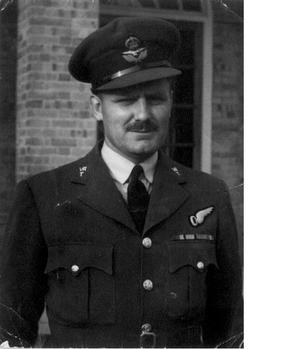
James Badcock
Chapter Three
Finally Friday dawned - Good Friday 30 March 1945 and most of us were up and about very early. We posted lookouts on any vantage point we could find - we had managed to 'win' a couple of pairs of very good binoculars and it was the lookouts' job to keep scanning the horizon to try and pick up any troop movements - on either side. Meanwhile the rest of us concentrated on cleaning up the field where our marquees still stood and generally finding anything else to occupy our minds. The day was, again, warm and sunny, the food was, again, conspicuous by its scarcity. The tension was terrific. The few Germans who were still about looked completely despondent - it was now their turn to be apprehensive. Incidents still happened - like the one on the road outside our new compound. I had gone down there about ll.00hours to see how things were going and when I came out to the compound gates I met a German Ober-Feldwebel (Staff sergeant). I had met him the previous day for the first time. We stopped to chat but we were interrupted by the jeers and howls from the Russian compound. He was explaining to me that the battle was now very near and that he expected a tank battle to develop around the Stalag at any time. He asked me to make sure that all the Britishers kept under as much cover as possible (we had some slit trenches up on the field) as he quite rightly said 'it would be a great pity for anybody to be killed at the last moment, after being away for so long'. I agreed with him. By now the Russians were really showing their teeth and the German asked me to explain to them what was happening and to ask them to take cover. Just how I was to do this, I don’t think either of us was very clear. I spoke no Russian, and neither did he, apparently - my German, learned entirely whilst I was a POW may have been adequate for a swear- off with a German, but would hardly be understood by a howling mob who knew no language other than their own, and didn’t want to listen, anyway.
'They are your prisoners,' I explained to the German 'you have a go.'
'They are your allies' he replied 'and anyway I am your prisoner, myself.' And with that he handed me his Luger and said 'perhaps this will help.'
It was all very amusing - for us, but the whole scene wasn’t so funny for the Russkis. It seemed that they were all Russians who had collaborated with the Nazis, after their capture (which explained why they looked so well-fed and clothed - I had never seen Russian POWs so well cared for) and now the moment of truth was at hand - they were afraid of liberation because they faced almost certain death when their own people got hold of them. It was impossible to tell them to get their heads down so I walked away and went back to the field where the marquees lay. There was tremendous excitement - one of the lookouts had spotted a tank column, but he was not certain whether they were Nazi Panzers or American Shermans. I thought they were German Tigers and this was confirmed when I looked in the other direction and saw a column of other tanks which were very definitely from the USA. So, there we were, caught right in the middle of the rival armour. It looked as if the battle must sweep right round us, and perhaps right round the Stalag - what a prospect after all this time. The time was exactly noon and we didn’t have long to wait. I had just called the section commanders together and told them to get everybody under cover when - wham - there was a bang and an unfamiliar whine. I have never hit the deck so quickly in my life - before or since - it was the opening shot (a tank shell) of the battle. Then came the aircraft, ours fortunately, and we hugged the ground and crawled towards the slit trenches. However, nothing sensational happened and we watched the village, about 2kms away from us. All of a sudden we saw it - a white flag, then another, then another, as the local inhabitants forgot all about their beloved Fuehrer and hung out their nice, clean bed linen from the bedroom windows as a token of total surrender. There was no more firing - for a moment there was total silence and then the boys let out a cheer - it was all over.
I made my way down to the main gates where the office block was situated and here one of the most amusing incidents of my whole career as a POW took place. There was still a poor, frightened looking, Goon at the gate, complete with rifle and bayonet. This was a moment I think most British POWs had waited for. When we were, ourselves, captured the first thing any German said to us was 'Ach so, my friend, for you the war is over' We'd all had the same treatment. Now, it was my turn!
I went up to the German. He sprang smartly to attention and gave me a real, first class salute - they always saluted a senior rank. I stopped, and in my best Stalag German I said 'Ach so mein freund fur zu der krieg is fertig,nicht wahr?' It must have been a good effort because, apparently, he understood. I was totally unprepared for his reaction. With a grin, he dropped his rifle but retained his bayonet, fumbled in his haversack, produced an enormous bread and cheese sandwich (ersatz cheese of course) which he proceeded to cut in half with the bayonet. He shook me by handing half the sandwich to me - and I shook him - I stood there and ate it - I was very hungry and that sandwich was like manna from heaven - in any case it would have been rude to refuse. When I left him to go into the office, he was still chuckling.
There was an American officer - Major Morton - who had been captured in the Ardennes, a few weeks before. He was the senior US officer and, as this was the American sector, naturally assumed overall command. I told him what I had seen - the white flags etc and we agreed that liberation must come in the next couple of hours or so. Now came our first big problem, to contain our chaps until the liberating army arrived. Obviously, we were right in the front line and there must be no rash actions or anything which might place anybody in the camp in peril. We decided to mount a strong guard on the gate and to appeal to our respective contingents to try to cool it down a little until the final
release came. We contacted the French Senior Officer and he agreed. It was no easy task, some of my chaps had been taken at Dunkirk - nearly 5 long weary years ago. However, reason prevailed and we all tried to stand by and wait. We had to wait for nearly 3 hours before it happened - what a long 3 hours that was!
It happened just after 3pm. I was sitting in my room in the barrack when I heard a tremendous roar - Hampden Park, Wembley Stadium or the Kop at Anfield Rd. - have never heard anything like this. I ran outside and looked towards the main gate to see a seething mass of people - the Yanks were here. I hurried down towards the gate and there I saw the most amazing
Sight. A US Army jeep, complete with a crew of 6 husky Gis, was being lifted from the ground and borne in triumph through the gate. It was amazing when you realise that the people doing the lifting were the ex POWs, many of whom an hour before could hardly lift a comb to do their hair, let alone lift a fully laden jeep. Pandemonium reigned. Everybody seemed to be talking at once. Strangers hugged each other like long lost brothers - so! This was freedom at last! Not a bit like the end of the Colditz story, I am afraid, where we saw one rather frightened looking GI push open the gate and warily step inside. There was no such apprehension at Stalag IXC, I can assure you.
When the hubbub had subsided a little we managed to make ourselves heard, enough anyhow, to warn the excited inhabitants that they must, on no account, whatsoever, go out on to the road outside the Camp as the 3rd US Army had the Jerry on the run and were in a hurry to catch him, so they didn’t need to be held up by a few hundred released POWs meandering about the road. It was very difficult, a few had already strayed on to the grass verges outside the wire. It was my job to go out and persuade them to come back inside - for their own safety. Meanwhile the main columns of the American Army were speeding by. The occupants of the armoured cars seemed to be as excited as we were. I was standing on the grass verge, having urged the last of my 'flock' back into the camp, when one of the Gis in a passing vehicle shouted to me - I looked up just in time to see him throw something. I stumbled along the grass until I found it - gold dust indeed - in the form of a pack of 20 'Camels' - real cigarettes at last! I sat by the roadside for a few minutes and really enjoyed a smoke - it truly was Good Friday.
I was brought back to earth by an orderly calling to me from the Camp Gates that I was wanted in the office. I went over and was introduced, by the American Major Morton, to a Colonel from the US 3rd Army. I can't remember his name, but he was a charming character. He explained hat he would get relief organised, as soon as he could, and asked what we were most in need of. We explained that it was medical supplies for the sick and, after that, food for everybody. He explained that things were moving so fast it might take him a little time but that we would have relief by the morning. In the meanwhile he asked us to get organised and prepare for evacuation - he wanted the British and American ex-POWs out of the camp as soon as possible. As there were about 1200 of each this was going to be quite an organisational exercise. He also requested that nobody was to leave the camp, unless detailed to do so. This was common sense, you couldn’t very well have hundreds of spare ex-Kriegies roaming about the countryside, but it proved an awfully difficult problem, for the first few days, anyhow.
So we started to get organised. In the British sector we had already appointed Barrack Commanders who were responsible for the discipline and organisation of their respective barracks - there were 8 of them so each had about 150 men to look after. I called them together and told them what the Colonel had said. We decided to have a general parade in the Compound and explain the situation. This we did and the order to stay put was not too well received. We appointed a Compound Quartermaster, to deal with the supplies as they were received and each barrack then appointed its own quartermaster to deal with rations etc. The time passed quickly. We rustled up some food from nowhere and, as I had now acquired a batman, a Yorkshire lad from Brighouse, who was a baker by trade, he cooked a meal for four of us. It was alleged to be rabbit. Where the said rabbit came from nobody asked - or cared, for that matter. Yorkie certainly knew his job - I had never eaten rabbit before (or since for that matter) - as I didn’t like what was supposed to be a country delicacy - but I ate it that evening - and certainly enjoyed it. Sleep was out of the question although I, for one, felt terribly tired, but the excitement still lingered on. Yorkie and I lay on our bunks and talked, listening to the bombers droning away overhead - the war was still with us.
The next morning we called a roll call for 08.00hours and there we were all lined up, barrack by barrack, in parade ground order. Finally, the barrack commanders all reported back 'all present and correct' and the work for the day began. We held a meeting down at Camp H/Q and drew up a set of rules. Parts of the camp were placed out of bounds to all ranks, except those on duty who were issued with a special pass - I still have mine (See Appendices) We hurried back to our compounds to propogate the orders and asked the chaps to keep reasonably with the Compound. We found a couple of footballs and these helped a lot, especially as we found a football ground in the German sector, complete with goalposts and marked out. We now had
An extraordinary job to do in the British compound and that was to sort out the true identities of everyone. This was necessary because of a system we had for helping would-be escapees in the old days. It concerned the RAF and the Army boys. The RAF contingent was never allowed out of the camp when we were in Stalag VIIIB. We were nearly all senior NCOs and, as such, under the terms of the Geneva Convention, could not be sent on Arbeits Kommandos (working parties). Now these parties lived outside the camp, at the site of their work - sometimes at a factory, sometimes a coal-mine in Ober Silesia, and, therefore, offered a much better chance of escape. What happened, therefore, was that any RAF bloke who fancied his chances of escape found an Army private who looked like him, and they exchanged identities - the Army private becoming W.O. Blanks of the RAF and the RAF W/O becoming Private Bloggs and thus going out to work. This scheme had been fairly successful. Of course, many such swapovers were detected at the Main Gate, as the working party left (especially if one Fraulein Richter was on duty - she could spot a swap a hundred yards off) and both parties were hustled off to the 'bunker'. However, most of the swaps got through and eventually made their escapes - although I only ever heard of one chap getting back to England. Naturally when we were pushed out onto the road in January the RAF contingent contained many such swapovers and they had no option but to march with us. It was these characters we now had to sort out. It was amazing how many times W/O Blanks, RAF, suddenly became, in reality, Private Joe Bloggs of the Downshire Fusiliers. This we had to sort out. The Barrack Commanders formed a committee to examine each case. We were determined to establish each true identity beyond all reasonable doubt. We had picked up quite a lot of stragglers during the march and a few more the Americans had already picked up roaming round the countryside, but we were determined they wasn’t going to be any infiltrators, or would-be escaping Nazis among our party. However, the job was finally completed and I was able to hand in to the US authorities a comprehensive list of all British ex POWs, complete with his true name, regimental numbers and correct POW number.
In the meantime the first relief lorries arrived and the Q/Ms were soon busy allocating rations. It was agreed that all POWs irrespective of nationality or rank, should be treated the same, as far as the rations were concerned. The Americans explained that these were only front line rations, and, as such were not as full as they would have liked. When we got the first supplies we thought this must be a joke. Tinned chicken, many varieties of tinned meats, butter etc etc It all looked pretty good to us - let alone being regarded as 'iron' rations. When you had been as hungry as we had even a bit of bread and cheese would have been a banquet - and here we were with food lavished on us which must have been better than the folks at home were getting on their wartime rations. In the afternoon we got our first taste of the famous US 'PX' rations. These are extras with which the US Forces are supplied. Again we got an expression of regret from the 3rd army that there was only enough supplies for each man to receive a half ration. When I tell you that this meant that we got only 60 cigarettes each and 6 chocolate bars plus some extras - you can imagine our feelings. So Saturday passed. Of course, the jackpot question was 'when do we go home?' but we had not yet been given any indication.
© Copyright of content contributed to this Archive rests with the author. Find out how you can use this.


 Recommended story
 Story with photo