

- Contributed by
- ralsmith22
- People in story:
- Ralph Morton Smith
- Location of story:
- Whitehall, London
- Background to story:
- Civilian
- Article ID:
- A8966244
- Contributed on:
- 30 January 2006
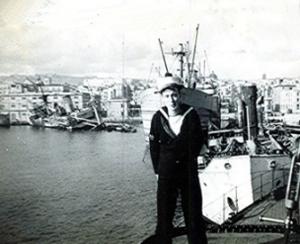
Naples Harbour December 1943
Recollections of the Second World War
From an Article by Ralph Smith OBE, MCMI, Chartered MCIPD
for the West London Branch, Chartered Institute of Personnel and Development.
December 2005
From school in May 1939 I joined the Admiralty, then an important department of state headed by a Cabinet minister and sundry Admirals, collectively known as the Board of Admiralty, whose stern and unforgiving rule of the Royal Navy remained little changed from the days of Nelson and Captain Bligh of HMS “Bounty”.
The British Navy in 1939 was still the largest in the world, as it had been for well over a century. Although a civilian, my job was in the centre of a network of communications spanning the world from the Navy's operational headquarters below the Admiralty building in Whitehall. The civilian staff worked an extraordinary routine of 12 hours on duty and 24 hours off, in three watches. Starting at 9am on Day 1, we worked all day till 9pm, then went home to sleep. Most of Day 2 was our own but it was advisable to have a nap in the afternoon because we were on duty again at 9pm that evening, working all night till 9am on Day 3. After struggling home one fell into bed for a few hours sleep - not too long though, because you still had to go to bed later for a "normal" night's sleep, ready for the 9am watch on Day 4, when it started all over again. I was 16 years old. Crazy? Many young men and women, including my future wife, kept this killing routine for six years. And it got worse, for reasons which follow.
War was declared on 3rd September 1939 and hostilities at sea began immediately with the sinking that evening of the British liner "Athenia". I was on watch and received her last SOS. In contrast, on land the "phoney war" went on for 9 months with little contact by the opposing armies. Then in May 1940 the Germans swept through Holland, Belgium and France in a "blitzkrieg" spearheaded by dive bombers and fast-moving tanks, a strategy originally propounded, believe it or not, by a British officer - B H Liddell Hart. - but exploited by the German Army. The French Army collapsed and the British were squeezed into Dunkirk, from which most of them managed to escape when Hitler, for reasons never clearly explained, ordered his tanks to halt outside the town. They left all their equipment behind. The evacuation itself was a triumph; but it represented a military defeat of overwhelming proportions.
At its peak, the British Empire was the largest formal empire the world had ever known. It ruled one quarter of the world's population. Generations of Britons, mine included, grew up believing they had a natural, not to say Divine, right and duty to lead the world. Now suddenly they found that a mere 23 miles of English Channel stood between them and destruction. Their shock and disbelief can be imagined. Churchill's "We shall fight on the beaches" call tells how desperate the situation was. We now know that the Germans thought the war was over and Hitler expected us to sue for peace. When we didn't, he resolved to occupy Britain, after destroying the RAF. Fortunately for us, the RAF had managed to extricate many of their aircraft from France and the ensuing Battle of Britain forced the Germans to abandon their plans. But it was touch and go until the Luftwaffe started to bomb London and our major cities instead of concentrating on RAF airfields. This gave the RAF precious time to recover, but thus it was that on the sunny morning of August 16th a wave of aircraft attacked South West London. Wimbledon and Merton were hard hit. Many people were killed. One of them was my father.
However, daylight bombing at the limit of fighter cover proved too costly for the Luftwaffe and in September 1940 they turned to night bombing - the "Blitz". As the sun set, sirens would wail all over London, followed by the unmistakable throb of German bombers' unsynchronised engines, then anti-aircraft fire, then bombs. This would last most of the night. For us toilers in the Naval communications centre, getting to work for the 9pm night watch became very tricky, as Underground lines below the Thames were sealed by flood gates while buses and trains would be cancelled or diverted. For the day watch, getting home across London in the thick of an air raid was no joke either and often required considerable ingenuity. The solution was to extend the night watch to match the hours of darkness, so that by December it became an incredible 17 hours - 4pm to 9am. Bunks were provided for us to have a couple of hours' sleep but some people felt worse rather than better and would walk about outside for an hour or so, regardless of bombs. No Working Time Directive for us. I was on duty on the night of 29th December 1940 - the second Great Fire of London - when you could read a newspaper in blacked-out Whitehall by the light of the inferno in the City. There was nevertheless a strong spirit of comradeship and shared danger among the watchkeepers. We suffered surprisingly few casualties but evil chance sometimes decreed that a signal reporting the loss of a warship, of which there were many, was decrypted by the wife or fiancee of a crew member. It was particularly hard in the case of submarines, which were often only “assumed” lost after failing to return from patrol.
I left London in 1942 on joining the Navy and exchanged my 12-hour watches for the British Navy’s 4-hour and the Dutch Navy's 6-hour watches in various ships, much of it watch-on/watch-off at sea, which is an equally uncomfortable way of life. The picture shows yours truly in Naples harbour prior to leaving for the ill-fated Anzio landing. Three full-scale invasions and other adventures brought me back to central London in late 1944, still in the Navy, where I experienced at first hand the continuing ordeal of the now war-weary Londoners. The Blitz had eased somewhat in the Summer of 1941 when to our amazement Hitler attacked Russia, but sporadic raids, using increasingly large bombs, continued. These culminated in the V1 flying bombs in June 1944, of which 2,340 fell on London, shortly accompanied by the truly dreadful V2 rockets. There was absolutely no warning of the latter, just a deafening explosion followed by the delayed roar of the supersonic missile’s descent, mixed with the rumble of collapsing buildings. They continued to fall on London until almost the war's end. A friend who kept a diary wrote on 5th January 1945 "Lots of rockets during the night" and not till April did she at last wrote "No rockets now". The war officially ended on 7th May.
My strongest recollection is not of jubilation and street parties but of wonder at seeing the street lights, and even the tiny bulbs in phone boxes, miraculously spring to golden life after nearly six years of blackness and neglect. The sky, for so long the source of sudden death, returned to the birds. We surveyed the wreckage of our world and set about trying to create what we hoped would be a fairer Britain for our children in terms of opportunity, health, welfare, education etc. Across the rest of the world, millions of subject peoples gained their independence from the old European empires - British, French, Belgian, Dutch and Portuguese - much sooner and on the whole more peacefully than they would otherwise have done, though some still met transitional problems. And the institutions of the United Nations and the European Community were created which, with all their faults, brought hope of future peace for many. So perhaps some good came of it all.
© Copyright of content contributed to this Archive rests with the author. Find out how you can use this.


 Recommended story
 Story with photo