

- Contributed by
- TORRANCE Duncan Leitch
- People in story:
- Duncan Torrance
- Location of story:
- Bavaria
- Background to story:
- Army
- Article ID:
- A7949343
- Contributed on:
- 21 December 2005
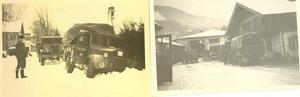
The M.T. sergeant, Sgt Green, supervises a recovery. The Fordson 15 cwt is going out backwards. The old adage, 'pull 'em out the way they went in.' Second picture, the workshops in Bad Wiesse.
CHAPTER XVII - THE DEEP MID-WINTER
The day after my return, it began to snow on our Schloss. We had long watched the snow level creep down the hills. Now it was upon us, and would remain there until the spring. I was soon to leave for a short spell.
The OC of the section left in Heidelberg was due for leave but had been required to stay 'till I got there to relieve him. Once there, I found a new officer had reported for duty. I was asked to train him in the short time we had before the snow closed us down.
We got out and did three days work. Then I decided we must get our bodies back to the cemetery at Bad Tolz, and bury them before the ground got too hard. We also had one damaged vehicle and one that was not too sound. I arranged to do some exhumations in the Stuttgart area on way down.
I was lying peacefully in bed on the eve of my departure. Then, at midnight, the 2 i/c from our HQ at Bad Tolz phoned. He had just got in after doing the same run as I was to do in the morning.
He told me of the difficulties he had had. The winter was down. The autobahn was temporarily impassable to heavily laden vehicles, let alone for towing.
The ground was frozen. I had completed my exhumations. Digging was impossible. I was not sorry.
We had several days to wait with nothing to do. How pleasant it was to walk up the wooded hills overlooking the River Neckar, in many ways more beautiful than the Rhine.
At last the weather reports indicated we could make the trip in reasonable safety. I began to assemble the convoy. We had our three tonner which was sound mechanically, and had a load of two tons on it. It was to be our ambulance if any of the three Humber staff cars broke down.
The engine of the first Humber had an ominous little end knock. The second had a damaged gearboxc and no shockabsorbers. The third was the Major's car which I drove. It had a clean break in its transverse front spring, compression on five cylinders only, and a cracked windscreen on which I cut my hand in the early morning darkness.
Our first excitement was just as we started. My engine stalled at the bottom of a hill. The vehicle following, slid alongside, unable to stop. Our journey was painfully slow. At times we had to drop down to 10 or 15 miles an hour, on account of the broken spring.
It was snowing when we set off. It faired up in the latter part of the morning. In the evening it began to freeze. All the roads were covered in a thin invisible sheet of black ice.
As the front spring had gone, the steering was taking the weight of the vehicle. It had developed a strong pull to the left, so strong that holding it was a continual struggle with both hands.
The unit had moved to resplendent quarters in Bad Wiesse, on the side of lake Tegernse, so I began to unpack my belongings again.
One day we had an unusual visitor. This was a young lady, a young lady from MI5.
She came to warn us that we might become targets of the Zionist terrorist organisations. They were apparently active in recruiting people from the camps of displaced persons. These were people without a home. Many of them could not, or did not want to go back to where they came from. If they went back to Russian controlled territory, there was a fair chance they'd face a firing squad. It was said that some train loads had been compulsorily returned to Russia. Rumour had it that the people on some of these trains were shot as they got off.
It was amongst these people that the Jews were recruiting the refugees that were moved across the Mediterranean in small boats to be landed in Palestine as illegal immigrants. They were the victims, not the authors. So, back to the ‘Empire Heywood' at Port Said.
Wasn't much we could do to protect ourselves from any potential attack. Our American Allies frequently carried arms. But they wouldn't allow their allies to carry arms. As a unit, we had not a single weapon. We were defenceless.
On one occasion travelling on a back road through a forest, I came upon a road block of 44 gallon petrol drums. It was manned by a gang of half-a-dozen or so scruffy ruffians. Whether they were Jews or thugs, I knew not. Fortunately, there was just enough room for me to pass through the gap between the edge of the road and the wood. It was wet, but the old 15 cwt just slithered through. Thought no more of it.
We had a unit in Czechoslovakia. The Russians suddenly decided to move in and occupy that sad country. Our unit left in a hurry. It is said they left a lot of stores and even some vehicles.
We always joked about filling the trucks up at night so we could get to the French Atlantic coast. Russia was a problem. We thought about this when we were on forest tracks near the border of the Russian zone. No use getting panicky if your not sure exactly where you are. You can't turn a three tonner round on a narrow forest track. There ain't room. Just hope you come out still in friendly territory.
Soon, I was asked to go back to Heidelberg and look after our quarters at Neckargemund. So, new quarters or not, I left the land of snow and went back to Heidelberg.
I had been up at Heidelberg but five days, when the CO was called to Rhine Army Headquarters.
I received orders of the best dramatic style. I was to return to Bad Wiesse 'by any available means' to arrive not later than midnight on Monday. On the Monday morning, I put my belongings on a 15 cwt truck. My driver and I set off. Then we met the ration truck returning, long before it should do. It stopped.
'Brakes gone sir. There's a leak, not a drop of fluid left in 'em now'.
My truck was the only truck left that could collect the rations. I had to resign myself to giving it up. In the end, we got away at four o'clock.
Soon it started to snow. Then a driving blizzard began. As we faced a long uphill climb, we decided to stop and put on our chains. Then we slithered to the top of the hill where we had a welcome break in an American canteen.
As my driver and I enjoyed our coffee, we were unaware that one of our tyres was flat. A link on one of the chains had knocked the valve off. We had to change the wheel. We couldn't risk another flat so we also took the chain off the other wheel.
Never had I known it to be so cold. I laid a blanket down on the snow, lay on it, got up to adjust it, but the blanket was already frozen down onto the ground. All our metal spanners and wrenches were just beginning to get sticky.
We took it hour about at driving. Our feet lost their feeling. Once my feet were so cold that I pressed lightly on the brake instead of the throttle. When the engine didn't speed up I thought, I had emptied one of the petrol tanks, so switched tanks.
The roads were like sheets of glass. After the driving blizzard, we could see neither the road nor other wheelings, so we were never sure we were on the road. The odd up-turned vehicle lay at the side of the autobahn to remind us of the penalty of carelessness.
The most hair raising experience was when only ten miles from home. We had to go down a hill and turn right where the main street bore round to a temporary wooden bridge on the left. I was driving, the driver was dozing beside me.
I dropped over the brow in second gear and then began to realise that we were travelling faster than the engine. Suddenly the tail of the truck slewed down the camber to the left hand gutter. I swung the steering and we were in the right hand gutter. We zigzagged down in this manner. I waited for the sound of someone's garden wall, or the truck to turn right round.
Suddenly the driver woke, 'don't try and turn right, Sir'. We regained control just before crossing the wooden bridge, then drove back up the hill.
We got into the camp at about five, had breakfast, washed and shaved, had another breakfast, and then it was into the office.
While the CO was away, I had delegated powers of a commanding officer. For some offences, could commit a soldier to the glasshouse (prison) for, I think, 28 days.
Unusual, but one soldier was put on a charge and had to appear before me. Not very glamorous, I remanded the case 'till the CO came back. At my level, I was too near everybody.
Now the working season was over. All we had to do was to catch up with the documentation and get our transport into some sort of order.
I now had time to collect my thoughts and observations of the German people who had brought ruin upon Europe and much of the civilised world. What I say is nothing to do with politics. I had always been too busy doing my own job to follow the machinations of the politicians. Never voted anyway. We didn't get the vote 'till we were 21.
The first thing that struck me about the Germans is their industry. They work from sunrise to sunset provided they are not softly treated.
'A women, a dog and a German, the more they are beaten the better they be.' They worship military discipline and resplendent uniforms. An officer to them, is someone set on a resplendent pedestal. He should never dirty his hands, and Is waited on hand and foot.
They have none of our more democratic or socialist ideas about officers. However, our Army is more disciplined than the Americans, particularly as far as the military police are concerned.
It is interesting to note the difference between the British and the American zones of Germany. If asking directions in the American zone, one is treated rather like a tourist who should reply, like an American, in a jocular fashion, not, as the manual puts it ‘in a manner of cool reserve'.
In the British zone, A German may raise his hat, address you as sir, give concise directions. When dismissed, may respectfully touch his cap again, and move on.
Food and the future are the country's chief problem. At the time of writing, a German's ration, is only two thirds of a British ration and supplied to him in a much less edible form when he can get it.
There is little doubt that there are people starving to death. It is said a really cold night may kill five hundred. Don't know, but I believe it. It is not pleasant living in a country where such degradation exists.
He has no hope for the future. He only works for food. Money is without value. Yes, cigarettes are the currency. They are what will buy food.
Anyone who can offer food is the person who will win the German people. The cries of the stomach are stronger than the political party.
The Civilian Control Commission is a body that is letting the country down badly. They can only offer their staffs contracts of three or five years. This is little use to people of ambition. A clique of officials is forming who want to take what they can of what is left of Germany.
The German anyway, is quite capable of administering himself. He is far more cultured that we are. The Nazi party is still in existence and I am not advocating we should leave Germany. But a strong police force of experts backed by a few troops, could certainly safeguard the world from rearmament.
One of the most amazing features is the way people manage to keep themselves clean. A family of four will regard themselves as lucky if they have two rooms in which to eat, sleep, and live. They have a soap ration, but the stuff that they get can hardly, under any stretch of imagination, be called soap. But who has seen a dirty German, let alone a child. Even their clothes, although patched, are always clean and neat.
And lastly what of vice. Do the women give their bodies away? The answer is undoubtedly yes. They have been reared to a different doctrine and culture from ourselves. Some submit willingly for love without wittingly committing a crime. But the vast majority do it for food or cigarettes which is the equivalent. I wonder what we would do, if we were as hungry and trying to exist in the present.
Even in the U.K., things were difficult. Rationing was tight. We'd much less food than we had in the war. There was no civilian petrol ration.
Dollars were everything. Unless you could pay in dollars, the Americans wouldn't put anything on a boat. The war was over. The dollar ruled.
At first, we used to draw our petrol from American supply points. Then we hadn't any dollars. So our petrol had to come up by rail from Austria in 44 gallon drums. This was a problem. Nobody had thought about getting the petrol from the drums into the lorries. No handpumps. No funnels. We had to tilt the drums, spill the petrol into a bucket, then slowly pour it into the filler to the lorry tank.
My time in the Army was drawing to a close. Significant that I had chaired one court of inquiry and one board of investigation.
The last excitement I had was strangely with MT again. The CO was in one of his amiable moods with a crowd of Americans at a club. A big sedan had slid off the road down a twelve foot embankment. The driver was full of Xmas spirit.
Despite our objections, the CO insisted we turn out and pull him up. When we pulled, the sedan just slid along at the foot of the bank. Eventually we had to put a three tonner in front, and one behind. We got him up. He was delighted. Wonder if we twisted his chassis. We had, warned him of the risk.
We spent Xmas and the New Year with the Americans. I got a greater insight into them. They were very hospitable to us, but, amongst themselves, I think they pretended to despise us, but secretly had an admiration for us. This may sound like double dutch. If it does,
its thanks to the amount of liquor I consumed.
The American drinks, not to enjoy his drink, but to get drunk. He swallows doubles at one gulp and is equally happy with poor whisky. His women drink as much and are the cattiest crowd of painted flesh that ever graced this earth.
The people at our parties were the colonels. These were the people the C.O. invited.
In fairness, when I had to negotiate at their Divisional Headquarters, I met a completely different crowd. They were clear thinkers. Their staff captains asked penetrating questions. I needed to have though it all through and prepared well. You've always got to be careful that the froth doesn't hide the core. The froth with age and status is the worst.
I remember one morning stepping into one of the Humbers. It was six in the morning. I had paid my respects to everyone in the unit, but somehow I was still there. Then the driver slipped the car into gear, let the clutch up, and we were away.
Like a blast of cold air, I suddenly came to realise what was happening. I had said goodbye to all my messmates. I would visit the sergeants mess no more. None of the men would come to me with their troubles. I had also said goodbye to my pay cheque.
A few nights later, with a crowd of other fellows, I stood on the platform of York station with my 'demob suit' in a cardboard box under my arm. Here we worked together for the last time as a team while we helped each other with our kit, while someone else was away saving some good seats.
Aged 21, life just starting. What a wonderful experience I'd had. Didn't feel that way then.
I wondered how my advert would read. They would all be the same. Many of them.
Ex Officer. A sound knowledge of administration. Capable of supervising men. Able to drive.
© Copyright of content contributed to this Archive rests with the author. Find out how you can use this.


 Recommended story
 Story with photo