

- Contributed by
- Frank Yates
- People in story:
- Frank Yates, Tonk Tonkinson, Peter Cooper, Athur Drewery, Billy Wright
- Location of story:
- Hilden Barracks
- Background to story:
- Army
- Article ID:
- A7406543
- Contributed on:
- 29 November 2005
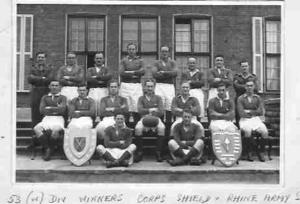
Rhine Army Shield won by 53rd Welsh
Memories of Frank Yates CHAPTER 44
I had an interesting Sunday when the G1 told me to report to Major Wightman (of Wightman’s Bank). He gave me his Humber car and driver and asked me to go to a place near Osnabruck to pick up a large sum of cash. The driver knew the way to the small Schloss, run by the Royal Army Pay Corps, where we were given several wooden boxes labelled “soap powder, Heinz beans etc.” When we got back, in the evening, Whiteman told me that there was in excess of a million pounds in various currencies in the boxes! As we were too late for dinner, he asked the “A” mess chef to rustle something up. The chef had been an apprentice at the Savoy before the war and he made us two large mushroom omelettes, which, to our amazement, rolled themselves up by dexterous movements of the pan!
On the 30th of March 1946, General Ross received the Freedom of Winterswyk, in Holland, liberated by us a year previously. Bobby Ross had by then, left the division and the reception, in the small town, was a low key affair, compared with the previous “do” in Den Bosch, the previous year, to which I will refer later. Ken and I were privileged to attend the glittering evening reception, because our old friends, the married dentists, from Winterswyk, rang us to say that they were coming to take us, as their guests, back to Holland. They collected us in their Mercedes car and brought us back to Hilden in the early hours, after a super evening.
Back to soccer, a Major Tonkinson, at Corps HQ, who was something to do with the Army Physical Training Corps, was more than interested in our div, with its superlative rugby teams (The 1/5 Welch Btn, in peacetime, only took in recruits who were Welsh schoolboy rugby internationals!), and our professional soccer team. He had his ear to the ground and it was not long before a Rhine Army Unit rugby competition was organised. It goes without saying, that the Welsh Division won the Divisional Shield and the 1/5 Welch, the Unit Cup.
Although “Tich” Williams was a rabid Rugby fan, he, Don and I were delighted when we got news from “Tonk” that the mighty Arsenal were to play Rhine Army at Düsseldorf. A large part of the Rhine Army team was from our division, but it contained players like Tom Galley, of Wolves, and the great Jimmy Hagan, of, of course, Sheffield United.
Our division was ideally suited to high level games, with our magnificent Rhine Stadium, now renamed, with a large sign “NINIAN PARK” (The ground of Cardiff City). Tich put on the game with great skill, as one would expect from a staff officer. He thought of everything and had a list prepared and duplicated. I well remember the first items were “Ball, spare ball, Welch band and Goat”. The scene, on the day was breath taking, Soldiers had lorried in from all over the British Zone .and the sight of about thirty thousand khaki clad British troops applauding the Welch Band parading round the perimeter track preceded by the white billy goat, led by its resplendent goat major, was repeated often in the next few months.
I was allocated duties looking after the Arsenal dressing room and the Manager, Tom Whittaker, who had managed Arsenal when they beat the “Blades” in the 1936 Cup Final, asked me for the match ball, which he put to soak in a bucket of water. The match ended in a draw and when I went to the visitors’ dressing room I was amazed to find about half a hundred weight of cotton wool and bandages, discarded by the players, after wrapping their precious limbs. All was well and we were congratulated on our arrangements.
Our Rugby matches were played at our PT school at Wuppertal stadium, a compact ground, surrounded by a steeply banked cycle track. This meant that spectators looked down to the playing area, giving an excellent view. The matches were very well organised by the PT staff at the stadium, one of them, Sgt. Major Peter Cooper, is now, 59 years later, a member of the “Senior Blades” of which I am Chairman! Although our divisional teams swept all before them, there were two occasions, when Rhine Army played the “Springboks” and the “All Blacks” when a few reinforcements came in from West riding Regiments, players from the Rugby League who added special skills. I will recount the New Zealand visit later, because it was more than interesting!
A most memorable weekend arrived when we were informed, by Army, via Corps, that the Rhine Army team would be playing England, the full international team, (excepting players still in the services). It was decided that the England team would stay at our infantry school, situated on the west bank of the Rhine, close to the Bailey bridge. The visitors were due to arrive at Munchen Gladbach airfield, some twenty miles west of Düsseldorf, so we hired a German motor coach, in which I and a couple of chaps from the infantry school, delighted at the prospect of entertaining the visitors, set off for the airfield.
The Dakota arrived on time and the leader of the visitors introduced himself to me as Arthur Drewry, the chairman of Grimsby Town, then a top division side. As the bags were being loaded into the coach, Mr.Drewry introduced me to Doctor Westwood, a Newcastle surgeon and chairman of Newcastle United and asked me to sit with him in the coach. On the way back, he told me that his sister had married a German before the War and had lived in the eastern part of Germany. After the start of the war, in 1939, he had no communication with her until last week, when he had received a letter from her with a Dusseldorf address. He immediately got himself on the England party, due, of course, to play in Dusseldorf. He had brought a large hamper of food for her and asked me if I could take him to the address.
I had no objections whatever to helping him but warned him that there was a “No fraternisation order” in force and, because of this, I would pick him up as soon as darkness fell.
My jeep had been fitted, by a previous owner, with an enclosed body made of plywood, very useful that night, when the heavens opened, and we would have had a very wet trip otherwise. I decided to drive myself and spent some time in studying the street map of Dusseldorf, before picking up the good doctor and his box from the Infantry School.
When we found the house, there was a very emotional meeting between the siblings. I stayed a few minutes, as she explained that her husband had been killed in the war and she, in the last stages of the Russian advance, had been raped three times by Russian soldiers as she struggled to make her way to the West, where the British or Americans would be likely occupiers. Before I left, I asked my charge if he would want me to collect him for the match, on the following afternoon. He asked me to pick him up in time for the plane home!
When on the match day morning I went, with the coach, to pick up the England team, there was a bit of a crisis, because the centre half, young Billy Wright, destined to captain England for the next ten years, was missing from the team talk!
Search parties were sent out and he was found, placidly fishing, a hundred yards upstream, having borrowed the tackle from someone at the school. I have no record of the other players, with a few exceptions. The goalkeeper was called Bly, from Grimsby and one of the wing halves was Frank Soo, from Stoke City, British born of Chinese parents. The centre forward, making a name for himself, was Albert Stubbings, who played, I think, for Liverpool. The match ended in an honourable draw but I remember that we changed our team round a bit at half time and “Ma ball” Pete McKenna was put in at inside forward, whereupon Frank Soo complained to me, looking up from his half time cuppa, “I’ve sweated my guts out for forty five minutes and now I’ve got to play against that mad Scots bastard”.
Next morning I collected Mr. Westwood and then the team, who had been royally, looked after by the Infantry boys. I sat with Arthur Drewry, who talked about Grimsby where, as well as being the chairman of the Town, he was a prominent fish merchant. He thanked me for looking after them and invited me, if at any time Sheffield United played Grimsby Town at Cleethorpes, I was to make myself known and I would be the guest of the directors. I never took him up on the offer! Dr Westwood, on departing, told me that he was bringing his sister back to Geordie land as soon as travel became normal.
Seeing them onto the Dakota, for the last farewells, I was surprised to find that the seating was a wooden bench down each side of the cabin, just as it was when dropping parachutists or carrying freight. Modern footballers travel slightly more comfortably nowadays, but after all there had been a war on!!
© Copyright of content contributed to this Archive rests with the author. Find out how you can use this.


 Recommended story
 Story with photo