

- Contributed by
- TORRANCE Duncan Leitch
- People in story:
- Duncan Torrance
- Location of story:
- Egypt
- Background to story:
- Army
- Article ID:
- A7593942
- Contributed on:
- 07 December 2005
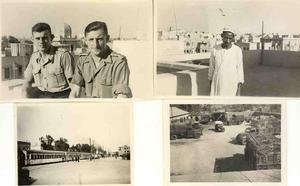
Left, with Paddy O'Ryan on the roof of the flat. Khalil who looked after us. The train had evacuated British families from Palestine (Israel). MFO Depot, note wire cages on trucks to stop theft.
CHAPTER X1V - Part One - A BASE WALLAH
I was conducted to yet another office in GHQ. A major started to tell me about my new job. I would have my own little unit and was virtually OC. While not actually having the powers of an OC, I was left in peace and quiet to run the job.
I had some 35 clerks, checkers, escorts and drivers. I would have eight three ton trucks and two cars - these interested me the most.
My job was accepting traffic for onward despatch to other MFO's (Miltary Forwarding Officers) throughout the Middle East. Much was officers unnacompanied kit. All were packages of up to 2 cwt and up to 6' long. I was also responsible for receiving any goods for despatch by ship out of the Middle East and arranging that despatch. This included documentation -12 copies of the bills of lading. These had to be typed three times,using carbon paper to get the 12 copies.
The present MFO, a Oaptain,would be there for the next ten days to show me the job. In point of fact, he was only there for two days.
A week after I had started, a document was published known as 'Q(M) Working Instructions'. Very interesting, but of little practical value. Some five days later, I received another similar document. It was the first ammendment, the old one completely rewritten. But it was of no more practical help.
The best way to learn what happenned was to go round the unit and sit at every desk for half-a-day, and do each job. You learnt what actually happened. If things didn't work, you picked up some ideas about how you could make them work.
I was put on the lodging list and thus lived as tenant in a civilian flat with two friends. One, Paddy O'Ryan from OCTU, was the staff captain who had controlled the posting of the other ranks from the boat. The other fellow, Johnnie Marchmont, I had known at school.
The flat I found very pleasant. It was more like civvy street than the Army. The main bugbear for me was that there was no privacy or get-a-way. As junior, I had no proper bed but slept on a couch in the living room.
I had never before been into the strong rooms of a bank so was glad to have the chance to do so. My mission was to collect three tons of regimental silver, which was to go under armed escort to Tripoli. An officer representing the unit aame with me to the bank. Then began the struggle of convincing the bank that we were authorised to take the silver. Eventually the Adjutant General was contacted and the bank became convinced we were not a pair of thieves.
The procession that left the manager's office to climb down into the bowels of the earth was formidable. In addition to the manager and ourselves, were two other officials, each with keys. Every door had at least two locks so it was impossible for one man to enter on his own.
Each door must have weighed about five hundredweight. After the door was opened, switches were connected to put on the lighting and air conditioning. Once inside, we started to check the stuff by serial numbers, and have the crates taken upstairs.
I had asked my boss in GHQ, what arrangements he considered I ought to make to safeguard the load overnight. He told me not to worry. So we sealed the rear wire mesh door of the truck with 5mm wire. We then jammed it in the yard with other trucks, all immobilised.
The arrangements made for the morning, was that the officer would hand a signed weighbill to my sergeant and proceed direct to Port Said. Included in the 24 pieces was one that was private property. There had been doubt whether we should take it or not, but finally it was put on the lorry.
The damage had been done. Our sergeant accepted a receipt for 23 items. It was not until the truck was half-way to Port Said, that we discovered the discrepancy. The receipt should have been for 24 items. We decided we would do no good by advertising our mistake. We kept quiet. Although this was the most valuable consignment we ever handled, I never heard anything about the 'missing' box.
At the outbreak of war, a number of units in the Middle East had deposited their silver with their banks for safe keeping. The silver was used in peacetime officer's messes and not appropriate to war. Now we were leaving Egypt. The Army was withdrawing. There were many problems with our evacuation. The silver was one.
One saturday we drew a similar load of silver which had to be transported to Suez on sunday to catch the SS Orontes, supposedly sailing at 1200 hours. I am always interested in visiting new places, so decided to accompany the truck, which I could do on a Sunday.
The MT corporal was the only available driver, so I arranged for him to pick me up in the morning on his way to the General Base Depot, where the silver was waiting under guard with an armed escort ready to travel with it.
When the truck, a Dodge three tonner arrived, it was apparent that the corporal driver had been out late the previous night and did not feel much like work. By the time we had checked the load, and got our escort, it was 0900 hrs. We had no time to lose. We had nearly a 100 miles to get to Suez.
It was fine to be in a Dodge cab again. The controls were the ones I had known so well in Benghazi. The weight mattered little and we were soon making a steady 40 along the road.
Suddenly, one of the escorts thumped on the cab roof, the recognised signal to stop. I stood on the brakes and jumped out to find the canvass canopy torn to pieces and trailing along the ground.
At the time I did not think much of it, but now I realise we were very fortunate not to have an accident. The canvass ripped straight down the centre and more or less fell off the truck. Had it lashed round it might easily have carried someone off with it.
It was soon after 11, when we saw the bay of Suez eating into the desert before us. But we did not realise that we were still twenty miles off. It seemed an age before we actually reached the town and began to make our way up to Adabyia where all the military installations are housed. Although ten miles away, we smelt nothing but oil, and went over fifteen level crossings.
Fortunately the SS Orontes hadn't yet sailed. Nobody seemed to know we were coming. But eventually I got a launch and started the forty minute sail to where she was anchored. On board, I found they had received a signal to expect 64 cases of coin weighing 2½ tons. Ours was 14 pieces of 2½ shipping tons. I managed to persuade the ship it was a corrupt signal.
We got it all stored in the ship's strong room. I was just about to get off, when on walked the Pay Corps representative. He announced that he brought his 64 cases. Things were in the balance for half-an-hour. But eventually the ship found she could take both consignments.
It was now three o'clock, and I was feeling hungry. Once ashore I started to make enquiries. There was only one NAAFI, and when I got there it was closed. But at least we were able to get a drink of lemonade through the Egyptian employees keenness for 'backsheesh'.
I had a load ready on the truck supplied by MFO Suez. But was how told that forty people had been stranded. They had been disembarked too late to catch the train for Cairo and the Transit Camp in Suez had been disbanded. Could I help? They had already scrounged another truck and needed one more. Naturally we unloaded again and got our human cargo on board. We had to drive most of the way back in the dark. Glad my driver had recovered.
Half-way to Cairo we stopped at a NAAFI for a breather. It was then I got the full wrath of the troops we were carrying.
If a boat was carrying passengers through the Suez canal, the charges were considerably higher. This was applied at the same rate whether the boat was full, or just had a few passengers. These men had been taken off a boat, would travel across Egypt by train, and back onto another boat in Port Said.
Nobody had explained to them what was happening. They just watched their boat sail for the Canal and UK.
They were tired, angry, and hadn't even got any Egyptian money. They kindly softened to my explanation. As they'd no money, I bought everyone a cup of tea and a sandwich.
Eventually, well on in the evening, we got to the Transit Camp. We stopped at the Guard point. I said the men were tired, could we take them up to their barrack block in the truck. Not a chance. They had to put their kit-bags on their shoulder and march.
What can you do ?
The Army was withdrawing from Egypt. Because of the evacuation, our traffic from Alexandria had been very heavy. During November, we began to get instructions about clearing the MFO out of Alexandria altogether, a part of our evacuation.
For the trucks, Alex return was a two day run which made it a slow job. The vehicles were clocking over 1,000 miles a week. In clearing Alex, we began to neglect our other work and soon found ourselves with an enormous amount of stuff on hand. UK traffic alone amounted to over thirty tons. Even our biggest day, on which we handled 4,000 pieces, seemed to make us little headway.
Our documentation fell ten days behind. We were short of checkers and short of vehicles, drivers, and in particular tyres. Every vehicle in our yard waiting repair was stripped of its wheels.
If a tyre blew out, and many were retreads, the driver was often held to blame. They were then fined £5. This was unfair.
A vicious circle arose. The men blamed me for overloading their trucks. We hadn't a weighbridge. Sadly for me, my drivers found one somewhere.
Something had to be done.
I got to know a few sergeants at different depots. It was arranged that I could slip in with a truck, put a few wheels on, and slip out. But I did this at my own peril. I was stealing them.
At last, understanding with the drivers was restored. Our lorries were moving. And with a smile.
Xmas began to loom ahead. We decided that we must be clear by then. We worked through the week ends on a full staff instead of the usual skeleton staff.
On the Monday before Xmas, our trucks began to pull in. The escorts that travelled up in our wagon on the daily Palestine train returned. The storage bays were tidied up. On Tuesday morning at twelve, we shut the doors and smiled. We were up-to-date. There was only 15 tons in the yard. The battle was ours.
© Copyright of content contributed to this Archive rests with the author. Find out how you can use this.


 Recommended story
 Story with photo