

- Contributed by
- John Constant
- Location of story:
- Burma
- Background to story:
- Army
- Article ID:
- A7882040
- Contributed on:
- 19 December 2005
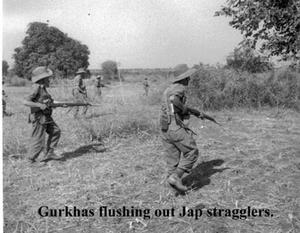
Gurkhas flushing out Japs
Chapter 7.
As a good view of the opposite bank could be obtained from there, the Sikhs had extended their flank to occupy it, and I went with the company commander, flat on our bellies for concealment, to watch for Japanese movement. While patiently pursuing this task, my hand idly picked an innocuous looking pepper; it was so "hot" I could hardly taste anything for days. What we did observe was not Japs' movement, but a bullock cart. That night, the Sikhs found enough country boats to send a strong fighting patrol across the Irrawaddy, manhandling one of the mountain guns onto the same bullock cart as we had seen. They dragged it to a suitable position and fired four rounds in the direction of the presumed Jap HQ. Then back to the shore and all safely across to our side of the river. Later, we heard from friendly sources that those Japanese had spent a sleepless night looking for the gun; of course without success.
Our brigade was denied the honour of making the assault crossing, and had to be content with our current task of securing the home bank with its choice of potential sites for launching boats and rafts. When I was sent to the Corps Commander’s Tactical HQ for the final planning, I was asked my opinion about the use of some feature, which no one else there had seen; the Corps Chief of Staff (COS) questioned my answer, with the words "Are you sure?" Answering in the affirmative, I was arrogant enough to add that I was a Sapper, which should, in my foolish opinion, have closed the matter, but the COS retorted "So am I!". By good fortune, it did turn out my way, and I was rather surprised to be warned by my Brigadier, that everything in Brigade HQ must be so organised that I could, if the CRE became a casualty, be ready to take charge of the whole Sapper task at once, until a replacement could be found for him. Fortunately no such sad event took place, and Tom Wright’s command of the bridging operation was successful, as described in the 1947 RE Journal pp 19-28 "The crossing of the Irrawaddy by 4 Corps --- February 1945" written by Colonel A Murray.
After dark on 13 February 1945, it was our Brigade's task to set up an elaborate traffic control system on the plain west of Pakokku, so that the unending, or so they seemed, elements of the bridging train could be brought to their appropriate bank sites, ready for assembly by first light. So tight was the planning and issue of equipment that the essential outboard motors (direct from the USA) had only just been landed in India, and were flown into the battle area with no opportunity for proper testing and preparation for use. After one company of 33rd Indian Infantry Brigade (33 Bde), with specialist guides, had paddled silently across the mile-wide river with complete surprise, the next 2 were to follow, before first light, using outboard motors on their assault-boats.
However, some of them could not be started, delaying their departure, and more broke down on the way across. Surprise had been lost and first light revealed their exposed position, when the defending Japs opened up with medium machine-guns concealed within caves on the Nyuang U cliff face. Both the 2 company commanders were killed, as was one of the Sapper officers with them; only two assault boats reached the beach, and that wave was effectively aborted, with hapless crews trying to paddle their sinking vessels across the 3-knot stream under fire. Nobody thought of St Valentine, whose day it was, in the few minutes after first light when all seemed to be chaos, as viewed from our position on the home bank; boats were moving in every direction, as bodies were being dragged from the water.
My intelligence sergeant had gone with them, but he succeeded in swimming back, unwounded. In the cool morning light, the guns of our Division immediately opened fire to destroy each Jap position, as it was identified, and this was soon augmented by a "cab rank" of ground-attack aircraft. As 33 Bde rallied, a wave of rafts made of folding boat equipment powered by the more reliable propulsion units, were quickly on their way, reaching the far shore with minimal casualties this time. An intrepid little D4 bull-dozer, landed further down from a folding boat raft, trundled up behind the cliff and sealed the Japs into their bunkers as they lay there. It had all happened so quickly, and the leading infantry were fanning out from the bridgehead, as the Sappers completed the remaining folding-boat rafts, and went on to the much slower task of launching the pontoons, with their heavier decking. This would have been one more case for DUKW-type rafts.
Nevertheless, by nightfall the whole of 33 Bde was over the river, with a few tanks, and some of our Brigade as well; the rest of us followed the next day, when the Sappers completed some 800 sorties with the various rafts, and on the third day this figure rose to 1000, I believe. Each day we enjoyed beautiful early spring weather, and the sight of all these rafts spread over an area of about four square miles was indeed memorable.
Our Brigadier could not wait to cross, with his Tactical HQ; he was successful in getting over on D-day to reconnoitre the battlefield, and to have a good look round Pagan, the ancient capital of Burma, with its famous Shwezigon pagoda. He was taking a great risk, as wounded Jap soldiers would crawl into the doorways of these many pagodas and lie there, until one or more members of our forces passed close enough. Then committing suicide, by letting off a hand grenade, the wounded Jap would hope to kill or wound our men, too. This was considered to be "honourable", avoiding the shame of being captured alive, and causing us further casualties.
© Copyright of content contributed to this Archive rests with the author. Find out how you can use this.


 Recommended story
 Story with photo