

- Contributed by
- Diane Turner
- People in story:
- Peggy M Robb (nee George)
- Location of story:
- Norfolk, Morecombe, RAF Stations at Marham, Creden Hill and Gloucester
- Background to story:
- Royal Air Force
- Article ID:
- A6434840
- Contributed on:
- 26 October 2005
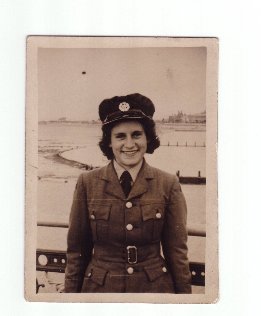
Peggy in WAAF uniform at Morecombe July 1942
Peggy’s War in the WAAF (Womens’ Auxiliary Air Force) between 1942 — 1946
Before joining the WAAF, when I was about 16 years old, I was a nanny to two little girls named Ann and Jane. I ‘lived in’ at the family house which was at Dunston about four miles from Norwich.
One night during 1940/41 when the war was very much at its peak, I was babysitting and had put the girls to bed. Whilst I was drawing my bedroom curtains, the whole garden was suddenly lit up by flares dropped from German aircraft. I then heard the bombs whistling down. I had been told if you heard them whistle you were not in danger from a direct hit.
I quickly got the girls from their beds and, accompanied by the family’s dogs, we rushed down to the air raid shelter in the garden. We stayed there until the ‘all clear’ siren sounded.
However, we all had to be evacuated the next day as an unexploded bomb had landed in the field at the bottom of the garden. The ground there was marshy - the reason it hadn’t exploded - so it was detonated by a bomb disposal squad.
I remember being in the garden during daylight hours and watching a ‘dog fight’ over Norwich between German and British planes. Norwich was very badly damaged during the war.
At this time, the Government was asking for volunteers for the Services. Unless I had been in a reserved occupation such as producing food etc., I would have had to either go into a munitions factory or work in the land army — neither of which appealed to me. I therefore decided to join the WAAF and, as I was under 18 years of age, my mother had to sign me in.
On 5th June, 1942 I was called up and, after a medical examination, I travelled to London on the train. After meeting up with more recruits, I then travelled to Bridgenorth in Shropshire where I spent about two weeks getting kitted out and being lectured on a variety of do’s and don’ts. I was then sent to Morecombe in Lancashire.
When I first arrived in Morecambe I was billeted in a house on Heysham Road. Originally Bed and Breakfasts, the houses on this road had been taken over by the Air Ministry for housing WAAFs and airmen. The house I and six other WAAFs had been allocated was not up to standard. The couple who ran it were really strict and the food was not very nice. We were made to go to the bathroom in the cellar even though there were other bathrooms in the house. We were not happy about this and complained to our WAAF officer. She had us moved to a really nice house and the previous house was taken off the list of Air Ministry houses. Rumours circulated that previously airmen had been billeted there and the couple were not happy when WAAFs turned up instead. They had two daughters whom they had hoped to marry off to airmen!!
Whilst at Morecambe I did my ‘square bashing’ (marching, saluting etc.). Flight Sergeant Fox, male, was our trainer and he kept us on our toes. We were lucky as it was July 1942 and the weather was really hot. We were only allowed to travel within a 15 mile radius of the town so I was unable to attend my sister Iris’s wedding in Norwich during this time.
Displayed everywhere were posters proclaiming ‘Careless Talk Costs Lives’ and we were sworn to secrecy regarding our postings.
Whilst at Morecambe I had a smallpox inoculation. Unfortunately I got vaccine fever and the following morning I fainted and was quite ill. The Medical Officer was called to my room which was unheard of — normally if you were sick you went on sick parade — so it must have been serious! However, I soon recovered after treatment.
I was asked which part of the country I would prefer to be posted and, after requesting Norfolk, was pleased to be told I was going to RAF Marham near King’s Lynn.
At Marham my job was to answer the telephones in the Officers’ Mess, which I enjoyed, keeping in close contact with the pilots. I was always happy to see them return from raids over Germany — but most often they did not return which was the saddest part of all. Sadly there were often wives or girlfriends on the other end of the phone asking to speak to their loved ones, whom I knew to be missing. The Adjutant was the one who broke the awful news.
Marham initially had Wellingtons which had five in a crew — a huge loss of life when one of those crashed. Later there was the ‘Wooden Wonder’ or Mosquito, which had a crew of two, pilot and navigator. All the air crew were extremely brave young men.
When the crews returned safely from their missions they were all rewarded with an operational breakfast of bacon and eggs. This was prepared for them by the cooks even though it was during the early hours of the morning. Carrot tablets were highly recommended for improving night vision and there was always a bowl of these in the dining room.
During the war there was, of course, food rationing. It was extremely difficult for supplies, which had to come across the Atlantic, to get through by sea. Merchant ships sailed in large convoys and were afforded some protection from German submarines and bombers by Naval warships, frigates, submarines and aeroplanes. Whilst I was at Marham there were also Americans and Canadians based on the station who received food parcels from home. They very generously shared their goodies with us.
We often took some time off and went into the town. There was always RAF transport available to take us there in the evenings.
I was really sorry to leave Marham but a posting came through for me and two others — Iris who worked with me on the phones (who later became my bridesmaid in 1946) and Jackie who was a policewoman.
It was around April 1944 when I arrived at 11 Squadron School of Technical Training at RAF Credenhill near Hereford. Initially I didn’t like this posting as there were no planes and I and my colleagues felt quite bored. Here WAAFs were trained to pack parachutes for aircrew. If they passed their exams they became fully fledged ‘Safety Equipment Workers’.
I was employed as a clerk and worked in Station Headquarters in the Orderly Room dealing with postings in and out of the station. I also made out railway warrants and drafted Personnel Routine Orders which were matters of interest to all on the station. My friend Joan typed them in another department and they were put up in various places on the station for all to read. There was a Corporal in charge and four WAAFs including ‘Kiwi’ a New Zealand girl. We all got on really well.
One day I remember an RAF Corporal coming into the Orderly Room. He had been posted from 5 Wing, another branch of the camp, to SHQ - I quite fancied this Scotsman!! I was intrigued to know if he was married and, as I had access to the personal documents of everybody on the station, I decided to check. These documents were kept in the Central Document Office in SHQ and all I had to do was collect and sign for them. To my relief I discovered he was single. My friend, Joan, arranged a date, I went out with him, and the rest is history!! Robbie and I married in 1946. He was an instructor on parachutes and dinghies and took WAAFs for their trade tests.
All clerks on the station were required to work a night shift in SHQ. This was done on a rota basis and there were always two of us on duty at a time. We shared a very small office with two single beds. Our duties included answering phones and collecting any information which came in and passing it on to the male Orderly Officer who popped in now and again. Our boyfriends sometimes used to sneak in and see us which was strictly against Air Force rules. On one particular night when Joan and I were on duty, Robbie called in to see us. Unfortunately his timing was wrong as it coincided with one of the Duty Officer’s visits and we had to hide Robbie behind a flimsy curtain in the office with strict instructions not to cough or even breathe!! It was quite a hairy experience.
It was usual procedure for an Orderly Corporal to check each hut to see that all lights were out and that everyone was in bed between 10-11pm each night. She would call our names in turn and we had to respond. Sometimes if one of us had a late pass and hadn’t got back on time we would always put a pillow in the missing girl’s bed and answer to her name when it was called out. Fortunately we were never caught.
We were always woken in the mornings by tannoy in the huts. A voice said; ‘At the stroke of the gong the time will be 7am’. The ablutions hut was a communal affair with wash hand basins in a row along the wall. At Hereford we were only allowed to fill a bath with 6 inches of water — there was a thick black line painted in the bath — or we could use a shower.
I found it very difficult to get up in the mornings but there was always someone who would bring me breakfast in bed — tea and toast during the week and a bacon sandwich on a Sunday. I never actually went on a morning parade during all the time I was in the WAAFs. I really don’t know how I managed that — I was just lucky I guess!!
We did not make our beds until we had finished duty. We had to fold our blankets and sheets (yes we did have sheets!) and leave them in a neat pile at the end of the bed. Kit inspections occurred quite often when we had to lay all our kit on the bed. If anything was at the camp laundry a chit had to be produced to this effect and if anything was missing or lost you were put on a charge — 7 days in the cookhouse. We couldn’t borrow each others clothing as everything was clearly marked with our name and number.
We liked our collars to be starched really stiffly so we always took them to the Chinese laundry in town where they did a wonderful job. The collars, separate from the shirts, were held in place by studs.
On one occasion when Robbie was going on embarkation leave prior to leaving for the Middle East, I put in to go on leave with him. However, my request was denied. I was told I was indispensable as there was nobody else who could draft PRO’s. I was really upset and threatened to go AWOL (absent without leave) but Joan came to my rescue and helped me out.
Robbie and I were able to go and see both sets of parents on his embarkation leave. My parents lived in the village of Brundall, 7 miles from Norwich. The train was very late getting into Norwich and we missed our connection to Brundall. We decided to see if we could hitch a lift. A van pulled up which turned out to be a prison van containing four prisoners. Much to our surprise we were put in the back with the prisoners!! As the driver’s cab was separate from the rest of the van, he told he told us to bang on the floor when we had arrived at our destination. We hadn’t travelled very far before the prisoners banged on the floor and the driver came round to let us out. After telling the prisoners off, he got back in his cab. The prisoners repeated this little game several times before we finally reached Brundall and we ended up feeling extremely sorry for the driver.
When we got to my parents’ house in the early hours of the morning, we had to waken them by throwing stones up at their bedroom window.
In those days of course, only very wealthy people had telephones and mobile phones had not even been invented, so it was not possible to just pick up a phone to tell my parents when we would be arriving. The roads were very quiet during wartime - only the privileged few owned cars and petrol was in short supply as it had to come from abroad. Obviously the military, police, fire brigade, ambulances and doctors had priority where petrol was concerned and anyone else had their petrol rationed. Rationing of many items including food, petrol and clothing continued well after the war was won and could only be purchased by saving coupons.
Another reason travelling in Britain was extremely difficult during war time was because of the ‘blackout’. It was against the law to show any lights after dark making it more difficult for German bombers to see towns and cities from the air. Also road signs and station names had been taken down to confuse the enemy in the likelihood of an invasion.
On another occasion when we arrived at Norwich and had again missed our connection to Brundall, a kind station master let us stay in a room until the next train arrived.
Once when I went on leave on my own I got off the train at Norwich. The station was, of course, in total darkness owing to the blackout. I walked over to where I thought my train to Brundall would come in and fell off the edge of the platform onto the rail. Luckily I didn’t hurt myself — I think my tin helmet and gas mask helped to protect me but I was rather shaken.
© Copyright of content contributed to this Archive rests with the author. Find out how you can use this.


 Recommended story
 Story with photo