

- Contributed by
- Ted Lewis
- People in story:
- Edward Terence Lewis
- Location of story:
- From Bethnal Green to West Africa
- Background to story:
- Royal Navy
- Article ID:
- A6198140
- Contributed on:
- 18 October 2005
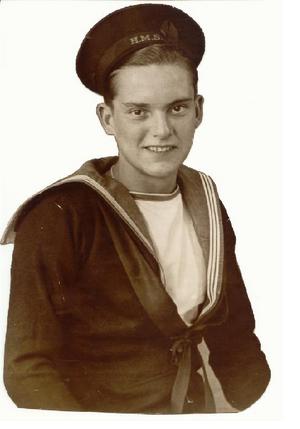
1942
1942.
I had just turned 17 when I joined the navy. You had a limited choice in those days; you knew you were going to be called up anyway when you reached a certain age and the chances of being shoved in the army was pretty strong.Now I'd been in the Home Guard - or 'Dad's Army'. I was attached to the King's Royal Rifles and I'd heard so many stories about the first world war - not so much about the fighting, but about the dirt and the conditions in the trenches,because they were horrific, no toilets or anything like that, so that put me right off the army.I thought to myself, well if I go in the navy at least I'll be clean - I'll be on water!
So I put down for the navy. Then I got called to come for an examination. I remember it still; it was in a disused shop in the Seven Sisters Road. I went in there, along with many others and there we all were, walking about in our underpants,there was a panel of doctors who examined us one after the other and then at the end of the day we went before this petty officer who was sitting at a desk and he said to me ''You'll be pleased to know you've passed all the tests and you've been accepted into the navy.'' Then he said ''Can you swim?''. So I said ''Why, aint you got no ships left?''
''A sense of humour,'' he said, ''You'll probably need that.''.
The next thing I know, I receive a letter that I have to report to Plymouth Barracks, HMS Drake. I went down to Paddington Station and I caught a train to Plymouth. Got out at North Road, Plymouth and there were these navy lorries waiting. So I put me case aboard one of these lorries, climbed up into the back of it and off we went. Eventually finished up in this big barracks which I later learned King Charles had used as stables for his cavalry. Big huge place - rambling. Cobbled stones on the streets. When you got up into the quarters where the men slept - where they slung their hammocks, it was frightening. All you could see was hammocks, slung up everywhere.
The following morning, the lorries were pulled up again and we all got into them again and they drove us to a camp - it's still there I do believe - HMS Raleigh. In the navy everywhere is called after a ship. All the shore establishments are named after ships and this one was HMS Raleigh. It was like an army camp; there were all the huts. Then there was one place where they had the mast and the flag flying from the mast. That was called the quarterdeck. If you was caught walking across the quarter deck you got bawled out of your life. You had to salute the quarterdeck and 'holystone' it; get the woodwork up, right white. They were very very strict on tradition.
Anyway, I got a place in one of the huts, in a bed, which was a luxury in itself, because most of the navy still slept in hammocks( which are very comfortable to sleep in, like having walls on the side that keep you warm )and we all settled down to the training.
The training was very very rigerous.We were introduced to an old man - he was old but he was very very good. I seem to remember that his name was Petty Officer Bill. There were 19 of us in this hut. He marched us round to the slops office and we lined up and then the bloke says: ''What size boots do you take?'', then he plonked a pair of boots on the counter, then a hat came over, underpants, socks, vest, a shirt, a wooly and a pair of bell-bottomed trousers, all piled up high. Staggering out of that hut, I was. They always done everything to inconvenience you. Well that's what I thought anyway. If you lived in London they posted you up to bleeding Scotland.
They had a big theatre in the camp and there we were given a pep talk. This bloke - he was an officer, with all the gold braid - he said ''Now remember, you are in the navy and if you don't want to be in the navy, stand up''. Nobody stood up, but I could see out the window that there was an army truck waiting to take any idiot that did stand up, off to the army.
We used to have a lorry come round from the regular army, pick us up and take us out to the rifle range in Purfleet. Now I'd been in the Home Guard so I'd done quite an amount of rifle training.
I'll tell you a story about when I was in the Home Guard. This particular weekend, there was a big manoeuvres coming off. The Bedford and Hertfordshire regiment of the regular army were going to attack us. They were going to come over Bow Bridge. There's a pub there, it's still called the Fountain. So this Saturday night, me and three others set up a Spiggat mortar as they called it,outside the Fountain pub, ready to defend the bridge. Anyway, we decided to pop in the Fountain. We had a drink and then someone suggested we went over to the Brewery and had a drink in their canteen - I think the beer was cheaper. So we went across there and had a few drinks and we all got drunk. When we came out the Spiggat mortar was gone. To this day I don't know where it went.
Anyway, back to HMS Raleigh. Training went on for 6 weeks. At the end of it I got leave and then I got sent to Scotland. When I got the papers I thought they said 'Greenwich' and I thought ''Well that ain't bad, it's only down the road and I'll be able to pop home'' but it was Greenock.
Well to cut a long story short, I got the train to Greenock, found my way to the docks and there lining the docks was HMS Beagle - a B class destroyer. I goes marching up there, sees the bloke on the gangway, he says ''We've been waiting for you, go and find your way on the mess deck''.
And that was it. About an hour later the bleeding thing sailed for West Africa.
© Copyright of content contributed to this Archive rests with the author. Find out how you can use this.


 Recommended story
 Story with photo