

- Contributed by
- TORRANCE Duncan Leitch
- People in story:
- Duncan Torrance
- Location of story:
- Lybian Desert
- Background to story:
- Army
- Article ID:
- A7488039
- Contributed on:
- 03 December 2005
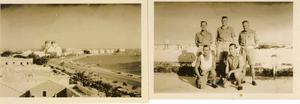
Beghazi from the roof of the Officer's Mess, 1946. Standing, Lt Gowdy left, writer centre, Maj Ward, Royal Engineers right. Two German Batmen on the front row.
CHAPTER X - Part Two -BURY ME OUT IN THE DESERT IN THE HEAT OF THE LYBIAN SUN'
My Green Howards Sergeant.
The Captain who had been in charge of us left, so I became more of an officer and less of a clerk. The last day, I went for my solo desert trip. We were so short of transport that I was forced to break one of the desert rules by taking only one truck. But we got to our destination and back without any trouble.
We failed in our mission which was a rather scatter brained effort. GHQ produced a document known as the 'Provisional List'. It was an interesting document, containing the names and positions of burials from many sources, including relatives and others.
On the face of it, it sounds a good idea and we did occaiasionally find graves using it. But many were absurd. Map references placing people in graves in the Mediteranean. One 'last seen flying over Bengazi, with no indication whether he'd taken off from Benghazi, or was attacking it. Another casuality buried 40 miles North of Derna, which put him forty miles out at sea. We even had one where a padre had recorded the compass bearing of a grave from his truck; presumably he then got in and drove the truck away.
The desert was strewn with minefields. All the old minefields that both sides had layed were still there. As we scoured the desert, we would see a plume of sand, and hear a bang. That was a mine that had become sensitive and yielded to the sun.
Care was need because in many cases the marker fences had gone. The minefields were then unmarked. Somehow though, the ground always looked slightly different, a touch higher over the mines so that one could sense from the crossword pattern that they were there.
I was told that, at one time, graves in minefields were opened. Such burials were found when a new minefield was laid over existing graves. In openting one of these graves, the team exploded a mine, killing one of the party. It was said that this brought to an end any search for graves in known minefields.
Another problem was stray grenades. The Italians had left a lot of 'red devils'. These grenades were in an aluminium case with a red base. Fitted with an instaneous allway fuse, they could go off at the slightest thing. If they were near a grave, they were a hit frightening. We hadn't got the one pound gun cotton slabs and time fuses we'd trained with for blowing up 'blinds'.
The night before we due to return from Derna, one of our drivers was in the NAAFI when a brawl occurred in which a corporal was injured. OC troops Derna wanted him for the court of inquiry.
We had a vehicle and no driver, could I have wished for better? While I had taken odd turns at the wheel before, it was not a popular performance either with the drivers or my OC, and was anyway a tchnical breach of discipline. I found it aggrivating to sit beside a driver who, with the wheel to steady him, would throw the vehivle about without mercy for its body, engine, load, and passengers.
To-day, however, I was to drive, legally entitled to so, in this operational emergency. There is a great deal of pride to be gained from driving a truck, far more than from a car. The vehicle is bigger and heavier involving more judgement. Every gear change constitutes a skilled task if it ,is to be done smoothly and quietly, no synchromesh.
The pleasure of the run was to some extent spoilt by khamsin. This hot wind off the Sahara blew in through the ventilators, keeping us warm instead of cool. The radiator gauge showed forty degrees Fahreneheit above the normal temperature. Even the throttle became painful on my foot.
Once back in Benghazi we set about registering the civil cametery which contained many military burials. It had been regisyered originally by the Italians, but their register we found to be every bit as complicated, innaccurate, and haphazard as the cemetery itself. A British unit hade made a registration in 1943, but this was done in a great hurry, contained many mistakes, and, as no exhumations had been carried out, was teaming with unknowns.
As space became short, the Italians had used the spaces between existing graves. These graves did not have memorials. The Graves Registration unit recorded them all as unknowns. We had to check them. They weren't military burials.
We set to for six weeks, exhuming as many as forty on a good day. Sometimes we had to stop to do the clerical work, but for the greater part of the time, we fought 'the battle of the files' in our evenings and week ends. We never seemed to get away from the smell of human remains. It permeated our clothes and even tainted our rooms.
One morning our local cashier gave us cheering news. We had been granted additional pay, at the rate of three shillings a day, when in close contact with human remains.
Before leaving the cemetery, I will record one discovery. It was with a great struggle that a marble memorial was lifted by four Germans from a grave which on exhumation we found to be the remains of a girl of about five. This was the sort of thing we were able to predict from the knowledge we had built up about the cemetery. It was not even safe to trust an elaborate memorial dedicated to a distinguished dead soldier.
© Copyright of content contributed to this Archive rests with the author. Find out how you can use this.


 Recommended story
 Story with photo