

- Contributed by
- kathandken
- People in story:
- Kathleen Baldwin nee Pennel
- Location of story:
- Walsall West Midlands
- Background to story:
- Civilian Force
- Article ID:
- A4333439
- Contributed on:
- 02 July 2005
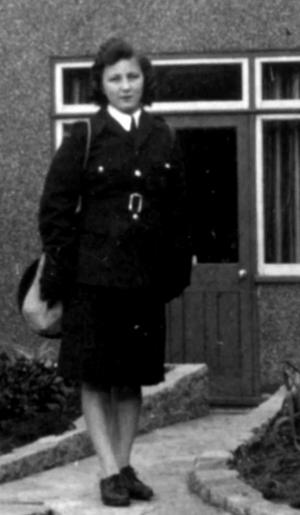
Going Out on ARP patrol
I was 17 years old when war was declared in 1939, working at a local Leathergoods Manufacturer as a clerk. After the initial shock of being at war nothing much happened. Territorials were called up but little else changed. Gradually things took shape, we were issued with ration books and gas masks and people were asked to volunteer for local services. I decided to apply to the ARP and duly became an Air Raid Warden. Our duties were patrolling the streets, checking lights were not showing and giving out general information. This was done on a rota system. When an air raid was in progress everyone turned out, guiding people to shelter and checking our allotted area. By this time a lot of young men were being called up including a lot of my friends. My own boy friend decided to volunteer for air crew and eventually became a pilot doing his flight training in America.
After a while the government decided to call the girls up and of course I was the perfect age. We had no choice it was the services or munitions and I was allocated to
munitions. I was lucky and did not have to leave home as many factories were in our area. I was assigned to a bomb filling factory on the borders of West Bromwich and
Walsall about 5 miles away from my home. There was a shift system, 5.45am - 2,15pm one week and the next week 1.45pm - 10.15pm. I had to find a way to get there. The buses went from the centre of Walsall which was one and a half miles away from my home. This meant I had to walk alone to catch the bus. My other option was to use my bicycle which I did and found it quite daunting for a teenager but I did it.
A whole new world was waiting for me at the factory. I was to be a CIA (Chief Inspector of Armaments) Inspector checking all the work. After checking in we were then taken to a long cloakroom divided into two sides down the middle. The side we were on was known as the dirty way, here we took off all outer clothing and shoes. A kit bag showing your special number was provided for these. At the dividing line you were checked by a woman for metals i.e., pins in your hair, jewellery etc., you also left your handbag with her. A small bag was provided to hold change for the canteen. You then climbed to the other side which was the clean side, here another kit bag was provided containing fireproof clothing including shoes. We were then taken to a general office where we were assigned our work. This included checking NCY (cordite) capsules for air bubbles. Twelve of these went round the fin of the bomb. The rest of the bomb was TNT and 808, a plastic green material very much like plasticine. This checking was highly dangerous and highly unhygienic as we were taking in great gulps of cordite. When break time came, we had two per shift, we had to walk along the clearways (tarmac paths) to the canteen about 1/4 mile and the toilets some 200-300 yards farther along the clearway paths.
After a while we were moved to another factory in Featherstone a village near to Cannock Chase. Here a three shift system was introduced and we did nights as well - 9.45pm to 7.15 am. with the change of venue coaches were provided and I was
the first to be picked up so it was a long journey. It was quite eerie here as the workshops were tiny dug outs in the ground. Only six operatives were allowed with
just one CIA Inspector for safety so we were told and as we were also always being told our work was highly secretive. The best moment for me was when on the early
morning shift the Tannoy told us our troops had landed in France and they were using our bombs (tank busters).
There was a lighter side to the war, I was involved with my Church, we had lots of social events. I was also Brown Owl to the Brownie Pack. Saturday afternoon and
evening was always free and we all went along to the local dance in the Town Hall, this was the highlight of the week.
At the end of the war my boy friend and I decided to get married and we were married a few days after the Japanese capitulation. This year, July 21st we celebrate our
Diamond Wedding; 11 days after VE Day.
Kathleen Baldwin
© Copyright of content contributed to this Archive rests with the author. Find out how you can use this.


 Recommended story
 Story with photo