

- Contributed by
- Frank Yates
- People in story:
- Frank Yates, Major Ted Branson
- Location of story:
- Hilden Barracks, Dusseldorf, Wuppertal
- Background to story:
- Army
- Article ID:
- A7407038
- Contributed on:
- 29 November 2005
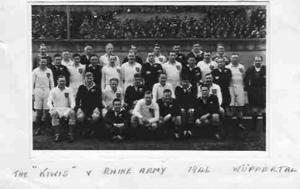
Kiwis v Rhine Army Wuppertal 1946
Memories of Frank Yates CHAPTER 47
Life in the Army, very pleasant, as far as I was concerned, was drawing towards its end. There were, however, a few purple patches before I was demobilised. Firstly, the visitation of the blond Adonis! A new GSO 2, arrived, Major Ted Branson was his name. Readers of these notes will know of his son, Richard Branson, the entrepreneur and airline owner. Ted was tall, with blonde curly hair, exceptionally good looking and sported a GOLD MONOCLE. He was (and still is) the son of Mr. Justice Branson, and a junior barrister. He had a slightly supercilious air, but was friendly and popular with us. On his first evening, in our mess, of which, because of his G2 rank, he was Mess President, he told us something about his life. I remember one of his anecdotes, concerning the “Old Man’s” Silver Ghost, dating from the Great War period. The judge had not used it during the war because of its heavy fuel consumption, but Ted, on leave, needed transport, so got the key for the Rolls Royce. Forgive me for explaining that cars, until the 1950s, did not start with the key, which simply turned on the ignition. It was then necessary, either to turn the engine with the starting handle or to put a foot on a massive floor mounted switch to operate the starter motor. Ted put the key in the ignition, turned it and the car started! This meant that the cylinders were so well engineered that they had kept compression over a period, so that the spark, caused by switching on, had fired up the engine.
After that first night in the mess, Ted failed to turn up for dinner the next night, or for many other nights. The mess sergeant told us that the major had asked for sandwiches etc. It appeared that Ted had a friend in Dusseldorf. It was suggested that she was some sort of German countess, or some such lady. Ted never mentioned her and we didn’t ask! It was remarkable, that even in an ex-enemy country, he found his social level!
On the first Sunday evening since his arrival, we took him down to the Yacht Club, the weekly Mecca for hundreds of officers. We had a Div HQ table and were watching the cabaret, when Ken nudged me and I followed his glance, to see a table occupied by Welch Regiment blokes, who were studiously watching the cabaret, each with the base of a wine glass stuck in his left eye. We hoped that Ted did not notice! No trouble ensued!
Our new G2 decided that we needed some recreation, so he hired some German horses and gave us compulsory riding lessons on the heath land beyond the airstrip. My first acquaintance with a horse was not a very happy one. First of all, getting on is a problem, and when that complicated exercise has been completed, at about the fifth attempt, you find that your height above the ground is frightening. To add to my worries, I was disconcerted to find that my steed seemed to periodically stumble and I was afraid that I might be projected over its head! Give me a motorbike any time! On our second lesson, Ted saw a German, gathering firewood with a horse and cart, although we were a couple of hundred yards from him, we could see that the man was beating the horse with a stick. Ted galloped away, jumping ditches and obstructions like a Hollywood cowboy. He returned, pink faced, with monocle gleaming, pushing his revolver into its holster. “I put the fear of God into him” he beamed,
While in Hilden, Ted visited the local shoemaker with one of his riding boots, London made, in glossy brown leather and ordered the German to make him a pair. The German riding boot has a kind of fold at the ankle, unlike the British pattern. When Ted got his boots, they were almost indistinguishable from their London equivalents. Our German wide boy explained to us that the German Trade Unions were called”Guilds” and to be a member, a trade test had to be passed. Imagine going into a British cobbler’s shop and asking him to make a pair of riding boots!
My last memory of the remarkable Ted was amusing. He had somehow got hold of a French Louis Quatorze gilded chair, which he used in the office. It was a very elegant and slender chair, which suddenly exploded under him, depositing him with a thump on his bottom, in typical “Ted” fashion, he laughed harder than us!
Back in the sports field, a letter was received from the War Office which announced that the New Zealand Rugby team, (The All-Blacks} was coming to Britain, for the first time in 5 years, and they would be treated as ambassadors of New Zealand and no effort or expense was to be spared. They intimated that all costs would be met by the War House. We quickly formed a committee to organise the visit, their first task was to book the Yacht Club for the evening of the game and to order 200 bottles of champagne, two barrels of beer and all the other necessary supplies, thought necessary to make the dinner a success. A cabaret was booked and arrangements for the match handed over to the PT staff at Wuppertal stadium. We arranged that they should stay at a Schloss, south of Dusseldorf, occupied by a Gunner Unit, who were delighted to entertain the Antipodeans. My job was to visit the Schloss several times a day, after collecting them from Munchen Gladbach airfield, to sort out any problems. One of the Maoris asked me to take him to see the M.O. He had a “Cauliflower ear” the first I had ever seen. It had been collected when they had played Scotland, and the ear WAS, literally, as big as a small cauliflower! The M.O. got out a very large syringe, stuck the needle in the offending ear and slowly withdrew the plunger. The ear subsided to almost normal and I took a happier Maori back to the Schloss.
After the match, ending in a draw, everyone went into Dusseldorf and the party commenced. What a party! After midnight, I counted nine drunken New Zealanders in one borrowed jeep, racing about, on the Rhine bank, after midnight. The leader of the visitors, a Brigadier Green, said, during the dinner, that they had never before experienced such hospitality and the War Office wrote us a letter of thanks, (And settled the bill!).
Soon after we arrived in Hilden, in June 1945, we found a small film theatre, in the main barrack block. It had a steel lined projection room and a screen, about 12 feet long, fitted with electrically operated curtains. All that was missing was a pair of projectors. The German procurer, (If that is the right word?), commandeered the projectors from somewhere and provided a projectionist, possibly from the cinema from which he had nicked the projectors. Then ENSA, in Brussels, was approached to see if any films were available. They offered us Lawrence Olivier’s “Henry the Fifth,” which was playing to empty houses in Brussels and Antwerp. Our theatre held about seventy and it was full every performance. We had 200 officers in the barracks, and many more in the neighbourhood and they wallowed in the pleasure of seeing the superb film played, with amazing brilliance and terrific sound, in our little cinema, The German “fixer” was then commissioned to obtain German films. He came up trumps with a string of great UFA pictures, “Der Grosse Frieheit”, shot in Hamburg and banned by the Nazis because they considered “Freedom “, with its implications, a dangerous word. We saw “Baron Munchausen” and a string of competent musicals and comedies. Our rudimentary knowledge of German did not detract from our enjoyment of the movies.
© Copyright of content contributed to this Archive rests with the author. Find out how you can use this.


 Recommended story
 Story with photo