

- Contributed by
- Frank Yates
- People in story:
- Frank Yates, John Simons, Bob Currie
- Location of story:
- Leeds, Chatham, Manorbier
- Background to story:
- Army
- Article ID:
- A7377537
- Contributed on:
- 28 November 2005
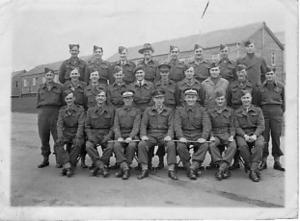
Manobier Gunnery Course
Memories of Frank Yates CHAPTER 25
We arrived in Leeds in early march 1944, for the purpose of becoming a Divisional LAA Regiment. We became 116 LAA RA and the LAA unit of 50th. (Tyne — Tees) Div, who were the owners of the 116 number, took over our number 50. Gone then was our AA. Command role of taking over gun sites all over the place and we became part of the 53rd. (Welsh) Division, which was based in Kent.
We were billeted, rather bizarrely, in several steep sloping streets in the centre of Leeds, The terraced houses were largely empty and so we got the whole battery in one street. A new CO. was appointed and we started indenting for our 1098 stores. Allow me to explain; “Indenting” is Army speak for requesting and the 1098 is an Army form listing all the stores and equipment that a particular unit should possess. It would for instance; list “Guns 40 mm Bofors, self propelled, and things like “Brushes, scrubbing, 7 in. A naval acquaintance (one of my headmasters) told me of a navy stores list containing consecutive items “Boats Tug” and “Boats Gravy”!
The Army took the opportunity, while we were together, to top up our inoculations and vaccinations. Over the years our arms were like pincushions!
As I have mentioned before, I was no stranger to a motorcycle and had had a little instruction on lorry driving. But I had never driven a vehicle with left hand drive. On a Sunday afternoon, when everyone was having a siesta, I appropriated a jeep and drove it through the virtually empty streets of Leeds, to Quarry hill flats, where I turned in the centre of the enormous building and returned. By this time I was managing to steer and change gear at the same time!
We knew that we were to be stationed in the Rochester— Chatham area, and I had the job of taking a convoy of ten vehicles down to Kent. I took the opportunity to drive the leading jeep. There were 8 lorries and a tail- end jeep, driven by one of our sergeants. Somewhere near Grantham, I spotted a nice long car park, backed by a high stone wall and decided to stop for a brew up. Signalling, I turned up to the wall and stopped, watching the drivers pull in one by one, neatly up to the wall — very impressive. Then the last jeep pulled up to the wall and climbed up it! The front wheels protrude in front of a jeep and I suppose that he had the four wheel drive engaged. We had to man handle it down again with a red faced sergeant, clinging grimly to the steering wheel!
In case the reader should think that, from the driving aspect, we were a bunch of incompetents, they would be right. Pre war, car ownership was very rare and most young people never got the chance to drive. It is a sobering thought, that the majority of the young Battle of Britain pilots, controlling a thousand horse power Spitfire, had never driven, nor were they licensed, to drive a car!
Eventually, the whole Regiment moved down to Chatham, calling en route at Peterborough to collect most of the equipment, from a temporary depot organised by the divisional Military Police.
The Maidstone Road, leading out of Chatham, climbs a hill from the Medway valley, reaching a plateau. On the right was a shadow factory, making Short aircraft, and opposite, our regiment had taken over the Davis Estate. This was a very large housing estate, not quite completed when the war began, the internal plastering had not been finished, but the essential services were all in place. It was fairly comfortable and convenient for access to the Medway towns.
The three batteries were spread in different parts of the estate, each one looking after its own messing. Everything worked very well as we gradually amassed our self propelled guns and stores. Our mess was in a detached, unfinished house and, of course, was quickly furnished with an upright piano. On one occasion I took a small party of drivers in a 15 cwt truck to an airfield in Lincolnshire to collect two S.P. Bofors from Waddington. Knowing that we would not make the double journey in one day, I told the blokes to bring their bedrolls, and we took bacon and eggs, bread, and stuff for breakfast. About an hour before twilight, I stopped in Stevenage, found a constable and asked where the local scoutmaster lived. When I found him, I asked if we could sleep the night in his Scout Hut, after shaking hands, left—handed, in the approved Scout manner. He sent runners round to summon the troop who looked after us with great enthusiasm. The scouts were in their seventh heaven, the gunners let them climb about the guns and work the traversing and elevating handles. The Scout Hut was just the job for a night’s stay. I was kindly invited to the Chez Scoutmaster where he and his good lady put me up for the night.
Next morning the Scouts were out in force, cooking breakfast, making tea, boiling water in dixies, for washing and shaving and then they cleaned the two guns and formed a guard of honour as we set off down the road to London.
Our battery mess was very well run by a Lieutenant secretary, and although we received modest mess bills, which included the hire of the piano, we were very grateful to him. At “elevenses” he organised large jugs of cocoa and Cadburys’ chocolate biscuits. Very civilised! Word of John Simons seemed to have infiltrated the “Wrennery” in Chatham. The chief Wren invited us to dinner and a musical evening (Assuming that John was going to supply the musical evening!) I still had my portable gramophone and had recently bought the latest best selling record of “Honky Tonk Train Blues”, composed and played by a black American virtuoso pianist called Meade Luxe Lewis. The composition became an uncanny journey on an American train, crossing points and crossovers, the rhythm of the wheels, beating away constantly. I suggested to John, who was of course a classical pianist, that if he were able to play jazz music, it would go down a bomb with the other ranks in the Wrens (Women’s’ Royal Naval Emergency Service). John asked me to get the music, (One shilling from the local music shop). When I gave him the sheet music, in his bedroom, he opened his kit bag and pulled out a rolled up bundle, tied with string. He unrolled it on the table and revealed a complete piano keyboard, modelled in sponge rubber. Propping up the music he played a soundless version and I left him alone, rapt in his bizarre performance. That evening, after dinner, John sat down at the piano and played “Honky Tonk”, quite brilliantly!
The great day arrived, John, I, Bob Currie and our Battery CO were welcomed to the Wren quarters in Chatham by the Chief Wren and her senior officers, in their “Wardroom.”. The wife of the Bishop of Rochester was a guest. She told us that her son was an aide to “Monty” and had been map reading the Field Marshall to a rendezvous point in the depths of Romney marshes, when he stopped the car, got out, opened the car door and said “Here we are sir” Monty replied “No we are not, find your own way home”. He slammed the door and ordered the driver to drive on. Her Ladyship clearly had a low opinion of that “Objectionable little man”,
The “Queen Wren was a very high born, “cut glass” Lady of about 40 years, conscious of the opinion that the Wrens was the elite women’s’ service Their uniform certainly looked smarter, and they always seemed to be better looking. Even if they were not, they certainly thought that they were!
The meal was quite something The Wren stewards, placed a plate of what I discovered were asparagus tips, and a dish of melted butter before me. I had never seen the things before and I had no idea how to eat them, so waited until the hostess picked up a tip, dipped it in melted butter and scoffed it, using her fingers. I followed suit, not finding them anything special. A steward brought me a fingerbowl and paper towels. The meal was accompanied by fine wines and was something to remember. After the coffee, we were led through to the ratings’ mess where the tables had been removed and a couple of hundred Wrens were sitting, waiting, for the concert. On our arrival they all stood up until told to be seated by Miss Lord Nelson! The platform, at the end of the room boasted a Bechstein grand. If I had not known John, I would have worried about him as he adjusted the piano stool.
He started off with some Chopin Etudes, all well known, including the dynamic, familiar “Revolutionary” He played part of the “Moonlight Sonata and the first movement of Tchaikovsky’s first piano concerto, all received with rapturous applause by the Wrens. Then, as a finale he played “Honky Tonk”. The girls went wild, demanding an encore. I got the feeling that the Chief Wren did not quite approve!
Shortly afterwards, the inevitable course vacancy arrived and you can guess who was nominated to attend. Off I went to an AA firing establishment at Manorbier, on the S. Wales coast, near the little resort of Tenby. I visited Tenby twice during my stay and was quite taken up with the quaint place with its monastery, on an island in the bay. I resolved to revisit after the war, but, unfortunately, never did. The course was very good, with a smattering of American, Canadian and South Africans. Apart from the usual technical, gunnery stuff, we spent a lot of time in discussion, exchange of experiences and opportunities to lecture the others on a variety of topics.
At the end of the course we were given rail warrants back to our units and I broke my own record by travelling from S. Wales to Kent, with a short stay in Sheffield, en route!
Then a Divisional firing exercise was organised on the Downs above Lewes in Sussex. The Field regiments fired off a lot of ammunition and although we were there with our guns, our efforts were confined to exercising our deployment techniques. Unfortunately a 25 pounder suffered a premature, just at the muzzle, killing three of the gun crew.
© Copyright of content contributed to this Archive rests with the author. Find out how you can use this.


 Recommended story
 Story with photo