

- Contributed by
- actiondesksheffield
- People in story:
- See Part One
- Location of story:
- South Atlantic Station 1939-41
- Background to story:
- Royal Navy
- Article ID:
- A5409137
- Contributed on:
- 31 August 2005
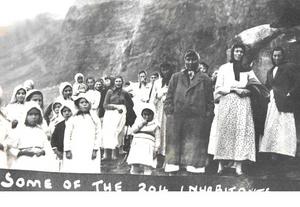
Some of the 204 Inhabitants on Tristan.
This story was submitted to the People’s War site by Bill Ross of the ‘Action Desk — Sheffield’ Team on behalf of Brian Armstrong, and has been added to the site with his permission. Mr. Armstrong fully understands the site's terms and conditions.
================================================
The same old trouble; too many bosses all giving different orders with the result that only two boats on each side were actually changed and two came back on their original falls. We all "laughed heartily" except the organizer. When the process started, there was some screaming from the promenade deck and the picnic would have provided endless material for a marine comic artist . It had all the comedy of an artist like Boathooks in people’s stern, black eyes and surprisingly enough, not a wet sheet.
Total casualties; both motor boats screens smashed, two boats with gunwales stove in and various abrasions. So ended the month of May. June was ushered in by an outbreak of 'flu or some similar complaint. People were going down like flies. Gargle parades and what not. Thanks to Glycerine of Thymol, I was lucky and escaped with a sniffle which only lasted a day or so. All that week we were wondering where we would go for stores and fuel, and no word coming through. Finally we were sent to Rio on 10th June and remained 24 hours. We left three of the crew behind, two seamen and a cook. This brings the desertions to date up to six and landing by sickness two. Three seamen deserted, two firemen and one cook, and one fireman and one seaman landed to hospital.
Shortly after leaving Rio, the ship's future programme was announced. She was to proceed to the Falkland Islands to load stores for the Cape, and whilst at the Cape, she would refit. News which cheered everyone up as the patrol was becoming monotonous, in view of the fact that unless a ship came close to us, we did not investigate, for reasons known only to the commanding officer, a situation which requires some explanation.
On our arrival at Rio, it was announced that the ship had steamed 35,000 miles on patrol.
Sailing from Rio on 11th June, we all felt better at the idea of a refit in civilized parts.
The three missing hands turned up. We picked them off one of the mail boats; the Highland Brigade I think. This was about two days after leaving. We hung around the patrol area until we were relieved by the Pretoria Castle on the 24th June, and then off at 16 knots for Port Stanley to embark stores for the Cape.
After a uneventful run down to the howling 50's, we arrived off the Falklands in a dense fog on the 29th. The master distinguished himself by getting the wind up and wanting to anchor the ship in 80 fathoms of water, but even he was eventually persuaded of the utter futility of anything like this. After a hectic rush in Port Stanley, everyone working like galley slaves, we got away on the Sunday and set a course for the Cape in a real westerly gale. The old cow just wallowed in it for a week. On the way over we made an attempt to look for Gough Island, but the weather was too bad and nothing was seen. On the 10th July we anchored in Simonstown (S. Africa) & discharged our stores, sailing again the same evening for Durban where we arrived on 13th, and anchored awaiting orders.
The following day, (a Sunday) we dry docked and for the rest of our time in the port the people of the City did their utmost to make us welcome. They succeeded very well as I have the pleasantest recollections of the port and that goes for the rest of the ship's company as well. Nothing was too much trouble for the Durbanites. They even accommodated up to six men each during the leave period. After an extensive refit during which time the first Lieut. was relieved by a Commander, the ship sailed on 13th August for Simonstown to embark stores and oil. We arrived at Simonstown on 16th then carried out gunnery trials, and after embarking stores, proceeded to Cape Town on the morning of 19th.
There we remained only a few hours. The new Commodore of the South American division joined the ship and off we went. Full of hope and everything else. We were barely clear of the harbour when a raider report was received and we immediately increased speed and steamed towards the position given. However to everyone's dissatisfaction the report was cancelled about 6 hours later, and we shaped a course for the Island of Tristan da Cunha.
Arriving there in the early hours of 24th August we landed a large quantity of stores for the islanders and removed the padre for reasons known only to the powers that be.
The visit to the island was all the more interesting, because we made contact with the islanders, who all have a certain resemblance to each other, and we were able to find out quite a bit about them from Padre Wilde who had spent about seven years there. It was disappointing not to be able to land but there was rather a heavy sea running, and at times, the islanders had difficulty keeping their boats running. We could have lowered our heavy lifeboats, but it would have been almost impossible to hoist them again as there was at least an 8 foot sea running. The ship's company rallied round very well and sent a lot of gifts ashore with the stuff, which had been brought from S. Africa. In fact the padre said afterwards that the ship's gear (cast off clothing mostly) was infinitely more acceptable than some of the quite useless stuff sent out by well meaning people at home. The only person to land was the surgeon and he told us that the health standard was very high, but the intelligence a bit backward. One interesting fact emerged from our visit. Shortly before our arrival, the islanders found what they take to be the figurehead of the Danish Training ship "Köbn Havn" which was presumed lost many years ago and was not heard of after she sailed from the River Plate for Australia about 1923 or so.
Our passage from Tristan to position XX, where we had to R.V. with H.M.S. Hawkins to transfer the Commodore, was marked by rather bad weather, which got worse as we neared the River Plate area and the night before arrival, we just hove to. The Commodore made a very nice speech to the ship's company before he left and everyone voted him a good Commodore for the Station.
August finished up rather well after all. The day following the big breeze was fine and calm in the Plate estuary. We met Hawkins, transferred the Commodore and what was more important, got our mail. Then we pushed off on the same old game, round and round in large circles, until it was time to head for Montevideo for our usual oiling. The day before arriving at Monte, we developed turbineitis and crawled into port on 12th Sept., feeling very uncertain. The breakdown was rather serious and the net result was three very pleasant days in harbour, which pleased everyone, not least myself as I had been promoted to Duty Commanding Officer and was clear of all gangway watching which was a very welcome change.
The English community were very kind indeed and everyone enjoyed the stay. Sunday 15th saw us on our way again and rather sorry to leave the hospitality of Uruguay. Still, we'll probably see it again in three of four months. The first half of the patrol was marred by poor weather and generally unsettled conditions, we were a long way from anywhere and very much on our own. The rest of September was marked by sweeping changes on the part of our new Commander who was rapidly assuming dictatorial powers and generally running things to suit himself. Remarks from the lower deck seemed to indicate that they thought it a great pity he hadn't had some toys to play with when he was young as he worried them considerably.
There was no excitement until Oct 3rd., when we went looking for a Finn who was supposed to have had some Graf Spee escapees on board. It was really remarkable how we found her as the weather turned very wet just about that time, and we actually spotted her lights in the middle watch on Oct 4th. Another half mile away and we'd have missed her. As it was, we identified her, then followed her till daylight when she was boarded, but no traces were found.
Rumours were flying all round the ship about this time as it was drawing near the end of the T124 agreement and there was a lot of hoping to get reliefs. One priceless yarn went round that the Hawkins was bringing the reliefs back from South Africa and on her arrival the Enterprise would take the T124s to Halifax, thus allowing the Newfoundland crowd to go home and the American gang to reach New York. The remainder were to proceed to Liverpool by A.M.C. This rumour was rather upset by orders to proceed to Rio de Janeiro for fuel and stores and the receipt of a signal from home asking if the reliefs were to be sent to Freetown.
Some of the gang had already packed and they were very fed up a couple of nights before the ship arrived at Rio. It was just about this time that the first unrest appeared in the wardroom. After a rather stormy meeting of the Mess Committee, the Mess Sec. resigned. The dictatorial atmosphere was creeping in again. A certain amount of speculation arose too, regarding the future movements of the T124 officers, more so when the navigating commander announced that he was going to resign the new agreement, which called for transfer to any ship, which the Admiralty might decide. The others were scared of losing their American rates of pay, although there was a certain amount of tension in the mess, and as there were 53 officers, it was amusing to sit on the outskirts and watch what was happening. A lively month or so was in store by all the forecasts. But like weather prophets who are nearly always wrong, one could never really tell. All that could be said was that it was an interesting situation with endless possibilities; who knows?
Speculation and rumour continued rife until the ship arrived at Rio on the 11th October and then the balloon was gently deflated when the Paymaster went ashore to the British Consulate and had the articles extended for a period of six months, or until suitable reliefs arrived on board. All very amusing to the regular R.N.R’s but very aggravating to the T124 personnel who were still left in mid air, as no reply had been received whether they would be re-engaged at the exorbitant rates. However no reliefs appeared and next day, Oct 12, we departed from Rio in very damp weather. Rio never did much for the ship so no one worried much at the bare 24 hours in port and as we were heading somewhere definably the party was interesting. We were bound for Isle de Trinidada off the coast just to make a "look see".
The island was sighted early on the morning of Oct 16th. I saw it at 3am, a good hour before anyone expected it. It was a busy day. We went to action stations at 5am and trained all our guns on the island as we approached, but it was like Mother Hubbard's cupboard, very bare. There were several disused huts on the beach and it was decided to send a landing party; however, that was next day. We steamed round the island then shoved off to have a look at Martin Vaz, some 30 miles to the eastward. Then pushed off for the night, returning next day for a spot of gunnery. Heaving a few bricks at Martin Vaz in the morning, we arrived back at Ila Trinidada in the middle of the day Oct. 17th.
With true pigheadedness, the all highest decided to land the party on a dead lee shore; no where else would do. Plumb crazy!!
Anyhow the motor boat went ashore taking the dingy and party. They were transferred outside the line of breakers and after pulling around a bit, were pitched headlong onto the beach, getting very wet shirts in the process. The island was uninhabited except by pigs and goats and the huts contained crates of the Brazilian garrison of the 1918 period, including some of their old rifles and a few pots. It wasn't practicable to bring any of the stuff off, as the landing party couldn't even fetch themselves off in the dingy, a whaler had to be sent in to tow them off and instead of the whole party taking about an hour, it wasn't until about 5pm that the ship was able to sail. Just because the big cheese was pig headed. However as we weren't on a timetable it didn't matter.
Sad to relate, we left the good weather behind at Trinidada; the next day brought rain and afterwards wind. Very depressing after the start of sunbathing. Still, there will always be other days. Up to arrival at Rio, the ship had steamed over 59,000 miles on patrol since commissioning and she had been nearly eleven months in commission. On Tuesday 22nd October we had a signal to say that 8 officers and 26 ratings had been sent from England in the Arundel Castle for passage to Queen of Bermuda via H.M.S. Hawkins from South Africa. They will probably arrive in our area early in December. What a nice time they will have had. There are some other reliefs as well around somewhere. On the same day we went off looking for a ship which was supposed to be taking some escaped Graf Spee'rs to Bahia. It will be largely a matter of luck if we find her, as the visibility is poor and there is a devil of a lot of rain around. Most depressing weather for this part of the world; we should be having sunshine and blue skies, not scotch mists. After nearly a week of patrolling and seeing nothing, we brought up off the port of Bahia on 29th October. It was a very welcome break in the monotony, even to see land. We saw the German ships at the port and had a good look at them from the entrance, then turned away and steamed off to sea.
Nov. 1st found us off Trinidada again with no object in mind but a cruise round. However shortly after sighting the island we got W/T information that one of the Huns in Rio Grande do Sul was going to make a break and off we went to the southward at a good lick to get into position to cover our allotted area of search. Unfortunately as we went south, the weather wasn't so good as it might have been and when we arrived at our area, the conditions were very much in favour of the bloke on the run. We searched for four days then gave it up as it was time for us to replenish with oil and water, our stores were getting low and off we went for B.A.
============================
Continued in part four: A5409245
© Copyright of content contributed to this Archive rests with the author. Find out how you can use this.


 Recommended story
 Story with photo