

- Contributed by
- John Constant
- Location of story:
- Burma
- Background to story:
- Army
- Article ID:
- A7881735
- Contributed on:
- 19 December 2005
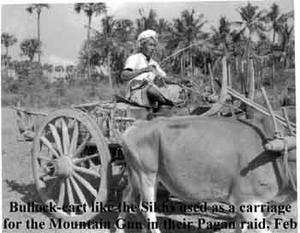
Local Transport
051219 "One More River"
Some Personal Reminiscences about India and Burma, 1943-45,
by Brigadier John CONSTANT
Chapter 1.
A dozen British officers, with battle-experience of the recently fought operations in the Western Desert of Egypt, had been selected to do their "Staff training" at the Indian Army Staff College, which was at QUETTA, in Baluchistan, rather than at its HAIFA equivalent, as had been expected.
I was one of this party, meeting in early August 1943 at PORT SAID, as directed to join a Polish ship, H T "Batory", built for the pre-war Transatlantic passenger trade. With her Polish crew and a RAF Wing Commander as OC Troops, they had just come hot-foot from launching the "HUSKY" Operation in Sicily by landing thousands of troops there. As that was an operation of war, the ship’s ample stocks of alcoholic drinks had been sealed, but were now made available for us and our fellow-passengers, most of whom were from the Indian Army; many were Muslim and therefore "tee-total", so those of us who enjoyed a drink or two were able to indulge our pent-up desires with all sorts of exotic spirits, many originating in Argentina or in South Africa.
This proved to be particularly pleasant, as the ship was well-equipped for cooler climes, but was singularly lacking in fans, and conditions on deck in August were very hot, initially in the Red Sea and later in the Indian Ocean. Although we were somewhat squeezed, sleeping 4 to a cabin, the voyage was not unpleasant, and quite uneventful, with regular meals and few duties. We entered Aden harbour for a few hours and I was able to go ashore for a quick "shufti" and a swim at the "Gold Mohur" Beach, where the bathers were protected from the sharks by wire-netting; it was both amusing and frightening to swim up to this wire in order to observe these powerful creatures closely, as they cruised up and down looking for a gap in this fence, meanwhile we wondered what would happen if the wire rusted and broke under their onslaught.
Continuing our voyage in H T Batory, we crossed the Indian Ocean towards Bombay, while most of the troops slept all day, and many of the officers played bridge; our little gang en route for QUETTA got to know each other well, as we swopped yarns during the voyage. I was in some demand to talk to those of the Polish crew, who could understand enough English, as I had paid a brief visit to their land before the war. They had not, of course, been back there for over four years, and it was not surprising that they were just as home-sick as those of us in comparable circumstances.
Our first glimpse of India, as we entered BOMBAY harbour, was both welcome and impressive, and we were soon given our instructions to disembark, with enough free time to pay a visit to the prestigious Willingdon Club, which one of our little "gang" knew well from pre-war days. That night we "entrained" and chugged along some 700 miles Northward to Marwar Junction in Rajastan, whence our train would have continued toward Delhi. However, we were to change trains there, enjoying a good meal before continuing another 500 miles across the Sind Desert in blistering heat. All through the heat of the day we stopped at every station for a tin-bath of ice to be replaced in each compartment; a simple form of air-conditioning, and we really needed it, arriving in the evening at Hyderabad (Sind) where we stayed the night in some comfort.
On the third day, we entrained again and crossed the mighty River Indus at Sukkur, before entering the foothills at Jacobabad, where the lunch-time temperature we noted was 124 degrees in the shade. This line was more interesting as it wound through the Baluchistan Hills to Quetta (some 700 miles from Hyderabad). Cooler at that altitude, our destination, the Indian Staff College, looked inviting, and I enjoyed the 4-month course there, really relaxing in its comfort, safety and the interesting companionship not only of British officers, but also of many Hindu, Sikh and Muslim officers. The work was pleasant and we saw something of the mountainous terrain all the way to the Afghan border.
Understanding that I had the choice of returning to the Middle East but, if I wished, I could remain with the Indian Army, where my wife and daughter would be eligible to join me. We chose the latter, but no date was given for the reunion; in fact, it never occurred. On conclusion of the course in mid-December, I had 2 weeks leave to move back to Bombay again, and chose to use the excellent Indian Railways to visit Peshawar and the Khyber Pass on the North-West frontier, before spending Christmas with family friends in Lahore, the capital of the Punjab. Determined to see the magnificence of Delhi, I reported to the General responsible for all the Army Engineers, and continued on my way to Bombay, where 4 of us from the Staff Course were to attend another one, this time a practical introduction to amphibious landings. There, the four of us stayed in a civilian bungalow on the beach at Juhu, where the modern sprawl of "Bollywood" has since developed.
The next four months was spent in Southern India, between Bangalore and Madras, training the 19th Indian Division in the dry-shod aspects of assault landings. As well as meeting many interesting people, including General Auchinleck, who was now the Commander-in-Chief of the Indian Army, and Judge Happold, a friend of my family.
© Copyright of content contributed to this Archive rests with the author. Find out how you can use this.


 Recommended story
 Story with photo